
PayPal Holdings Inc (NASDAQ: PYPL) reported Q1 2026 earnings beat with a revenue of $7.7 billion, EPS of $1.08, and Total Payment Volume of roughly $403 billion, extending a pattern the company has built over the past year: steady growth, controlled execution, and numbers that, on the surface, suggest a business regaining its footing.
Table of Contents
But once you look at it properly, these are not the numbers of a company accelerating into a new phase; they are the numbers of a company stabilizing, smoothing, and tightening what it already has, and the market can tell the difference. That’s because when growth is real, it pulls everything with it – volume, margins, sentiment, and price. But when growth is controlled rather than expanding, it shows up exactly like this: solid earnings, restrained reaction, and a stock that still needs to prove itself again the moment the report is over.
Doubtful Investors And A $1.5 Billion Buyback
If you line Q1 2026 up against Q1 2025, the story becomes clearer. PayPal is still processing hundreds of billions in volume each quarter, around $403 billion, while revenue sits in the same $7+ billion range, which tells you the business hasn’t broken, but it also hasn’t meaningfully accelerated.
That’s where the tension comes in. Volume is growing, but what the company earns from that volume is not expanding at the same rate, which means more activity is flowing through the system without a proportional increase in economic value per transaction. And that distinction matters more than the headline numbers, because a business that scales cleanly gets stronger as it grows, while one that scales under pressure becomes more dependent on efficiency to maintain the same level of output.
You can see that pressure indirectly in how PayPal is supporting its earnings. The company repurchased about $1.5 billion of its own stock in the quarter, which helps sustain earnings per share even when underlying growth isn’t doing all the work.
There’s nothing wrong with that on its own. But when buybacks become this visible, the question shifts from whether the numbers are improving to how they are improving, and that’s where conviction starts to weaken.
PayPal Is Selling A Bigger Future Amidst Customers’ Complaints
PayPal is trying to push beyond that perception by leaning into AI, rolling out agentic commerce tools designed to power automated, AI-driven transactions, positioning itself as infrastructure for how people will shop and pay in the future.
On paper, it’s the right move. It expands the narrative beyond payments and gives investors something forward-looking to hold onto. But right now, it hasn’t translated into a shift in how the business is valued or trusted, because it hasn’t yet shown up in a way that changes the trajectory of growth. It reads like an extension of what PayPal already is, not a transformation into something meaningfully different.
Not to mention, while the company is pushing that future-facing story, the present still carries friction. Users continue to complain about fees, about better alternatives, about choosing not to use PayPal unless they have to. That kind of sentiment doesn’t break a business overnight, but it caps enthusiasm, and when enthusiasm is capped, valuation follows.
A Relentless and Reluctant Market
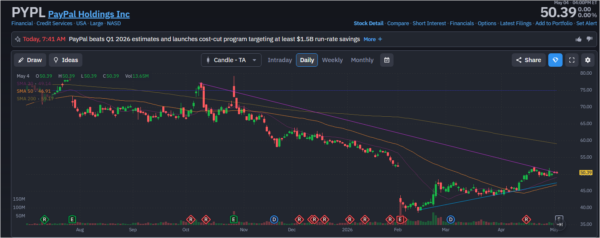
The chart in PayPal reflects the same tension sitting inside the earnings, because while price reacted positively and pushed into the $50 – $51 range after the release, that move immediately ran into structural pressure from the broader downtrend, with the declining 200-day moving average still hovering near $59 and acting as overhead resistance that has not yet been reclaimed.
What stands out isn’t the initial reaction, but the lack of follow-through, as price failed to expand with force and instead settled into a controlled consolidation just above the 20-day and 50-day moving averages around $48–$49, suggesting that while buyers are present, they are not committing aggressively enough to shift the longer-term structure.
Volume reinforces that read, because although there was a clear spike around earnings, participation tapered off quickly afterward, which is not what you see when institutions are building conviction, but rather when they are probing and reassessing.
So while the stock is holding a rising base from the February lows near $40, indicating stabilization, it remains a move that looks supported, not sponsored, and until the price can reclaim the mid-$50s with sustained volume, this is a market reacting to the numbers, not fully believing them.
/
When The Sad Pattern Appears Again
If you’ve been around for a while, you’d agree with me that this same sequence keeps showing up around PayPal’s earnings, quarter after quarter, and year after year. The company delivers a beat, the stock reacts, and then the move fades as the market reassesses what those numbers actually mean. It doesn’t collapse because the business isn’t broken, but it doesn’t run either, because the belief isn’t strong enough to carry it.
Look, strong companies don’t need time to validate their earnings. They get paid immediately because the market trusts what it’s seeing. PayPal, on the other hand, keeps falling into a cycle where the numbers arrive first and the belief tries to catch up later, and often doesn’t fully get there. As such, I’d rather focus my time and money on other companies backed up by both strong convictions and numbers, instead of catching this falling knife.
Leave a Reply