In recent months, NVIDIA has lost access to billions of dollars of Chinese AI business. Most companies would spend the next earnings call explaining the damage.
Table of Contents
Yet, NVIDIA Corporation (NYSE: NVDA) reported Q1 earnings for FY27 with a revenue of $81.6 billion and diluted EPS of $0.76 instead. That contradiction was the most fascinating part of the quarter because Nvidia did not merely overcome a headwind that could have crippled most companies; it produced numbers so large they almost buried China’s story.
And the deeper I went, the harder it became to view NVIDIA as “just” a semiconductor company going forward.
China Has Crippled Growth Stories Before
Apple Inc. (NASDAQ: AAPL) regularly faces scrutiny whenever Chinese sales slow. Nike Inc. (NYSE: NKE) spent years treating China as a critical growth engine before slowing demand became a recurring concern. Starbucks Corporation (NASDAQ: SBUX) spent decades building China into its most important international growth engine. Yet, increasing local competition has pressured the company to explore strategic alternatives for its China business as growth slowed
That’s how global markets normally work. When a major market weakens, growth slows, and investors reassess expectations.
NVIDIA faced something far worse than slowing demand.
The company disclosed that H20 export restrictions resulted in a $4.5 billion charge during the quarter. It also disclosed an additional $2.5 billion in H20 revenue it could not ship due to those restrictions.
That is $7 billion of impact connected to a single product line. For most companies, a disruption of that magnitude would dominate the quarter. For NVIDIA, it became background noise.
NVIDIA Showed How Little China Matters
The quality of numbers NVIDIA released this quarter is disturbing, but in a good way.
Revenue reached $81.6 billion. Gross profit reached $58.8 billion. Operating income reached $44.1 billion. Operating cash flow reached $48.8 billion. Free cash flow reached $26 billion.
The board also approved an additional $80 billion share repurchase authorization.
When you compare this to the $7 billion connected to China again, NVIDIA still generated enough cash in one quarter to fund entire industries.
But make no mistake, this story isn’t about how NVIDIA survived China’s restrictions. In fact, focusing on that alone could cause a fatal misinterpretation of these earnings, which could lead you to a false conclusion about the AI boom and where it’s headed.
What I’m trying to tell you is that the global AI spending has expanded so rapidly it absorbed the restrictions that broke down the internet a couple of months ago.
And nowhere was that reality more visible than inside the Data Center business. Let me explain.
What Selling The Capacity Behind An Infrastructure Race Looks Like
A step further in this report, you’d bump into Data Center revenue climbing to $75.2 billion, up 92% year-over-year.
Not only that, Gaming also generated $3.8 billion. Professional Visualization generated $509 million. Automotive generated $567 million.
Place those figures next to each other, and the transformation becomes impossible to ignore.
The old NVIDIA still exists, which is where most investors’ theses are stuck.
But the new NVIDIA completely dominates it. The company no longer looks like a chipmaker benefiting from AI demand. It looks like the company supplying the computational backbone behind one of the largest infrastructure buildouts in modern history.
The quarter repeatedly pointed toward the same destination; Blackwell systems ramped. AI factories expanded. Sovereign AI projects accelerated. Inference demand continued climbing.
The world’s largest technology companies, the government and enterprises… Everyone is still spending because, before an AI model can reason, before a robot can navigate a warehouse, before an autonomous vehicle can interpret its surroundings, someone must build the computing infrastructure first. And NVIDIA is sitting at the center of it all.
A Powerful Uptrend
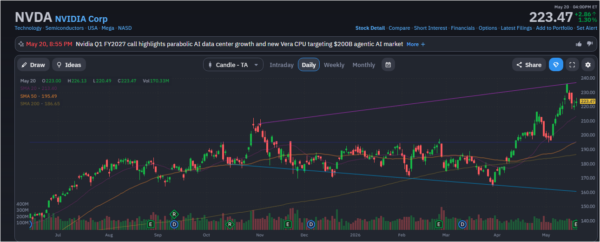
NVDA exploded higher following earnings, confirming what had already become one of the strongest charts in the market. The stock recently broke above the key $200 resistance zone, turning a level that capped rallies for months into potential support.
Technically, NVDA remains firmly above its 20-, 50-, and 200-day moving averages, signaling a strong momentum across multiple timeframes.
The earnings-driven surge also pushed the stock toward the upper boundary of its rising channel near $235-$240. While some short-term consolidation would be normal after such a sharp run, the trend remains firmly in the bulls’ favor as long as NVDA holds above the $200 breakout area.
At the moment, buyers continue treating every pullback as an opportunity to gain exposure to the AI infrastructure buildout.
The Spending Still Hasn’t Hit The Wall
Of course, Wall Street keeps searching for signs that AI spending will cool.
NVIDIA’s guidance told a different story.
The company guided for approximately $91 billion in Q2 revenue despite the continued impact from export restrictions.
That may be the most important figure in the entire report.
Because guidance arrives after management has already seen customer orders, deployment schedules, capacity plans, and infrastructure demand.
And yet the company still expects another leap higher. This is why NVIDIA is losing billions of dollars tied to China, while still producing revenue, profits, cash flow, and guidance that most corporations could not generate under ideal conditions…could go down as the most critical AI story in decades.
And if this infrastructure race keeps accelerating faster than global tension, the company’s biggest challenge may no longer be finding customers. It may be keeping up with them.
Leave a Reply