Nike Inc. (NYSE: NKE) stock is in freefall, but that’s not news to long-suffering investors. The stock has been in a seemingly uninterrupted five-year down trend. But do the current numbers show horror or opportunity?
Table of Contents
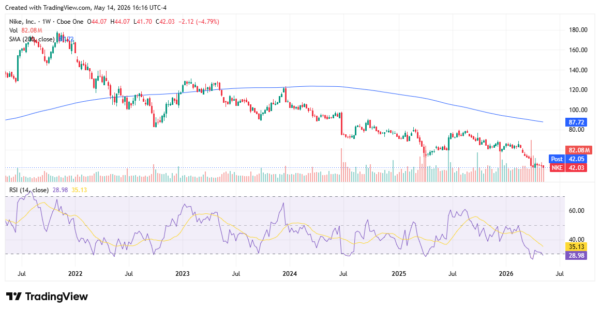
Arguing for horror, NKE has shed more than 75% of its value since hitting an all-time high of $179 in November 2021. The stock has posted a five-year compound annual decline of nearly 19%, touching a 52-week low of $42.09 in April 2026. That price level puts it squarely in multi-year low territory. For a company that was once the gold standard of consumer brand investing, it’s hard to see how far the stock has fallen.
The problem is that, at a time when many stocks stay inflated far above what its fundamentals suggest, investors have not been patient with NKE. Revenue in fiscal 2025 fell 9.8% from 2024 and came in lower than it was back in 2022. Net profit margins have nearly halved to under 7%, and continue to shrink into 2026. Decisions under former CEO John Donahoe, including pivoting away from the wholesale market and underinvesting in innovation, gutted the brand’s momentum, and new CEO Elliott Hill is still fighting to reverse the damage.
In addition to all of that, investors have to factor in tariffs, a collapsing China business, layoffs, and an EEOC investigation. You’d have to be crazy to buy NKE right now?
And yet — that’s exactly the kind of setup that has historically produced outsized returns for patient, contrarian investors. The question isn’t whether Nike is broken. It clearly is. The real question is whether it’s broken beyond repair, or whether this is the sort of generational dislocation that looks obvious in hindsight.
China and Tariff Relief Could Help Nike Recover
For all of Nike’s domestic struggles, the most intriguing near-term catalyst may have unfolded in Beijing in mid-May. The United States-China summit produced early signals of a diplomatic thaw. Nike sits at the intersection of both major trade levers.
On the cost side, tariffs hammered Nike’s Q3 gross margin down 130 basis points to 40.2%, per the company’s own earnings release, with higher North American tariff costs cited as the primary culprit. Any sustained reduction in duties on Chinese-manufactured goods would flow directly to the bottom line.
On the revenue side, Greater China — which generated $1.615 billion in Q3 but declined 7% year-over-year (10% in currency-neutral terms) — remains Nike’s most damaged market. Reduced geopolitical friction won’t rebuild the brand overnight, but it removes a meaningful headwind that has fueled Chinese consumer nationalism toward homegrown brands like Anta and Li-Ning. Nike is also counting on the 2026 FIFA World Cup as a global brand reset moment. A simultaneous improvement in U.S.-China relations could amplify that tailwind considerably in the world’s largest soccer-following nation.
NKE Technical Analysis Shows Oversold Conditions
The weekly chart tells a brutal story. NKE has been in an uninterrupted downtrend since its November 2021 all-time high near $179, and the stock is now trading around $42 — roughly 76% off that peak. The 200-week simple moving average, currently sloping downward at $87.72, sits so far above the price that it has ceased to function as support and is instead a reminder of how far the stock has fallen.
What’s notable, however, is the Relative Strength Indicator (RSI). At 28.98 on the weekly timeframe, NKE is in deeply oversold territory — a reading that has historically marked at least short-term exhaustion in selling pressure. The last time the weekly RSI approached these levels, the stock staged meaningful bounces.
That doesn’t mean the downtrend is over. It means sellers may be tired. For short-term traders, an RSI this low on a weekly chart could be a buying signal — even if the long-term picture remains structurally bearish until price can reclaim territory well above current levels.
The Risks Facing Nike’s Turnaround Strategy
The bear case for Nike isn’t subtle — it’s comprehensive. Revenue over the nine months ended February 28 was essentially flat at $35.4 billion, while cost of sales rose 5%, squeezing gross profit down 5% to $14.5 billion. Net income for those nine months dropped 32% to $2.04 billion. Converse, once a reliable contributor, is in freefall — down 35% in Q3 and 30% for the nine-month period. Cash and equivalents have declined 23% year-over-year to $6.66 billion as buybacks, dividends, and capital expenditures outpace earnings.
Management’s guidance is sobering: revenue is expected to decline in low single digits over the next three quarters, with gross margin expansion not expected until Q2 of fiscal 2027. Beyond the numbers, Nike faces an EEOC investigation, two rounds of layoffs totaling thousands of jobs in 2026 and intensifying local competition in China that a trade deal alone cannot fix. The turnaround is real — but it is slow, and the runway to prove it is shrinking.
Is Nike Stock a Buy for Contrarian Investors?
Nike is not a comfortable buy. The chart is broken, the fundamentals are under pressure, and the turnaround timeline keeps extending. But discomfort and opportunity are often the same thing at different times. The weekly RSI near 29, a valuation at multi-year lows, 24 consecutive years of dividend increases, the World Cup ahead, and now a potential U.S.-China trade détente create a confluence of factors that rarely align.
For traders, the oversold technical setup offers a defined short-term opportunity. For long-term investors, the question is simpler: Do you believe in the Nike brand a decade from now? If the answer is yes, prices like these tend to look very different in hindsight.
Leave a Reply