For years, the biggest threat to McDonald’s Corp (NYSE: MCD) was supposed to be changing consumer taste. Healthier fast-casual chains. Better burgers. Consumers increasingly talk about brands like Chipotle Mexican Grill (NYSE: CMG), Shake Shack (NYSE: SHAK), and In-N-Out Burger with the kind of emotional enthusiasm McDonald’s rarely inspires anymore.
Table of Contents
Yet, the numbers keep telling a very different story. McDonald’s reported Q1 2026 earnings with revenue of approximately $6.52 billion versus expectations of $6.47 billion, while adjusted earnings came in at $2.83 per share against estimates of $2.74.
That contradiction matters because it suggests the company may no longer dominate fast food because consumers love it most. Increasingly, it may dominate because difficult economic environments make convenience, familiarity, and predictability more powerful than preference itself.
Better Burgers Don’t Always Beat Better Convenience
This is where the conversation surrounding McDonald’s becomes far more psychologically interesting than investors realize. Many consumers genuinely do seem to believe competitors offer better food experiences. Some chains feel fresher. Others feel healthier, more authentic, or more aligned with changing consumer tastes.
But emotional preference and consumer behavior are not always the same thing, especially during financially pressured environments.
Because while consumers continue praising alternatives, McDonald’s still operates across more than 43,000 locations globally, supported by one of the largest convenience and distribution systems in the restaurant industry.
That scale becomes difficult to compete against once economic pressure starts reshaping spending behavior. People may want the premium burger, the healthier bowl, or the more exciting restaurant experience. But difficult economies compress decision-making. Consumers increasingly prioritize what is nearby, fast, familiar, and mentally easy to justify within tighter budgets. McDonald’s sits directly in the middle of that behavioral reality.
This is why the company remains one of the most misunderstood businesses in the market right now. Investors often analyze the company as though it’s still competing primarily on food quality. But at this scale, McDonald’s is really competing on habit, convenience infrastructure, and consumer routine. Those things become far more resilient during uncertain economic cycles than social-media discussions about burger quality.
Predictability During Financial Stress Is A Goldmine
The deeper you go into the earnings report, the clearer this becomes. McDonald’s continues leaning aggressively into affordability-focused ecosystems because management clearly understands modern consumers are becoming increasingly price-sensitive even while traffic remains resilient.
Global comparable sales rose 3.8%, while U.S. comparable sales increased 3.9%, supported heavily by McValue platforms, lower-cost bundles, app engagement, and loyalty-driven promotions designed to keep consumers inside the company’s ecosystem even as broader spending pressure intensifies. Loyalty sales across McDonald’s top markets surpassed $9 billion during the quarter, while total systemwide sales exceeded $34 billion.
That matters because McDonald’s increasingly behaves less like a restaurant company and more like consumer defensive infrastructure. The app ecosystem reinforces repeat behavior. Loyalty systems deepen routine spending. Delivery expands accessibility. The real-estate footprint makes the brand almost impossible to avoid during moments when convenience matters more than excitement.
Ironically, the exact frustrations consumers express about inflation and affordability may also be strengthening McDonald’s position rather than weakening it. People may complain more than ever, but financially uncertain environments also push consumers toward predictable spending patterns. McDonald’s has spent decades building itself around exactly that behavior.
Wall Street Still Treats McDonald’s Like Economic Shelter
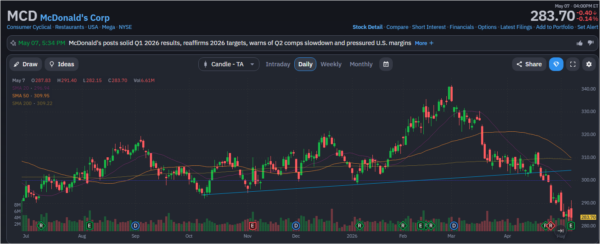
The chart reinforces that institutional psychology almost perfectly. Despite recent volatility, MCD still trades more like a defensive economic asset than a fragile consumer discretionary stock vulnerable to structural collapse.
Technically, the stock pulled back sharply from the $340 region earlier this year toward the low-$280s, while currently sitting below both its 50-day moving average near $309 and 200-day moving average near $309. On the surface, that looks weak. But the broader interpretation matters far more than the short-term technical damage itself.
Even during periods of pressured margins, slower traffic expectations, and growing criticism surrounding fast-food pricing, investors continue treating McDonald’s as one of the market’s safest large consumer franchises because its scale, cash flow generation, real-estate structure, and behavioral dominance remain incredibly difficult to replicate.
Volume expanded during the recent decline and post-earnings reaction, yet the stock stabilized around the high-$280 range instead of collapsing the way structurally weakening consumer brands often do.
That behavior tells you institutions still view McDonald’s less as a restaurant stock and more as a company tied directly to survival-oriented consumer spending during uncertain economic conditions.
McDonald’s Isn’t A Genius Play Anymore
That is the uncomfortable conclusion sitting underneath these earnings.
Not that consumers suddenly love McDonald’s again. Some don’t. But McDonald’s may have become so deeply embedded in modern spending behavior that dissatisfaction alone is no longer enough to meaningfully weaken the business during difficult economic times.
At this point, being bullish on McDonald’s isn’t a genius play. It’s common knowledge, because while competitors may continue winning emotionally, McDonald’s continues winning behaviorally. And during financially stressful periods, habit becomes far more powerful than preference.
Leave a Reply