
People cut many things during economic stress. They cut impulse purchases, electronics upgrades and any unnecessary subscriptions. But historically, one of the things wealthy consumers cling to is lifestyle preservation. I’m talking about the routines, experiences, and status signals that reinforce how they see themselves and how they want the world to see them.
Table of Contents
That is what makes Marriott International Inc (NASDAQ: MAR) so interesting after its Q1 2026 earnings: beneath the headline numbers sits a company that increasingly appears less dependent on hotel occupancy cycles and more on monetizing the resilience of higher-end consumer behavior itself.
Marriott reported Q1 2026 revenue of roughly $6.65 billion alongside adjusted EPS of $2.72, up 17% year-over-year, while adjusted EBITDA climbed to approximately $1.37 billion and global RevPAR increased 4.1% despite geopolitical weakness in parts of the Middle East.
At first glance, those simply look like strong travel numbers. But the deeper you dig into Marriott’s fact book and long-term expansion strategy, the clearer it becomes that the company is quietly positioning itself above much of the economic pressure weighing on ordinary consumer spending. Because Marriott no longer needs every traveler to win. Increasingly, it just needs consumers who keep spending even as everyone else starts pulling back.
Marriott No Longer Needs Every Traveler To Win
The easiest mistake investors can make with Marriott is treating it like a traditional hotel operator. The company has evolved far beyond that model. Marriott now operates or franchises nearly 9,500 properties across 144 countries and territories, representing approximately 1.7 million rooms globally, while its development pipeline expanded to over 618,000 rooms across more than 4,100 properties.
But the real story is not the room count. It is the ecosystem forming underneath it. Marriott is steadily expanding into luxury resorts, branded residences, apartments, outdoor lodging, midscale hotels, MGM partnerships, extended stays, and premium experiences, enabling the company to monetize different forms of travel behavior simultaneously.
That matters because the company’s business increasingly behaves less like a cyclical real estate operator and more like a fee-extraction platform tied to global travel demand. Franchise and management fees continue growing because Marriott does not need to own most of the underlying real estate to profit from the movement of affluent consumers through its ecosystem.
And honestly, I think that’s where the discussions surrounding the company become surprisingly insightful. Many investors do not describe Marriott the way people normally describe hotel companies. They talk about Bonvoy stickiness, brand loyalty, long-term durability, and repeat behavioral patterns that survive recessions better than expected. They are sensing the same thing the market is increasingly pricing in: Marriott is no longer just selling rooms. It is monetizing routines, loyalty, identity, and status preservation on a global scale.
Wall Street Keeps Buying The Dip For One Reason
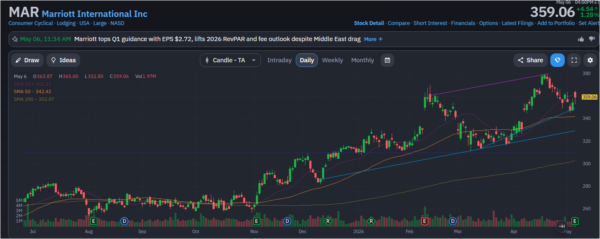
The technical setup reinforces the same psychological shift. MAR no longer trades like a classic cyclical hospitality stock reacting violently to occupancy fears or short-term travel weakness. It trades more like a premium platform that the market expects to compound steadily through economic cycles.
Technically, the stock continues holding firmly above its 50-day moving average near $342 and well above its 200-day moving average near $302, while maintaining a broader long-term uptrend despite volatility tied to geopolitical headlines and macro uncertainty. Even after recent pullbacks from the $380 region, institutional buyers repeatedly stepped back into the stock near support zones, preventing deeper technical deterioration.
That behavior matters because markets do not consistently defend premium valuations unless they believe the underlying business model has structural resilience. And Marriott’s valuation increasingly reflects that assumption. Investors are now betting that rich consumers, loyalty ecosystems, global diversification, and Marriott’s asset-light fee structure can continue producing durable growth even if broader consumer spending weakens further.
Volume patterns strengthen that interpretation. Participation expands around earnings and major updates, but unlike speculative momentum names that fade quickly after catalysts, MAR’s price structure continues rebuilding higher lows over time. That usually reflects longer-duration institutional confidence rather than temporary retail enthusiasm.
One Layer Of The Economy Still Has Money To Spend
Personally, I do not think Marriott’s Q1 earnings prove the overall consumer economy is universally healthy. If anything, I think they may be exposing how uneven modern economic resilience has become underneath the surface.
That’s because while many consumers continue to struggle with inflation, financing pressure, and slowing discretionary spending, one layer of the economy still appears capable of sustaining luxury travel, premium experiences, loyalty spending, and aspirational consumption patterns at remarkable levels. Marriott has spent years positioning itself directly in the center of that layer.
It’s no wonder why I’m moderately bullish on Marriott here despite the premium valuation. Not because hotel demand is magically immune to economic cycles, but because Marriott increasingly looks well positioned to withstand many of the pressures hurting ordinary travel operators.
The company no longer depends entirely on filling rooms during boom periods. It depends on maintaining relevance within a global network of consumers who continue to prioritize travel, status, and experience-driven spending even during uncertain economic conditions.
And to be fair, that may be the most important thing these earnings revealed. Marriott may not actually be the story of a universally strong economy at all. It may be the story of what happens when one layer of consumers becomes wealthy enough to keep spending, under conditions in which the broader economy increasingly struggles to absorb it.
Leave a Reply