In post-war Europe, millions of families spent years patching up old homes because moving to a better place became financially unrealistic.
Table of Contents
Their walls cracked. Roofs leaked. Pipes burst. And people only repaired what they had because replacing it cost too much.
Today, something eerily similar is happening across large parts of America’s housing market.
Yet, in its fiscal Q1 2026 earnings report, Home Depot Inc (NYSE: HD) reported revenue of $41.9 billion and adjusted EPS of $3.63, both ahead of expectations. Of course, most investors would take this by face value, but a second look under what’s beneath this earnings beat, you’ll discover an economy where Americans have stopped moving, where existing home sales remain near multi-decade lows, and where homeowners locked into older low-rate mortgages can no longer justify upgrading into dramatically higher monthly payments.
So instead of buying new homes…millions of Americans now pour money into repairing the ones they already own.
This is the story of how Home Depot rebuilt itself around that reality faster than most investors noticed.
Americans Stopped Buying Dream Homes
Comparable sales barely moved 0.6% during the quarter, but Home Depot still generated $41.9 billion in quarterly revenue, $5.1 billion in operating income, and about $3.4 billion in net earnings.
Average tickets also climbed another 2.1%. Read those figures together, and it’ll become clear that consumers may have reigned in spending on: new homes, large remodels, and discretionary housing upgrades… while spending to maintain the homes they can no longer afford to leave.
That distinction changes the entire psychology surrounding the business, especially when you think about the fact that roofs still fail. Water heaters still break. Air conditioners still die during the summer. And America’s housing stock keeps getting older.
In fact, the median U.S. home now sits more than 40 years old.
Together, they create a brutal long-term maintenance cycle underneath the economy itself.
The longer homeowners stay trapped inside aging properties, the more unavoidable those repair costs become.
And Home Depot appears to be positioned under that pressure.
Home Depot Is Meeting With Contractors Behind Closed Doors
For years, investors framed Home Depot around: DIY shoppers, housing booms, and weekend renovation culture.
The quarter exposed something very different.
Professional contractor sales outperformed DIY demand again during the quarter as Home Depot continued shifting deeper into the Pro economy.
With over 2,300 physical retail stores across the United States, Canada, and Mexico, the company spent $18.25 billion to acquire SRS Distribution, deepening its presence in roofing supply, landscaping, pool contractors, and specialized trade professionals.
All of which indicates that the company has now taken the center stage in the parts of the housing economy that homeowners cannot postpone.
Think about it, a consumer delays remodeling a kitchen, a leaking roof becomes an emergency, or an aging HVAC system eventually forces replacement.
And contractors remain tied to those recurring repair cycles regardless of whether home sales collapse or mortgage rates stay elevated.
In return, a much harder form of demand is created underneath the business than many investors still associate with Home Depot.
No wonder the company generated more than $20 billion from its Pro ecosystem last year alone, and why the management continues pouring capital into distribution infrastructure, trade credit, same-day delivery, fulfillment expansion, and contractor-focused supply chains.
So if there’s anything to take home from this piece today, it’s that Home Depot no longer behaves like a company waiting for housing euphoria to return. It sees where the housing market is heading and it’s spreading its tentacles.
Wall Street Is Starting To Price In Housing Survival
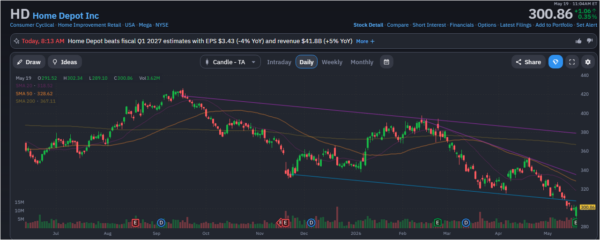
HD pushed sharply higher after earnings as buyers drove the stock back toward the upper end of its long-term trading range. The move came after Bernard Marcus and Arthur Blank’s company, backed by investment banker Ken Langone, generated roughly $41.8 billion in quarterly revenue while maintaining resilient spending trends despite one of the weakest housing environments in years.
The stock reclaimed momentum above both its 20-day moving average near $362 and 50-day moving average near $352 as volume expanded following earnings.
You’ll also see that HD is pressing directly against resistance near the $380-$385 zone, an area that repeatedly capped rallies over the past year. A breakout above that region could open the door toward retesting all-time highs near $400.
Overall, the setup reflects that the market is starting to price in the possibility that Americans trapped inside aging homes may keep spending heavily to maintain them anyway.
This Housing Paralysis Could Be A Significant Moat
This was probably the most important contradiction within the quarter.
The same housing paralysis crushing mobility, affordability, and existing home sales also traps millions of Americans inside aging homes that continue demanding repairs. This type of pressure has created recurring spending, and Home Depot is having a field day monetizing it.
Take a look, customer transactions rose 2.1% during the quarter while online sales climbed roughly 8%.
Meanwhile, operating cash flow still came in around $6.6 billion over the trailing twelve months, even as the company continued investing in: supply chain infrastructure, delivery networks, distribution capabilities, and contractor expansion.
Going forward, Home Depot won’t be trapped by America’s housing paralysis. If anything, it has shown it has the ability to leverage the situation, shift the market it serves, and scale its profits in the shortest time possible. A moat is missing among its competitors.
So if you still frame this stock as a simple housing-cycle stock, you might be in for a rude awakening, because as you’ve seen for yourself, the earnings suggest something much larger is happening under the surface.
Leave a Reply