
Dollar Tree (NASDAQ: DLTR) delivered one of its best earnings days in years on May 28, 2026, with DLTR jumping roughly 17% after the discount retailer posted first-quarter results that beat expectations on nearly every headline metric.
- Net sales rose 7.2% to approximately $5.0 billion.
- Adjusted operating income climbed 22% to $473 million.
- Gross margin expanded 120 basis points year-over-year.
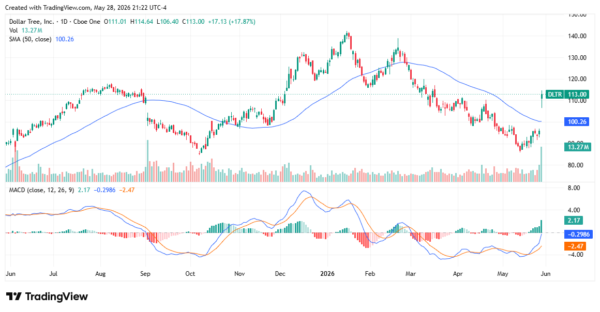
The stock, which had been grinding lower for months, exploded out of a base on massive volume — 13.27 million shares traded, well above its norm.
Table of Contents
On the surface, this looks like a story of a company hitting its stride: a pure-play Dollar Tree banner, freed from the drag of the Family Dollar divestiture completed last July, executing cleanly on its multi-price store conversion strategy. With roughly 5,900 locations now operating the expanded format and 630 additional conversions completed in Q1 alone, management has clearly accelerated its transformation.
But investors who chase this move without reading between the lines may be buying a story that is more complicated and a bit more fragile than the headline numbers suggest. The underlying driver of Dollar Tree’s comparable sales growth is not what most bulls are assuming. And the macro tailwind that is lifting this stock could reverse faster than many expect, leaving momentum investors holding a very different kind of bag.
Strong Numbers, Troubling Mix: Ticket Up, Traffic Down
Here is the detail that deserves more scrutiny than it is getting. Dollar Tree’s comparable store sales rose 3.5% in Q1 2026 — a solid result by any measure. But peel back the components and the picture shifts. Average ticket was up 4.5%. Customer traffic was down 1.0%.
That is not a volume story. It is an inflation story — or more precisely, a pricing story enabled by Dollar Tree’s multi-price strategy, which now allows the chain to sell items above the traditional $1.25 price point. Customers are spending more per trip, not because they are buying more, but because prices on the shelf are higher. That distinction matters enormously for the durability of the comp.
For comparison, look at the trend over the prior two fiscal years. In all of fiscal 2025, traffic was positive — running at +1.0% for the full year. In fiscal 2023, traffic was surging at +7.4% for the year. The sequential deterioration in foot traffic is real and ongoing.
Dollar Tree is not gaining customers; it is extracting more from the ones it already has. That works until it doesn’t. In a business that depends on serving financially constrained households, the ceiling on ticket price increases is not unlimited.
The consumables comp of 3.2% and the discretionary comp of 3.9% both look healthy in isolation, but neither reflects a customer who is shopping more freely. It reflects a customer who is buying what they need and paying more for it.
Dollar Tree’s Customer Doesn’t Need a Rate Cut — They Need a Job
There is a persistent misreading of Dollar Tree’s customer base that flares up every time the stock rallies. The assumption is that Dollar Tree is a defensive name — that when the economy weakens, its low-income shoppers have nowhere else to go, and the stock becomes a safe harbor. That narrative is partially true, but it cuts both ways in ways the bulls may not fully price in.
Dollar Tree’s core shopper is economically stressed in the literal sense. These are households living paycheck to paycheck, for whom a 4.5% increase in average ticket is not a neutral event. The traffic decline is the tell: some customers are already voting with their feet, either visiting less frequently or consolidating trips.
More importantly, this customer does not need the Federal Reserve to cut interest rates. They are not carrying adjustable-rate mortgages or revolving high-yield credit card balances in the way that a rate cut would meaningfully relieve.
What they need is wage growth, stable employment, and lower food and energy prices. If the labor market softens — which is a live risk in the current environment — Dollar Tree’s traffic problem accelerates, and the ticket tailwind fades with it.
The macro setup that is helping Dollar Tree right now is not a tailwind of strength. It is a tailwind of constrained options.
Technical Analysis: A 17% Gap Is a Gift and a Warning
DLTR spent most of the past year in a sustained downtrend, falling from highs near $140 in early 2026 to lows approaching $80 before stabilizing. The 50-day simple moving average (SMA), currently at $100.26, has been sloping downward throughout — a clear sign of persistent selling pressure.
Today’s 17.87% gap is wider, closing at $113, putting the stock back above its 50-day SMA for the first time in months. The MACD has crossed bullishly, with the histogram turning green and the signal line at -2.47 beginning to compress. Volume surged to 13.27 million shares — confirming institutional participation in today’s move.
This is a legitimate technical breakout from a well-defined base. Momentum traders have reason to be interested. A measured move from this base projects potential toward the $125–$130 zone, which represented prior support-turned-resistance in late 2025 and early 2026.
But this is also a stock gapping into a downtrend. The 50-day SMA is a level to watch, not a line of safety. A failed follow-through in the coming sessions — or a broader market pullback — could pull DLTR right back into its prior range. Stops matter here more than usual.
Conclusion: Trade the Momentum, Respect the Exit
Dollar Tree had a genuinely strong quarter, and the market is right to reward it. The company’s execution on its multi-price conversion, its free cash flow generation of $392 million in a single quarter, and its aggressive $595 million share repurchase all reflect a management team that is doing what it said it would do.
But this is a momentum trade. The fundamental thesis — that Dollar Tree’s stressed customer base is sustainably spending more — has a clock on it. If the economy weakens further, traffic erosion accelerates. If the economy improves meaningfully, this customer discovers they have options, and Dollar Tree loses its captive audience. Either scenario caps the upside on a buy-and-hold basis.
Own it with a plan. Know where you’re getting out. And resist the urge to call a 17% gap a new beginning — for Dollar Tree’s customer, the hard math hasn’t changed.
Leave a Reply