
A car manufacturer optimizing production lines. A defense contractor exploring operational systems. A pharmaceutical company researching drug discovery. A supercomputing center integrating quantum infrastructure into research environments.
Table of Contents
Individually, those stories barely register. Together, they formed one of the most psychologically interesting parts of D-Wave Quantum (NYSE: QBTS) latest earnings release.
This is because, while Wall Street still debates whether quantum computing is commercially viable, institutions increasingly appear willing to test the technology within real operational systems.
That contradiction sat all over D-Wave Q1 2026 Earnings Release
Revenue fell sharply to $15 million from about $64 million a year ago, while losses and margin pressure remained significant. Yet bookings exploded 502% year-over-year to approximately $31 million, and the company finished the quarter with more than $300 million in cash reserves.
As you’ll discover, these numbers exposed the most difficult phase to value in any technological revolution: the moment institutional adoption begins before the economics become mature enough for Wall Street to price confidently.
Institutions Are Experimenting Before The Economics Look Comfortable
The easiest way to dismiss quantum computing is to focus strictly on the financials. D-Wave remains unprofitable. Revenues are still volatile. Gross margins compressed materially this quarter, reinforcing how commercially early and operationally uneven the sector still is.
But underneath those awkward economics, institutional behavior is starting to look harder to ignore.
Ford Otosan is deploying D-Wave systems for manufacturing optimization. Davidson Technologies is working with the company on defense applications. Japan Tobacco is exploring drug discovery use cases through quantum systems. Germany’s Julich Supercomputing Centre continues integrating D-Wave infrastructure into advanced computational research.
Truth is, revolutionary technologies don’t always arrive cleanly. The economics usually look awkward long before adoption patterns become obvious. But once serious institutions begin experimenting operationally across multiple industries simultaneously, the line between futuristic theory and emerging infrastructure starts becoming harder to define clearly.
That ambiguity is not unusual during major technological transitions. Early commercial internet infrastructure looked financially awkward, too. Revenues were inconsistent. Monetization models were unstable. Many companies failed outright. Yet underneath the chaos, banks, retailers, logistics firms, and governments had already started integrating internet systems into real operational environments before Wall Street fully understood how economically foundational the technology would eventually become.
All of which indicates that quantum computing may now be entering a similar commercial transition phase.
Why Bookings Figures Trump Revenue Decline
A few years ago, speculative technology companies could rally almost entirely on imagination. Investors rewarded futuristic narratives, massive theoretical markets, and long-term disruption stories without demanding immediate commercial validation.
That environment has changed dramatically.
Rates are higher. Capital is tighter. Investors increasingly want contracts, customers, operational deployment, and survivability.
You can’t overlook that because the sector now sits between two conflicting realities.
On one side, the economics still look immature enough for many investors to dismiss entirely. On the other hand, institutional adoption patterns increasingly suggest the technology may be progressing beyond pure theoretical experimentation.
That is why the bookings figure matters psychologically far more than the revenue decline itself.
Bookings climbing from roughly $5 million last year to over $31 million now suggest customers may be moving from tentative experimentation toward more meaningful deployment commitments.
Historically, that middle phase is where markets become psychologically unstable, because investors no longer try to determine whether the technology sounds revolutionary. They are trying to determine whether commercialization is beginning to form fast enough before patience disappears.
Repricing Survival Odds
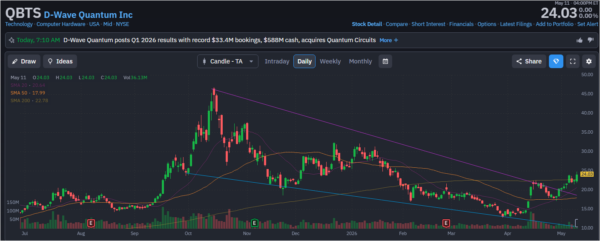
QBTS’s post-earnings chart reflected my thought process.
After earnings, shares surged toward the $24 region while volume exploded above 36 million shares, signaling unusually aggressive participation for a company many investors still dismiss as speculative. More importantly, the stock reclaimed both its 20-day moving average near $20.64 and 50-day moving average around $17.99 after spending months trapped below a descending trendline dating back to the October highs near $45.
Pay attention here, because earnings reactions in immature technology sectors often reveal changing institutional psychology more than changing fundamentals. Investors were not reacting merely to quarterly revenue.
The combination of exploding bookings, improving adoption signals, strong liquidity, and expanding enterprise engagement appears to have shifted attention back toward commercialization survivability rather than short-term profitability alone.
And honestly, I think that may be one of the most important signals in the entire earnings report.
The Hardest Technologies To Value Are The Ones Becoming Real
Personally, I think that is what makes D-Wave one of the most psychologically fascinating companies in speculative technology right now.
The business still looks financially immature. The sector remains highly volatile. The economics are still too early to value comfortably using traditional frameworks. Yet real institutions are increasingly willing to integrate quantum systems into operational environments.
That does not necessarily make the stock easy to own from here.
If anything, it makes the company harder to value, and this is exactly where you have to be cautious. The most difficult phase of every major technology transition is usually the moment the future starts becoming believable before the economics fully catch up.
Leave a Reply