Humans have a complicated relationship with spending money, which is why most companies that raise prices spend the next several quarters managing customer backlash, retention decay, and the quiet erosion of loyalty that follows. But the strongest businesses – the ones that have moved beyond transactional relationships into something closer to institutional habit – operate in a different way entirely. Just like Costco Wholesale Corp (NASDAQ: COST) did in its Q3 earnings report.
Table of Contents
Costco reported third-quarter fiscal 2026 EPS of $4.28 on revenue of $63.21 billion, beating Wall Street on both measures. If you’re anything like me, you’ll be asking:
What kind of company raises membership fees and emerges on the other side with stronger customer engagement, accelerating membership revenue, and some of the highest traffic levels in its history?
The Fee Increase Did The Opposite of What It Was Supposed To Do
Let’s begin with what should have happened. A membership fee increase, by conventional retail logic, produces friction – some percentage of customers reconsider, renewal rates soften, and revenue growth decelerates temporarily while the base adjusts. That is the normal sequence.
Costco ran the opposite one. Membership fee revenue grew 7.4% in the second quarter, then accelerated to 10.4% the following quarter. Paid household memberships increased 4.5% to 79.6 million, total cardholders climbed 4.6% to 143.1 million, and renewal rates held at 92.7% in the United States and Canada and 90.2% worldwide. All told, this describes a customer base that has moved past the point where the price is the primary consideration.
And it gets even better. Traffic remained above 5% growth, net income climbed 13.1% – well ahead of revenue growth at 9.4%. Most mature retailers sacrifice margins for traffic, or traffic for profitability, or pricing power for retention. But Costco is doing none of those things, which raises the more important question here today:
If customers are not pushing back against higher fees, what exactly are they paying for?
A Small Comment That Explains More Than The Financials
On its earnings call, CEO Ron Vachris noted that many members used Costco gas stations for the first time during the quarter – and that observation sounds insignificant until you think about what it represents.
You see, Costco didn’t acquire a new customer in that moment. It increased its relevance to an existing one, which makes this business structurally different from what most investors still model it as. Because the strongest businesses eventually stop depending on customer acquisition as their primary growth engine and instead find new ways to participate in the lives of customers they already have.
This is why a member who originally joins to save money on groceries gradually folds Costco into more of their weekly routine – fuel, pharmacy, household goods, e-commerce, optical, travel – until what began as a single spending decision has become a larger share of their total wallet. Worldwide traffic increased 5.2%. E-commerce grew 14.8%. And CEO Ron Vachris confirmed that the final five weeks of the quarter became five of the highest-volume weeks in company history.
In short, members are not just spending more money at Costco; they are finding more reasons to spend it there, and the gap between those two things is enormous.
Investors Need Fresh Evidence
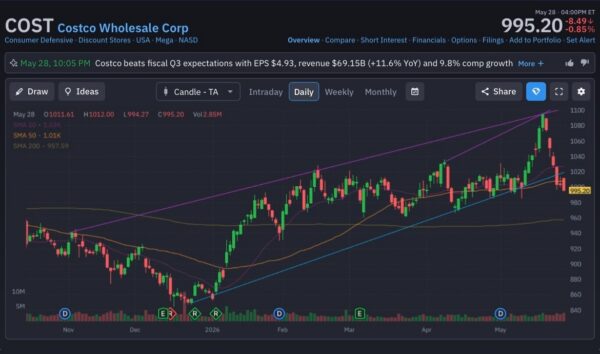
Unlike some recession-resistant stocks, investors are not treating Costco Wholesale with skepticism. If anything, the opposite is true. Costco has become one of the market’s favorite “quality stocks,” and the chart reflects that confidence. Shares spent most of the past six months climbing in a steady uptrend, rising from the mid-$800s to an all-time high near $1,096 before earnings.
But that enthusiasm ran into a wall after the report.
Even after beating expectations with EPS of $4.93 and revenue of $69.15 billion, the stock finished at $995.20, down 0.85%, after trading roughly 2.85 million shares. To me, that says less about the quarter and more about expectations. The business delivered. The stock simply had little room for error after a near 30% run from its January lows.
Technically, COST has now slipped below its 20-day and 50-day moving averages while testing the psychologically important $1,000 level. Momentum remains positive on a longer-term basis since shares still sit above the rising 200-day moving average near $958, but the post-earnings selling suggests investors may need fresh evidence before pushing the stock back toward its recent highs. The business looks stronger than ever. The chart says the market already knew it.
Here’s Why The Market Will Keep Paying A Premium
I’ll be direct about something. Until recently, I analyzed Costco through a retail framework, and I think that framework only explains a fraction of what is actually unfolding here. It doesn’t explain why the stock commands a valuation premium that most retailers could never sustain across a full cycle, and it doesn’t explain why that premium has persisted and expanded even as the business has matured.
A traditional retailer depends on transactions. Costco depends on a membership relationship: the membership comes first, then transactions follow from it. That compounds over time in a way that changes the entire growth calculus, because every additional category Costco captures increases the value of the membership, every additional interaction raises the probability of renewal, and every renewal extends the lifetime value of the customer in ways that have nothing to do with promotional pricing or competitive positioning.
Meaning, Costco is no longer competing for market share like a small fish in a big pond. Instead, it is becoming the control room, the pond itself, where customers are reorganizing their lives and spending habits entirely.
Businesses that reach that position tend to remain dominant far longer than the models built to price them ever anticipated.
Leave a Reply