There’s a reason experienced operators don’t celebrate oil spikes the way headlines do. Because price is noise unless it converts, and this quarter made that distinction impossible to ignore. Chevron (NYSE: CVX) reported Q1 2026 earnings EPS of $2.97, down from $3.55 a year ago, on revenue of $48.7 billion versus $51.2 billion.
Table of Contents
That’s not a minor miss you smooth over; it is a direct contradiction to an oil market that has spent months surging and whipsawing on geopolitical tension. If higher prices automatically meant higher profits, this quarter would look very different. It doesn’t.
A Market Driven by Conflict Doesn’t Pay Cleanly
By now, you already know that Oil hasn’t been trading on fundamentals; it’s been reacting to risk, with Iran-linked tension around the Strait of Hormuz pushing prices higher one moment and reversing them the next, and that kind of movement cracks open an opportunity for oil companies to cash in, without creating consistency, which is exactly why Chevron’s numbers don’t match the narrative.
The company generated about $5.2 billion in upstream earnings, down from roughly $5.7 billion, even as production held near 3.3 million barrels of oil equivalent per day, which removes the easy explanation that volumes fell and leaves you with the real one – prices moved, but Chevron couldn’t keep enough of that move. This wasn’t a weak oil market. It was an unconvertible one.
Where the Earnings Leak Actually Happens
You don’t need theory when the income statement is already telling you what’s going on, because downstream earnings fell to about $1.8 billion from $2.3 billion, while cash flow from operations dropped to roughly $6.8 billion from $8.7 billion, and when those two move in the same direction as upstream weakness, it stops being segment-specific and starts becoming structural.
Most people will overlook the fact that Chevron doesn’t get paid on where oil trades at its peak; it gets paid on what it realizes over time, and when prices spike and reverse instead of holding, refining margins compress, realized pricing lags, and costs creep in just enough to turn what looks like a strong market into one that quietly drains profitability. Thus, the leak.
While You Watch the War, Chevron Is Buying Time
Now step away from the quarter and look at where Chevron is actually placing its bets, because while the market is glued to short-term price moves, the company is expanding its position in Venezuela through an asset swap that consolidates its heavy oil exposure, and that decision tells you exactly what management is optimizing for.
Heavy oil doesn’t surge with headlines; it builds with time, which means Chevron is deliberately leaning into assets that won’t show up in next quarter’s earnings but will matter when pricing stabilizes, and that creates a gap between what you see now and what the business is actually positioning for. In short, the market is watching volatility while Chevron is preparing for durability.
Market Is Seeing the Same Problem, Just Faster
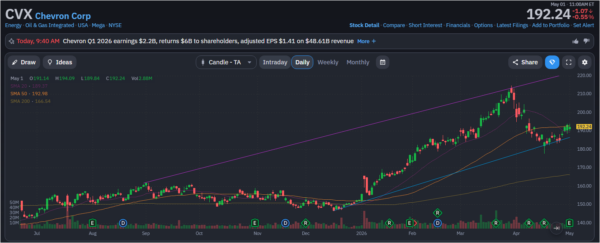
What you’re seeing on the chart for CVX lines up almost perfectly with the thesis once you stop looking at price as direction and start looking at it as behavior around expectations.
Chevron had been in a steady uptrend, riding higher oil sentiment into the $210–$215 zone, but notice what happened into earnings: price failed at the trendline resistance and pulled back sharply toward the $190–$195 range, where it’s now trying to stabilize.
That matters because this wasn’t a breakdown of structure. The 50-day moving average is still holding, and price remains above the rising 200-day, but it was a clear rejection of higher levels right when earnings failed to match the environment.
In other words, the market didn’t abandon Chevron. It simply refused to pay a premium for earnings that didn’t fully convert oil strength.
This came as no surprise because Chevron didn’t break; it simply didn’t deliver what the environment suggested it should, and when that happens, the market doesn’t panic; it discounts.
The Entire Quarter In One Line
Oil is being moved by geopolitical chaos, and Chevron didn’t keep enough of it.
That’s the entire quarter in one line, and once you see it that way, everything else becomes easier to place, because this wasn’t about weak demand or failing operations; it was about a market that paid in volatility while Chevron earns in consistency, and those two don’t align.
So the question isn’t whether Chevron works.
It does.
The question is what happens when oil stops whipsawing and starts holding, because the moment prices become consistent instead of reactive, that gap between price and profit closes. When it does, you won’t be looking at a different company; you’ll just be looking at the same one, finally getting paid properly.
Leave a Reply