
AI ETFs are quickly becoming one of the simplest ways to invest in artificial intelligence, especially as the sector’s long-term growth outlook continues to strengthen. It’s very clear that artificial intelligence is here to stay.
Table of Contents
According to Grand View Research, the global AI boom could grow from about $137 billion in 2022 to more than $1.81 trillion by 2030. Meanwhile, the Marketing AI Institute notes that artificial intelligence could boost profitability by 38% on average and contribute up to $14 trillion in additional global economic value by 2035, based on Accenture research.
MIT Technology Review has also highlighted the rapid pace of change, noting that AI could rival or surpass human capabilities across many domains within decades. For investors, that kind of growth trajectory signals a major long-term opportunity
However, that opportunity also raises a key question: what’s the smartest way to gain exposure? For those hesitant to pick individual winners beyond names like NVDA or AMD, AI ETFs offer a more balanced and accessible approach.
Why AI ETFs Are a Smart Way to Invest in Artificial Intelligence
AI ETFs allow you to invest in a diversified basket of companies involved in artificial intelligence, automation, and related technologies. Instead of betting on a single stock, you gain exposure to an entire ecosystem—from chipmakers and cloud providers to software developers and robotics firms.
This diversification helps reduce risk while still allowing you to benefit from the overall growth of the AI industry. It also saves time and effort, since professional fund managers handle the selection and rebalancing of holdings.
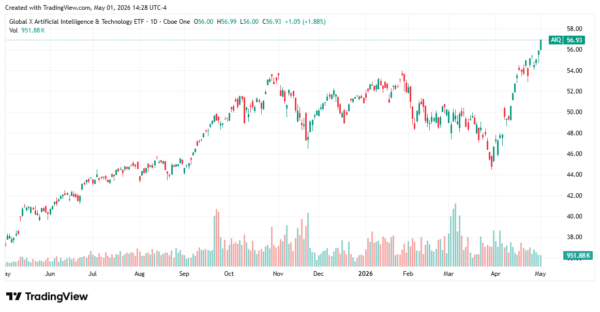
AIQ ETF: Broad Exposure to Artificial Intelligence Leaders
If you want diversified AI exposure at a reasonable cost, the Global X Artificial Intelligence & Technology ETF (NASDAQ: AIQ) is a strong option.
With an expense ratio of 0.68%, the ETF invests in companies that potentially stand to benefit from the further development and utilization of artificial intelligence (AI) technology.
Some of its top holdings include Palantir Technologies (NASDAQ: PLTR), Oracle (NYSE: ORCL), Broadcom (NASDAQ: AVGO), Netflix (NASDAQ: NFLX), NVIDIA (NASDAQ: NVDA), Microsoft (NASDAQ: MSFT), and Meta Platforms (NASDAQ: META).
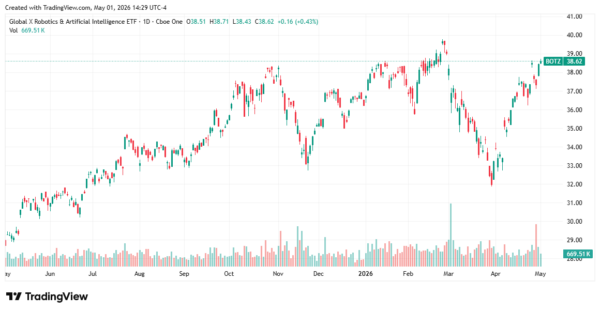
BOTZ ETF: Targeted Exposure to Robotics and AI Innovation
Another top option is the Global X Robotics and Artificial Intelligence ETF (NASDAQ: BOTZ), which focuses more specifically on robotics and automation.
Also carrying an expense ratio of 0.68%, BOTZ includes around 40–50 holdings such as NVIDIA, Keyence (OTCMKTS: KYCCF), DynaTrace (NYSE: DT), Intuitive Surgical (NASDAQ: ISRG), Upstart Holdings (NASDAQ: UPST), and C3.ai (NYSE: AI). This ETF leans more heavily into industrial automation and robotics, offering a slightly more concentrated bet on how AI is transforming physical industries.
For investors who want targeted exposure to robotics alongside AI, BOTZ provides a compelling complement to broader AI ETFs.
The Case for AI ETFs as a Long-Term Investment Strategy
Artificial intelligence is shaping up to be one of the most important investment themes of the next decade, and AI ETFs provide a practical way to gain exposure without taking on unnecessary risk. Instead of trying to predict which single company will dominate, funds like AIQ and BOTZ allow investors to participate in the broader ecosystem and drive innovation.
This approach is particularly valuable in a fast-evolving sector like AI, where leadership can shift quickly, and new technologies can disrupt incumbents. By investing in AI ETFs, you’re effectively positioning your portfolio to benefit from multiple growth drivers, including semiconductors, cloud computing, enterprise software, and robotics.
Over time, that diversification can help smooth returns while still capturing meaningful upside. For investors looking to balance growth potential with risk management, AI ETFs stand out as one of the most efficient ways to invest in artificial intelligence today.
Leave a Reply