
Baidu Inc ADR (NYSE: BIDU) released its Q1 2026 earnings report with a revenue of RMB32.45 billion ($4.47 billion) while adjusted EPS came in at RMB12.06 ($1.66) per ADS, both ahead of expectations.
Table of Contents
But as you’ll discover, this quarter had nothing to do with the revenue beat.
Baidu’s advertising business – the engine that built the company into China’s dominant search platform – fell from roughly RMB16 billion to approximately RMB12.6 billion ($1.74 billion) during the quarter.
At the same time, the company’s AI-powered business surged 49% year-over-year to roughly RMB13.6 billion ($1.87 billion). And understanding this crossover, including why and how it happened, could change how you value BIDU going forward.
Investors Still Value Baidu Like A Search Engine
For years, Baidu operated one of the cleanest internet business models in China; traffic came in, advertisers followed, and cash poured out.
That machine now looks far less reliable.
Weak consumer demand across China continues to pressure advertiser spending, while competition inside the country’s internet economy continues to intensify. The search-driven advertising system that has carried Baidu for years no longer appears strong enough to remain the company’s long-term growth engine by itself.
And the company’s own numbers are starting to expose that reality.
In fact, for the first time ever, AI-powered business contributed more than half of Baidu’s core revenue mix. That figure alone exposes a company that had already begun to shift its center of gravity, even as everyone was still talking about Baidu as “China’s Google.” And now the company has morphed into a full-scale AI infrastructure that is getting more and more difficult to ignore.
Baidu Is Building The Layer Underneath China’s AI Boom
The most important figure that explains this transition better is the AI cloud revenue, which surged 79% year-over-year to roughly RMB8.8 billion ($1.21 billion).
I chose this number because while Chatbots attract attention, infrastructure changes the economics of AI completely.
Normally, the companies supplying GPU access, enterprise AI systems, cloud compute, and AI infrastructure are those that sit underneath the broader AI economy itself.
That is where recurring enterprise demand starts forming, where long-term spending cycles begin compounding, and most importantly, where Baidu is determined to position itself before weakness inside China’s internet economy drags the old advertising business down further.
This is evident in China’s transportation industry, where Baidu continues to aggressively scale Apollo Go, a ride-hailing and robotaxi platform, as it pushes deeper into autonomous driving infrastructure. In this quarter alone, Apollo Go has provided more than 1.4 million rides, while cumulative rides have surpassed 11 million.
Then, in cloud computing, its AI model, ERNIE, is powering the next generation of search, cloud, enterprise AI, and generative AI products.
And instead of keeping ERNIE trapped inside a chatbot like ChatGPT, Baidu is embedding it across its infrastructure and monetizable AI systems to drive cloud demand, enterprise adoption, and AI-powered services.
As you can see, this is why the AI-cloud revenue is the most important figure this quarter: more than any other figure, it shows how radically different the business model is from the one investors still associate with Baidu.
Now, before you leave, another thing to consider is the speed of this entire transition.
Usually, companies drag their feet as they shift from their former legacy to a new one. Not Baidu. As a matter of fact, Baidu Core generated roughly RMB7 billion in operating cash flow during the quarter, while the company returned approximately $172 million to shareholders through share repurchases.
This means two things;
One is that the AI business is becoming large enough financially to reshape how the entire company is valued.
Two, the company is not funding this AI transition from weakness.
And once investors stop viewing Baidu primarily through advertising revenue (old legacy) and start viewing it through AI infrastructure growth, the company’s valuation can shift violently.
A Technical Breakout Attempt
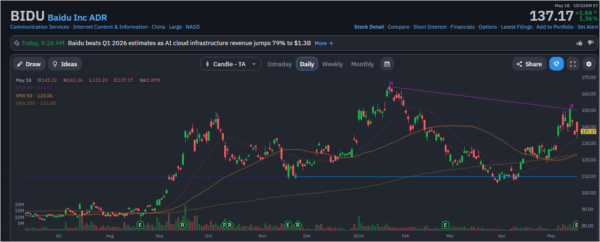
Despite its profits falling like a sack of bricks, BIDU ripped higher after earnings as investors aggressively repriced the company around its accelerating AI infrastructure story. The stock pushed toward the $145-$150 resistance zone after AI cloud revenue surged 79% to roughly $1.21 billion, while AI-powered revenue climbed 49%.
Technically, BIDU reclaimed both its 20-day moving average near $132 and its 50-day moving average near $123 following the earnings gap higher. Volume also expanded sharply as momentum returned to the chart after months of weakness.
The key battleground now sits around the descending trendline near $145-$150. A clean breakout above that region could shift momentum aggressively toward the January highs near $160.
The larger setup now looks less like a weak internet stock and more like a company attempting a full AI-driven rerating underneath the surface.
Old Things Shall Pass Away
Net income attributable to Baidu fell sharply from RMB7.72 billion to approximately RMB3.45 billion ($475 million).
A profit collapse that severe normally dominates investor attention.
Yet, this quarter, the bulls locked onto AI cloud growth, AI-powered revenue, and the company’s accelerating transition underneath the surface.
That reaction says a lot about how the company is no longer clinging on to an old empire with deteriorating corners. In what now seems to be the right, strategic, and timely move.
Leave a Reply