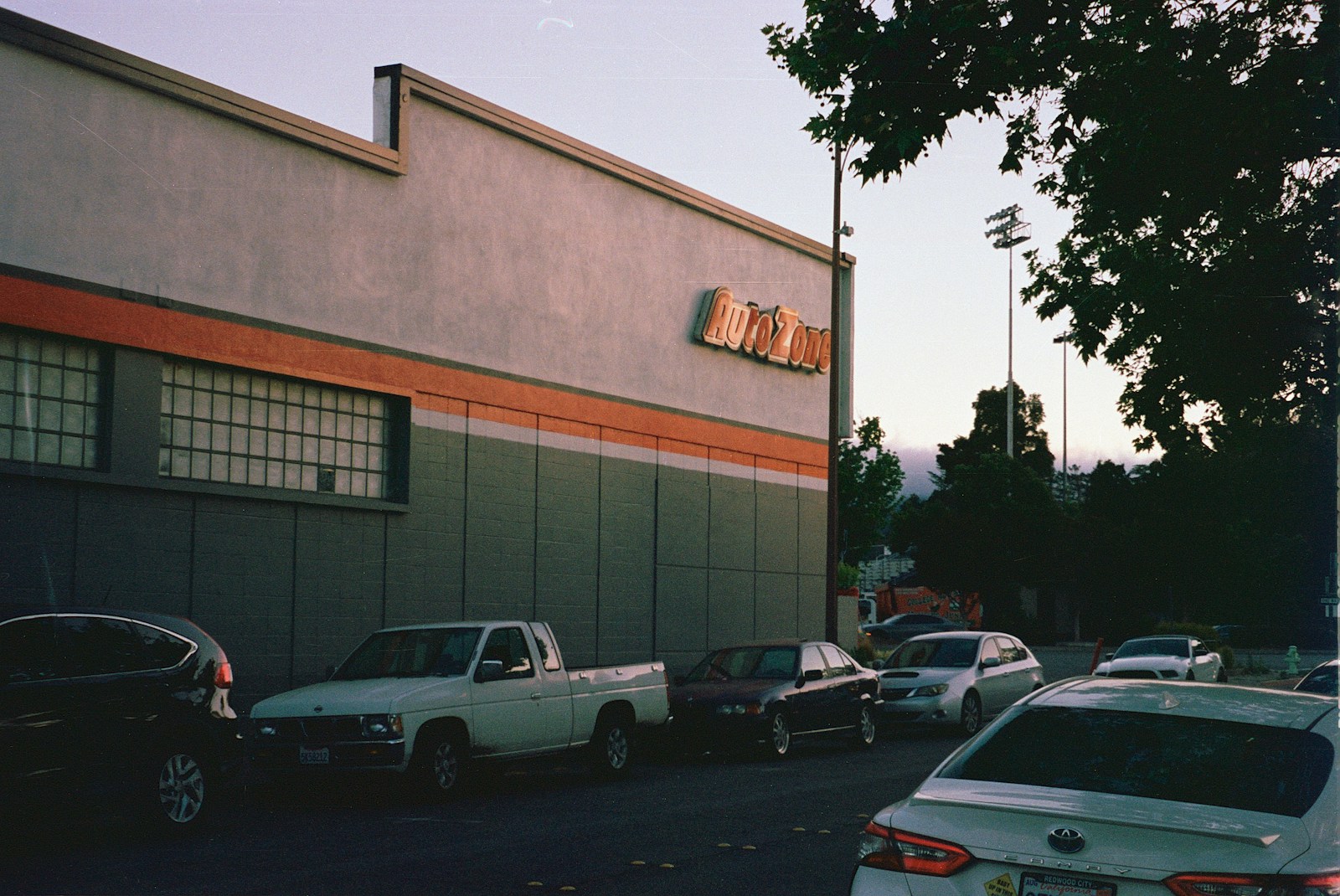
In the decades following World War II, America perfected the art of replacement. A car wore out, you bought another. An appliance failed, you upgraded it. Back then, prosperity wasn’t measured by how long something lasted but by how quickly you could afford the next one.
Table of Contents
AutoZone Inc. (NYSE: AZO) just delivered an earnings report that suggests that mindset is changing fast.
AutoZone reported third-quarter FY2026 earnings with revenue of $4.46 billion and earnings per share of $35.36, beating expectations while delivering domestic same-store sales growth of 4.1%.
However, this quarter reinforced a simple idea: consumers are becoming more selective about replacement and more committed to preservation.
Americans Are Choosing Preservation
The easiest explanation for AutoZone’s performance is an aging vehicle fleet.
I think the quarter revealed something deeper. Let me explain.
In the first quarter, domestic same-store sales grew 4.8%.
In the second quarter, that growth slowed to 3.4%.
By the third quarter, domestic same-store sales accelerated back to 4.1%.
That progression tells you that maintenance spending isn’t fading. New vehicles remain expensive. Financing remains expensive. Insurance remains expensive. Consumers understand those realities every time they make a monthly payment, renew a policy, or walk into a dealership.
And since every increase in replacement costs strengthens the economics of maintenance, this means that AutoZone’s opportunity expands each time consumers choose preservation over replacement.
The Trend Is Bigger Than DIY Customers
One figure deserves more attention than it received among investors.
I’m talking about the commercial sales that grew 7.3% to $1.4 billion during this quarter.
Professional repair shops are seeing the same behavior that individual consumers are seeing. Vehicles are staying on the road longer, generating demand for maintenance, repairs, and replacement parts long after many owners might have traded them in during previous cycles.
At the same time, AutoZone generated gross profit of $2.37 billion and operating profit of $885 million.
Commercial sales growing faster than the overall business confirms that preservation is no longer confined to DIY consumers. Repair shops are benefiting from the same behavior, reinforcing the idea that maintenance has become a financial decision rather than a temporary response to economic uncertainty.
Management Is Turning Preservation Into Cash
Management didn’t simply collect it.
The company continued investing in inventory, technology, distribution capacity, store growth, and commercial expansion while repurchasing approximately $741.7 million worth of stock.
Even better, they repurchased $741.7 million of stock while funding those purchases primarily through operating cash flow, a decision that signals confidence in both the durability of demand and the company’s ability to keep converting that demand into cash.
If preservation continues proving resilient, AutoZone’s buyback machine could remain one of the most powerful drivers of shareholder returns.
Wall Street Keeps Watching Tomorrow’s Vehicle
While Wall Street remains fascinated by the vehicle of the future, AutoZone continues generating cash from the vehicle already sitting in the driveway.
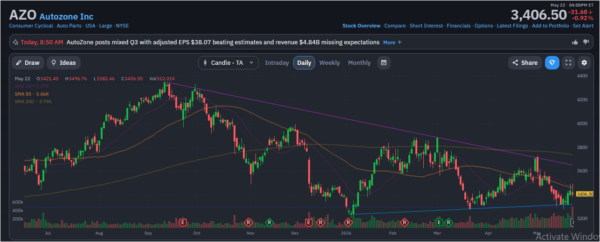
Take a look at the chart; shares remain trapped beneath a long-term downtrend line that has capped rallies since last September, suggesting many investors remain cautious about the company’s future.
Yet every major selloff has attracted buyers near the $3,250-$3,300 area, creating a support zone that has held repeatedly throughout 2026. The stock continues trading near its 50-day moving average while attempting to stabilize above support, even as the declining 200-day moving average overhead suggests skepticism has not fully dissipated.
To me, that looks like a market struggling to reconcile two competing realities: the transportation future it keeps talking about and the maintenance economy AutoZone continues profiting from today.
There’s no doubt about it, electric and autonomous technology vehicles will continue gaining market share.
But the overwhelming majority of vehicles on American roads today still require maintenance, repairs, replacement parts, and ongoing investment from their owners. That reality helped drive another quarter of sales growth, profit growth, and cash generation.
And as long as consumers continue extending the life of the vehicles they already own, the company remains positioned on the right side of that decision.
The Market May Be Looking Too Far Ahead
AutoZone’s earnings delivered a simple reminder.
Consumers still maintain the vehicles they own. They still repair them. They still postpone replacement when the economics make sense. And management continues turning that behavior into sales growth, profit growth, cash flow, and aggressive share repurchases.
I don’t view that as a bet on old cars at all. If anything, this is a bet on a consumer who increasingly treats replacement as a financial decision rather than a habit.
Wall Street may continue debating the future of transportation. But AutoZone keeps getting paid by the present.
That’s a position I find difficult to ignore.
Leave a Reply