Applied Materials (NASDAQ: AMAT) reported Q2 2026 earnings revenue of roughly $7.10 billion while non-GAAP EPS came in around $2.39, both ahead of expectations.
Table of Contents
A few years ago, building a faster AI chip mostly meant shrinking transistors, packing more of them onto silicon, and letting the semiconductor industry’s old scaling tricks do the rest.
Now, the situation has flipped on its head. The chips are running hotter. Power consumption is exploding. Memory systems are struggling to keep up.
And moving data efficiently across modern AI systems is becoming so physically demanding that semiconductor companies are starting to redesign the architecture around the chips themselves.
That was the real story hiding underneath Applied Materials’ earnings you won’t find anywhere else.
Old Semiconductor’s Playbook Is Starting To Crack
For decades, the industry relied heavily on transistor shrinking to improve performance.
Smaller transistors meant: more speed, better efficiency, higher density, and lower power consumption.
AI workloads are now pushing that system harder than it was ever designed to handle.
Modern AI systems constantly move staggering amounts of data between GPUs, high-bandwidth memory, interconnect systems, networking infrastructure, and increasingly dense chip architectures packed into tighter spaces.
The result is a manufacturing problem that keeps getting uglier underneath the surface, like how the chips now generate enormous heat, power leakage worsening and wiring complexity exploding. In short, the shrinking transistors alone are no longer solving enough of the problem.
That pressure is already showing up boldly in AMAT’s Q2 2026 earnings as the company generated about $5.26 billion in Semiconductor Systems revenue while gross margin expanded to roughly 48.7%.
Pointing to the inevitable conclusions that chipmakers are already spending aggressively trying to solve the next manufacturing barriers forming underneath AI infrastructure.
And the spending pressure looks far deeper than a temporary AI craze.
Chipmakers Are Being Forced Into Extreme Manufacturing
The deeper I went through the report, the more intense that pressure became. Already, Applied Materials has been pushing aggressively into advanced packaging, angstrom-scale manufacturing systems, transistor redesign, memory integration, and wiring innovations designed specifically for increasingly demanding AI workloads.
That stood out immediately because semiconductor companies do not suddenly start throwing billions into atomic-scale precision, advanced packaging, new transistor architectures, and backside power delivery systems unless the old methods are starting to strain.
Applied Materials also generated roughly $1.57 billion in operating cash flow during the quarter while continuing to expand deeper into those manufacturing layers.
Put together, that combination becomes impossible to ignore. Yet, it pales in comparison to the collective actions of the heavy spenders within the industry as they are now prepared to splurge against this physical complexity surrounding AI chips, which, sadly enough, is rising faster than many investors still appreciate.
All of a sudden, Taiwan Semiconductor (NYSE: TSM). partnering with Applied Materials around AI-era manufacturing research makes much more sense under that backdrop.
So does the company’s partnership with Micron Technology (NASDAQ: MU) around next-generation memory manufacturing.
Even the expansion of research collaborations with Stanford University, Arizona State University, and Rensselaer Polytechnic Institute is starting to feel less like typical corporate expansion and more like the industry pulling deeper scientific resources into the fight.
AMAT’s Earnings Sent The Stock Toward Fresh Highs
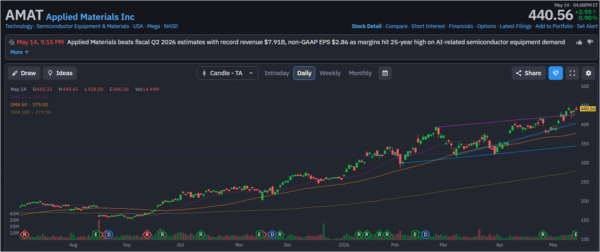
AMAT climbed toward fresh highs after earnings, trading near $440, after management reported record revenue of roughly $7.91 billion and non-GAAP EPS of approximately $2.86, with margins reaching a 25-year high. Volume also surged toward roughly 15 million shares as institutional buyers piled into the stock immediately after the report.
The chart now reflects the same pressure building underneath the semiconductor industry itself.
Chipmakers are spending aggressively on complex manufacturing systems as AI workloads continue pushing hardware requirements higher.
Technically, AMAT continues riding a strong long-term uptrend while holding firmly above the: 20-day moving average near $409, 50-day moving average near $379, and 200-day moving average near $280.
The post-earnings move also pushed the stock toward the upper boundary of its rising trend channel as momentum and institutional accumulation remained strong throughout the session.
The breakout zone near roughly $420-$425 now becomes the key level to watch. Sustained buying above that region keeps the chart structure constructive while reinforcing the broader trend surrounding AI-driven semiconductor manufacturing demand.
AMAT Is At The Center Of It All
Before now, most investors still view the AI race through visible winners: GPUs, chatbots, and hyperscaler spending.
Applied Materials sits several layers deeper underneath the companies, trying to physically keep future AI chips scaling as complexity rises.
And the pressure forcing that spending does not look temporary.
The semiconductor industry spent decades making chips smaller.
Now it is being forced to redesign from the packaging to the wiring to the transistor architecture, and even the manufacturing processes surrounding those chips, because smaller alone is no longer enough.
Put simply, the AI race no longer looks like a simple battle over who builds the fastest chip.
It is a manufacturing arms race over who can keep advanced chips improving before the physical difficulty of building them starts slowing the entire industry down.
And Applied Materials already appears to be sitting directly inside that fight.
Leave a Reply