
For many years, McDonald’s (NYSE: MCD) has suffered the scourge of all things that were wrong with the fast-food industry. Amid a broader shift that began with millennials and continues with Gen Z, consumers have consistently gravitated toward convenient but healthier alternatives. However, with the Iran conflict, along with rising economic challenges, MCD stock suddenly looks like a very smart bit of speculation.
Table of Contents
Fundamentally, one of the more exciting elements of the Golden Arches is the fruits of the company’s product innovation. Following the pilot program of the beverage-focused CosMc’s concept, McDonald’s recently announced a major strategic undertaking. Rather than just building more standalone cafes, the fast-food giant is integrating CosMc’s tech and menu into its core locations.
Specifically, McDonald’s is launching its Refreshers and crafted soda line nationwide, including its high-margin items such as its dirty sodas and energy drink collaborations. Financially, specialty beverages carry significantly higher margins than food products like hamburgers. By capturing a slice of the multi-billion-dollar industry, which is currently dominated by Starbucks (NASDAQ: SBUX), MCD stock could benefit from a sizable boost in same-store sales.
Such an optimistic outlook is supported by McDonald’s massive and loyal consumer base. Further, with digital transactions increasingly ramping up across the discretionary retail sector, the fast-food giant has taken great steps to integrate the latest tech. This has resulted in a conspicuous pickup in systemwide sales in key markets.
What’s really fascinating amid the K-shaped economic recovery is McDonald’s ability to capture market share from consumers facing recent financial headwinds. Because of the increasing pressure both economically and geopolitically, many patrons who would rather eat at fast-casual restaurants like Chipotle (NYSE: CMG) are trading down to McDonald’s.
Even better, because of the investments the company has made, the trade down doesn’t feel that much of a compromise. With MCD stock in a slog over the past year, now may be an intriguing time to consider opening a long-side position. Additionally, an intriguing market signal has made this prospect all the more enticing.
Using the Inductive Approach to Trade MCD Stock
Obviously, the whole idea of estimating what may happen in the future is to profit from the potential move before it happens. It doesn’t really do you much good to read a story waxing poetic about what did happen — unless you’re into that sort of thing. Of course, forecasting comes with a certain degree of risk because no one knows exactly what will happen.
To help narrow down the odds, traders use induction, which is a fancy term for pattern recognition. An inductive methodology relies on the uniformity of nature or the assumption that the future will resemble the past. It’s not a perfect, foolproof approach, but when dealing with the unknown future, it’s the best (and only) philosophy we have.
For example, technical analysis is highly inductive. If you see a head-and-shoulders pattern, you have been taught that there is a high probability that the target security will fall in value. Apparently, people have studied head and shoulders — and supposedly, a great many of these patterns end up in bearish trends.
However, no one (to my knowledge) has quantified these claims. We don’t know what the success ratio is for these technical patterns. Further, no arbiter exists to objectively define what these patterns are and when they are valid.

To help get around this dilemma, I prefer to use a discretized inductive analysis. We take the infinite realm of the scalar signal and convert this data into discretized signals. In this manner, we’re quantifying what a signal actually means and using that quantification to calculate a forward distribution of likely events in the future.
There’s no really elegant way of expressing discretization, so let me cut to the chase. What I’m doing is conditioning data associated with the last 10 weeks to find out what is likely to happen in the next 10 weeks.
It’s no different than comparing a baseball player’s career batting average to his batting average when there are runners in scoring position (RISP). If there’s a favorable discrepancy between his aggregate average and his RISP average, that’s conditioned data that can be used to one’s advantage.
Turning Theory into Action for McDonald’s Stock
Let’s move into some practical applications, particularly for options traders. Using a dataset going back to January 2019, if you were to hold McDonald’s stock at random for any 10-week period, you would statistically come out a winner due to the security’s upward bias.
Specifically, out of 362 rolling 10-week sequences, 228 of them have risen above the starting price. That gives MCD stock an exceedance ratio of 63%, which is fantastic. It’s also somewhat expected, given the blue-chip status and reliable nature of the Golden Arches.
Drilling into the details, if we assume a starting price of $301.84 (Tuesday’s close), MCD stock — using an inductive calculation — would be expected on average between $298 and $315. Probability density would likely peak at $305, meaning that random speculation over the aforementioned period should more often than not lead to a modest return.
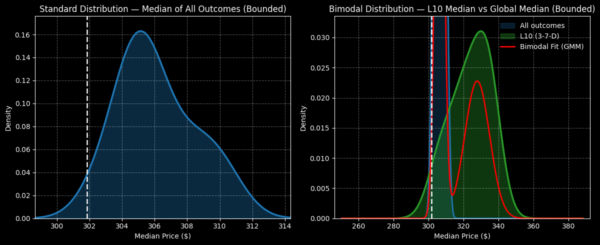
Of course, we’re not interested in trading MCD stock randomly; instead, we’re specifically targeting the current signal to see if there’s a meaningful advantage over the aggregate baseline. In the last 10 weeks, MCD has printed only three up weeks, leading to an overall downward slope. Under this 3-7-D condition, the 10-week forward distribution noticeably shifts toward the positive end of the profitability axis.
Nominally, if we assume the same $301.84 starting price but under 3-7-D conditions, MCD stock will likely range between $290 and $360. Probability density is projected to peak at $330, which is a considerable improvement over the aggregate forecast.
By now, you know where I’m going with this. We can use the leverage of options to enhance the potential return of this tempting trade.
I really can’t help but gravitate toward the idea of the 325/330 bull call spread expiring June 18. We’re betting that McDonald’s stock rises through the $330 strike at expiration. If it does, the maximum payout comes out to a stunning 410%. Also, keep in mind that the net cost you pay per spread is only $98.
Bear in mind that induction has its risks. I’ve said it before, and I’ll say it again: just because you see a thousand white swans does not mean all swans are white. Still, when you consider the tendency of MCD stock rising to $330 over a 10-week period under 3-7-D conditions and the very reasonable net cost of the bull spread, I can only repeat the corporate slogan.
I’m lovin’ it.
Leave a Reply