
Last month, big-box retailer Best Buy (NYSE:BBY) delivered what was on print a solid earnings report. While the company missed slightly on revenue, it posted adjusted diluted earnings per share of $2.61 for the fiscal fourth quarter, handily beating analysts’ consensus estimate. However, BBY stock fell sharply following the disclosure. As it turns out, Wall Street isn’t going to be flattered with beauty metrics.
Table of Contents
Sure, an earnings beat is an earnings beat, but the top line — despite being a modest miss — represented a greater share of the story’s significance than what appeared to the naked eye. Without going into a factoid salad, the bottom line is that management practically admitted that it cannot grow its way toward a compelling business. Instead, it must cut costs to survive in a brutal, competitive environment.
However, there is a common argument that because BBY stock has been volatile, the security has likely priced in much of the bad news. Especially in the past six months, BBY has lost nearly 23% of value. As such, some contrarians view the big-box retailer as a reversion-to-the-mean play.
Recently, SimplyWall.St gave a breakdown of the bull and bear case for BBY stock, noting that the fair value of the security has been trimmed to $72.50 from $74.85. Of course, compared to Wednesday’s close of $63.53, the downwardly adjusted fair value of $72.50 is still more than 14% above the baseline. Using the article’s title as a reference, the implication is that BBY is a decent opportunity.
Nevertheless, I would be cautious about throwing around the fair value argument. Such a methodology assumes that behavioral regimes are static, whereas in reality they are more likely to be dynamic and path-dependent.
Look at baseball. A 25-year-old stud may have hit 40 jacks in a season. But a decade later, that same player is now older and fatter. He may also have picked up some injuries that are only compounding now. So, to say that you have a discounted cash flow to account for the myriad nuances of oldness, fatness, and injuries is quite a major presupposition.
Sure, the fair value of BBY stock could be accurate — or it might not be. A number just can’t be hand-waved into the discussion without a serious prosecution of how that number came to be.
Using an Inductive Approach to Trade BBY Stock
It must be stated upfront that I’m not against fair value analyses. However, you as the reader should realize that the validity of the value calculation is only as good as the model itself. Fundamentally, the challenge with this methodology is whether the patterns that have been observed in the past is truly a relevant benchmark for understanding the future.
Of course, this philosophical criticism applies to all inductive methodologies, which rely on the uniformity of nature; that is, the past is likely to repeat in the future. However, inductive forecasts have a tendency of falling apart when they don’t account for variable behavioral states. Therefore, I like to take a Markovian view of the market.
Let’s go back to our former stud turned the old-and-fat guy on the team. Just because a player is old and fat doesn’t necessarily mean that they don’t have any value. In fact, in certain situations, a veteran player who may have lost a step (or two) can bring exceptional value to the table. In other words, the probability of future performance depends on the current state — not the aggregate states of a distant past.
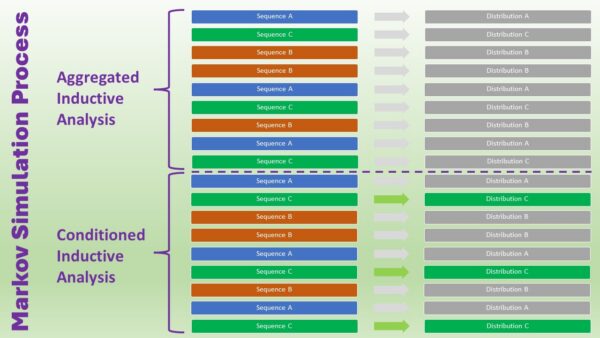
I believe BBY stock is in a similar situation. No, I don’t think it’s reasonable to assign a forward fair value of Best Buy based on an aggregate of past-paradigm valuation ratios. While these stats shouldn’t be ignored, we would be mixing together an environment where brick-and-mortars had dominance, along with the current era, where digital sales rule.
Instead, I prefer to look at how Best Buy stock traded based on behavioral states. Over the past few years, BBY has flashed all kinds of distinct market signals. Thus, it’s much more instructive to identify what the current market signal is and then look to the past as to how that specific signal operated relative to the aggregate baseline.
If there’s a positive variance between the signal and the aggregate noise — which I’d like to demonstrate that there is — we may have ourselves an opportunity.
Identifying a Compelling Trade for Best Buy Stock
Using a dataset going back to January 2019, a random 10-week long position held in Best Buy stock will likely land in a narrow range between $63 and $64 (assuming a starting price of $63.53). Peak probability density would land somewhere around $63.42. As it turns out, out of 362 rolling 10-week sequences, only 179 ended up above the aforementioned spot.
Put differently, BBY stock has an exceedance ratio of only 49.4%. Sure, some folks may buy BBY for its 6.04% dividend yield but from a near-term snapshot, there’s a statistically higher tendency of negative returns (strictly looking at capital gains) than positive.
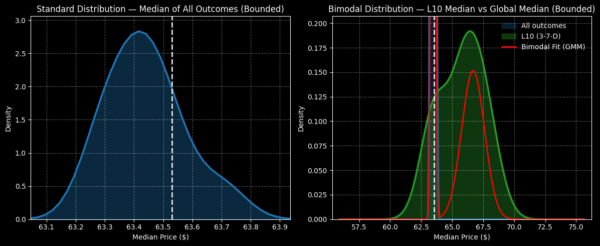
Because of this bearish bias, we wouldn’t put the old and fat Best Buy in the lineup every day if we had better options. However, what we do know from the data is that BBY’s negative bias appears in the aggregate; it doesn’t always appear in all market sequences.
For example, in the past 10 weeks, BBY stock has printed only three up weeks, leading to an overall downward slope. Under this 3-7-D condition, the exceedance ratio at the end of a 10-week period on average rises to 58.1%. It’s an extremely small sample size so I don’t want to get too excited. Still, under Markovian logic, the forward probabilities of BBY do have a tendency of changing depending on the current state.
What’s more, the forward 10-week distribution is noticeably more optimistic, with Best Buy stock expected to land between $60 and $71. Further, peak probability density lands at around $66.50.
Thanks to this analysis, I’m tempted by the 65/70 bull call spread expiring June 18. Should BBY stock rise through the $70 strike at expiration, the maximum payout is over 138%. Breakeven lands at what the data perceives to be a realistic target at $67.10.
Leave a Reply