Pressure rarely announces itself in a single quarter. It accumulates small concessions, deliberate exits, until the boundaries of what a business is allowed to earn have been redrawn without anyone formally announcing the change. That is the frame you need for UnitedHealth Group’s Q1 2026 earnings report. Though impressive, I see a company negotiating its profitability inside a system it no longer fully controls.
Table of Contents
Margin Expansion Has a Hidden Price Tag
Right now, the headlines are going completely nuts over UnitedHealth Group, Inc (NYSE: UNH) figures: revenue of $111.7 billion, up roughly 2% year-over-year; adjusted EPS of $7.23; operating cash flow of $8.9 billion; and debt-to-capital of 42.9%. A profile of a business that still executes with discipline. But execution is not the story here. The method of execution is, and that distinction is where most investors stop paying attention.
UnitedHealthcare Group delivered $86.3 billion in revenue and $5.7 billion in operating income, with margins climbing to 6.6% from 6.2% and the medical cost ratio declining to 83.9% from 84.8%. On the surface, that reads like control. Clean, even. The kind of improvement that gets quoted in bull cases without further examination.
However, margins don’t expand in a regulated system without trade-offs – they are earned by choosing where not to participate as much as where to lean in. Total membership fell to 49.05 million from 50.1 million, including a reduction of roughly 965,000 Medicare Advantage members. Indicating that the company is tightening its exposure to areas where returns no longer justify the capital under current reimbursement conditions, and the margin improvement is the direct result of that exit. You cannot separate the two.
Washington’s Boogeyman strikes again
Let’s be precise about where the pressure originates, because pricing it correctly changes how you see this business going forward.
A significant portion of UnitedHealth’s revenue runs through government-backed programs – particularly Medicare Advantage – where reimbursement rates are not set by the company but determined in Washington.
Earlier this year, initial Medicare rate proposals came in at roughly 0.09%, effectively flat, before being revised higher after sustained industry pushback. That sequence alone triggered sector-wide volatility because it exposed the underlying reality plainly: pricing power here is conditional.
When reimbursement moves, margins move with it. When reimbursement stalls, companies adjust or absorb, and UnitedHealth chose to adjust, shedding lower-return Medicare Advantage cohorts while tightening its medical cost ratio in the process. Put simply, UnitedHealth now profits under the government’s permission.
Can Optum Absorb All The Pressure?
For years, Optum was the layer that converted scale into higher-margin, diversified growth and justified a premium multiple. It still drives revenue. But the conversion is weakening, and that is a material shift in the investment thesis.
Optum Health reported $24.1 billion in revenue, down 3% year-over-year, with reported operating income of $1.141 billion and adjusted at $1.312 billion – a 5.4% margin. Optum Insight delivered $5.1 billion in revenue, but adjusted operating income dropped to $774 million. Optum Rx generated $35.7 billion in revenue, up 2%, while operating income slipped from $1.3 billion to $1.2 billion and scripts declined to 383 million from 408 million.
Yes, Revenue is holding. Earnings are compressing. Margins depend on adjustments rather than on clean operational leverage. But a growth engine in full stride does not produce these numbers. A system absorbing external pressure while trying to maintain its output does.
Patients and Volume Stood Strong, But…
Patients didn’t disappear, and neither did volume collapse. In fact, the system is still processing claims and moving members at scale. What changed is the quality of that volume – the margin attached to each dollar flowing through the business. Costs are higher. Investment remains elevated. Reimbursement is constrained. So the company does what disciplined operators do in this environment: it selects or exits where necessary, and defends where it can.
That is precisely how you get margin expansion alongside membership contraction, and revenue growth alongside earnings compression in key segments. Both outcomes are intentional, and holding them together is the only honest way to read this quarter.
What The Chart Looks Like
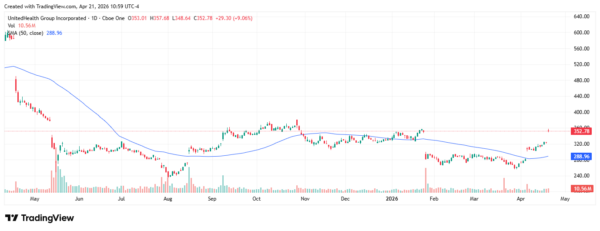
Just before the earnings hit, UnitedHealth Group was trading around the $300–$310 range, sitting just beneath its 50-day moving average and well below the declining 200-day, a setup that reflected hesitation
Premarket, the stock jumped over 6.8%, and that momentum carried into the session, pushing the price aggressively toward the $340–$350 zone, reclaiming both the 21-day and 50-day moving averages in one move. That kind of reclaim, in a single session, is not retail noise; it’s institutional repositioning. Volume confirms it, expanding meaningfully relative to prior sessions.
RSI pushed toward 60+, shifting out of neutral into bullish momentum without yet entering extreme overbought territory, exactly where sustained moves tend to build from.
Now, price is pressing into a prior supply zone while compressing beneath the 200-day. If that level gives way, you’re not looking at a bounce anymore but a trend transition. Signaling that the market is repricing the business’s durability under pressure, rather than its beat.
The Negotiation Is Just Getting Started
No doubt this quarter proves UnitedHealth can perform under pressure, further proving it as a good buy. What it does not prove is how much tighter conditions can get before the trade-offs migrate from segment margins and membership figures into the core numbers that investors anchor their entire thesis to.
That is the question worth sitting with, and if you’ve been paying attention, you already know this is no longer a simple growth story, but a negotiation. One where profit still exists, but only with permission.
Leave a Reply