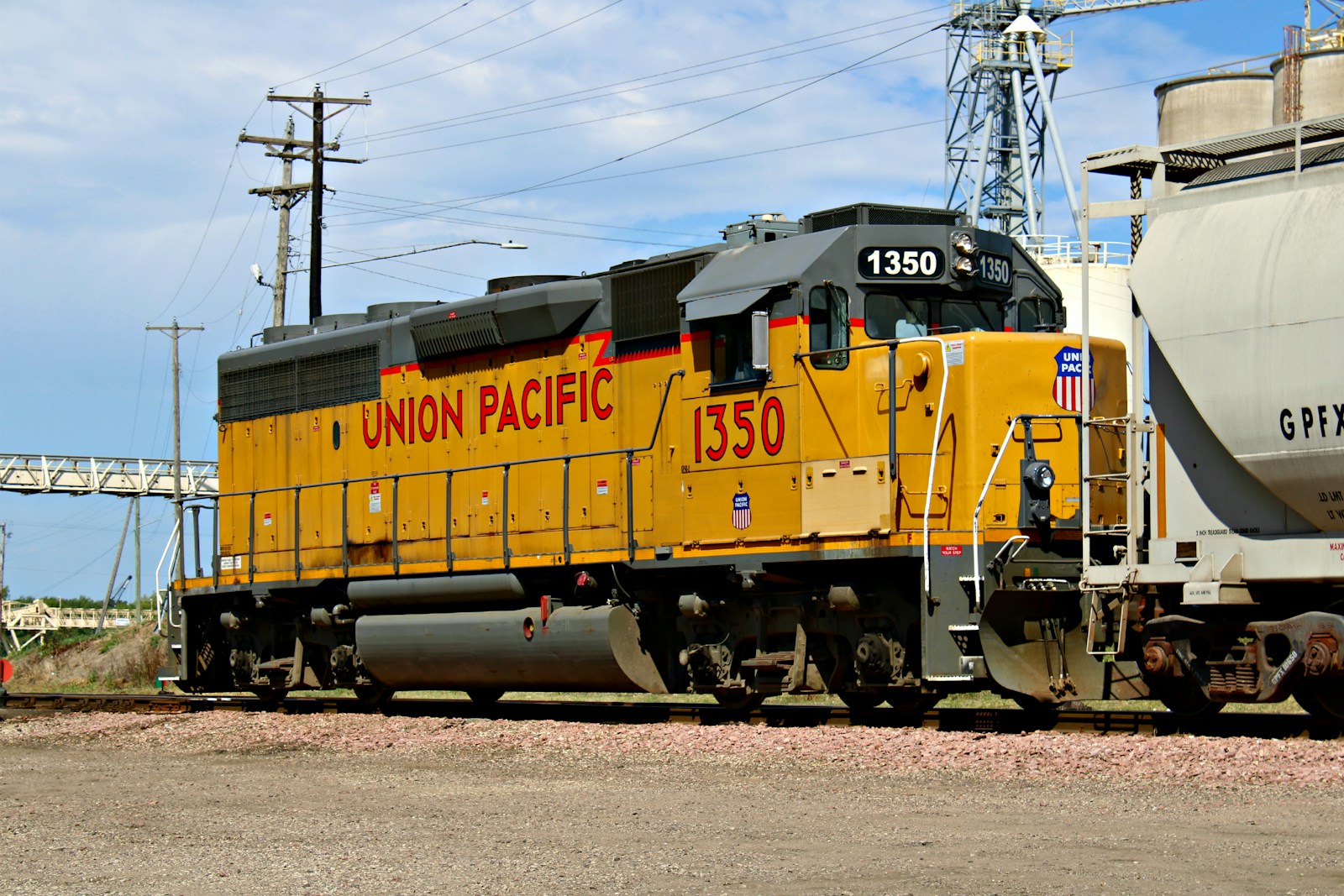
Union Pacific Corporation (NYSE: UNP) just delivered the kind of quarter most investors will read too quickly, too happily, and misframe entirely. The Q1 2026 earnings report showed revenue coming in at $6.22 billion, up 3% year-over-year, with adjusted EPS landing at $2.93 against estimates of roughly $2.86 and GAAP EPS at $2.87. Albeit a clean one, the beat is not the story worth telling – the mechanism behind it is, because that mechanism reveals precisely what kind of company Union Pacific is morphing into before the market has been given official permission to price it that way.
Table of Contents
When Volume Falls And Earnings Rise
Volume declined 1% year-over-year, which immediately eliminates the most convenient explanation for the strong result and forces a more honest question:
How does a railroad grow revenue and expand earnings in a quarter where it is moving less freight?
The answer sits entirely in pricing power and cost discipline, two variables that do not show up in the headline number but explain everything beneath it.
Freight revenue, which increased 4%, was supported by core pricing gains and fuel surcharge revenue, while costs were controlled tightly enough to drive operating income to roughly $2.46 billion and push the adjusted operating ratio to 59.9% – a level that reflects genuine operational efficiency rather than favorable demand conditions doing the work for management.
You’d not always find companies pulling more earnings out of fewer carloads through deliberate control of their cost structure and pricing architecture, like Union Pacific. So when you do, you need to look beyond the income statement to understand the magnitude of their goals and actions.
Norfolk Southern $85 Billion Deal
The proposed merger with Norfolk Southern is not a side conversation happening parallel to the operating story – it is the lens through which this entire quarter should be read.
If approved, the merger with Norfolk Southern (NYSE: NSC) creates the first single-line, coast-to-coast freight rail network in the history of the United States, eliminating the interchange friction between eastern and western carriers that currently forces freight to transfer between systems, absorb delays, and accumulate cost at every handoff point along a transcontinental journey.
The resulting network would connect ports, manufacturing hubs, energy corridors, and distribution centers into one continuous system – compressing transit times, reducing structural cost, and increasing asset utilization across a national footprint in a way that no incremental operational improvement could replicate on its own.
Trump Locks Horns With Another Regulatory Body
Trump has made its posture on large-scale industrial consolidation reasonably clear, with public support for transactions of this kind and a policy disposition that favors conditional approval over outright rejection, which moves this deal from theoretical to plausible in a way it would not have been under a different political environment. That tailwind is real and deserves weight in how you think about probability-weighted outcomes.
The problem is the Surface Transportation Board governs the formal process, and its standard is demanding – the companies must affirmatively demonstrate that the merger enhances competition and delivers measurable public interest benefits, a bar that introduces meaningful time, regulatory scrutiny, and outcome uncertainty regardless of the political backdrop. The deal is plausible. It is not guaranteed. And that is what keeps the opportunity open for investors who are willing to think ahead of the confirmation.
How UNP Manufactured The Earnings
Now, let’s return to the Q1 earnings and read it with the merger context in place.
Revenue growing despite a volume decline, earnings expanding through pricing power and cost discipline, operating efficiency tightening to a 59.9% adjusted ratio – none of these moves are accidental, and none of them are purely about the current quarter.
Union Pacific is compressing its cost structure, reinforcing its pricing architecture, and improving network efficiency in a way that generates value today but compounds exponentially inside a larger, unified, coast-to-coast system.
These are exactly the operational characteristics you want embedded in the foundation of a network before you dramatically expand its scale – and the company is doing that work now, before the regulatory outcome is known.
As such, the earnings are structurally aligned with a future that has not yet been formally approved.
Price Action’s Confirmation
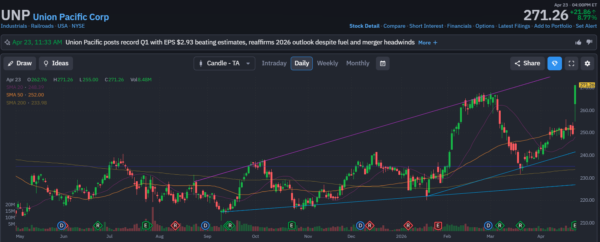
Price action is doing exactly what the earnings implied. Union Pacific has broken out to $271, up nearly +8.8% on the day, reclaiming both the 50-day and sitting well above the 200-day moving averages. That’s institutional positioning.
The trend structure has remained intact: higher lows since November and a clear breakout above the prior consolidation range around $250–255. Volume expanded on the breakout, confirming participation. All pointing to the fact that price is pushing higher despite flat volumes in the business (-1%).
Everyone Is Wrong About Union Pacific, Again
Most investors debating this stock are focused on whether volumes recover, whether pricing holds into a softer macro environment, and whether demand conditions improve enough to drive the next leg of growth.
Those are reasonable questions for a different company in a different situation – but they are the wrong frame here, because they treat Union Pacific as an operator waiting for the economy to do the work, rather than a business reshaping its structural position ahead of a potential $85 billion expansion that would make today’s efficiency gains look like a footnote.
If the merger is approved, the company will grow at a scale that will redefine the earnings trajectory entirely.
If not, you are still holding a company that just proved it can grow earnings without volume growth supporting it, which is a quality of business that deserves a better multiple than it is currently receiving.
Leave a Reply