
Tractor Supply Company (NASDAQ: TSCO) reported Q1 2026 results on April 21, and the headline numbers once again gave skeptics something to chew on. Earnings per share came in at 31 cents, missing the consensus estimate of 35 cents. Revenue of $3.59 billion also trailed the $3.71 billion analysts had penciled in.
Table of Contents
On the surface, it looks like a continuation of the story that has weighed on TSCO all year. That is, the stock is already down roughly 10% in 2026, and has gapped further below key technical levels after earnings.
But investors willing to look past the misses will find a company that held its margins, opened stores at a record pace, and, critically, reaffirmed its full-year guidance in an environment where many retailers are cutting theirs. For patient investors, that distinction should matter more than the headline numbers.
The results weren’t completely unexpected. After the company’s weak Q4 2025 report that flagged softness in discretionary categories, management had telegraphed that Q1 would carry a heavier SG&A burden due to accelerated store investment and the timing of new openings. That warning proved accurate, and the fact that results landed roughly in line with those lowered internal expectations is arguably more reassuring than alarming.
The real question for TSCO investors isn’t about one quarter, but whether the fundamental thesis around Tractor Supply’s needs-based, rural lifestyle model remains intact. Evidence from Q1 suggests it does.
The Needs-Based Model Is Doing Its Job
The most important number in Tractor Supply’s Q1 report wasn’t EPS — it’s the product category breakdown. Management confirmed that four of the company’s five product categories delivered positive comparable sales results, with the lone exception being companion animal.
Softer demand trends, category shifts, and an unfavorable product mix in pet dragged on comp sales, which rose just 0.5% overall — a meaningful improvement from the 0.9% decline in Q1 2025. Strip out that category headwind, and the core of Tractor Supply’s revenue mix — the consumable, usable, and edible goods that keep farms and homesteads running — continues to perform consistently, reinforced by strength in big-ticket items.
This is precisely the defensive characteristic that makes TSCO worth holding through a rough patch. Unlike a general merchandise retailer exposed to consumer discretionary swings, the bulk of Tractor Supply’s sales are anchored in products customers need regardless of the economic backdrop. Livestock feed, equine supplies, agricultural inputs, and similar staples don’t sit in a cart waiting for a sale event.
- Net sales grew 3.6% year over year to $3.59 billion
- Gross margin held flat at 36.2%, a meaningful signal that pricing integrity and cost management are functioning as intended despite tariff and transportation headwinds.
- Owned brands and exclusive product categories rose to 31.8% of total sales, up from 30.9% a year ago — a quiet but important indicator of margin resilience and pricing power.
Record Expansion Backs the Long-Term Case
While the per-share profit number disappointed, Tractor Supply continued to reward shareholders. The company returned $244.40 million to shareholders in a single quarter — $118 million in buybacks and $126.40 million in dividends — while simultaneously funding a record 40 new store openings, bringing the total to 2,435 Tractor Supply locations across 49 states.
New store productivity held in the 65%–70% range, meaning new locations are generating more than two-thirds the sales volume of a mature store almost immediately. That’s a healthy indicator that the expansion model isn’t being diluted by overbuilding.
The February dividend increase extended the streak to 17 consecutive years of dividend growth, a milestone that only deepens the income case as TSCO trades near multi-year lows. At a post-earnings price around $39.57, the yield has climbed meaningfully above the ~2.1% it offered earlier this month, giving new buyers a more attractive income entry than existed just weeks ago.
The company’s full-year EPS guidance of $2.13 to $2.23 implies the current price is roughly 18x the midpoint — modest for a business with this track record. Capital expenditures rose to $202.6 million in the quarter, with $93.7 million directed to new and relocated stores, signaling management’s continued conviction in long-term unit economics even as short-term results face pressure.
Technical Analysis — Deeply Oversold, But No Floor Yet
There’s no getting around it, this is an ugly chart. TSCO has been in a persistent downtrend since its peak near $64 in late July 2025, and Tuesday’s post-earnings gap down pushed the stock to $39.57 — well below the 50-day SMA of $48.40, which has been acting as a ceiling throughout the entire decline. That moving average is itself sloping downward, a sign that the trend remains under institutional selling pressure rather than stabilizing. Volume on the gap day spiked to 25.9 million shares, consistent with distribution rather than capitulation buying.
The RSI(14) was in oversold territory before the earnings report and is now at 25.45, deeply below the 30 threshold that traditionally defines oversold territory and well beneath its 38.34 signal line. The last time the RSI reached levels this extreme was briefly near the February lows, which produced only a short-lived bounce before the decline resumed.
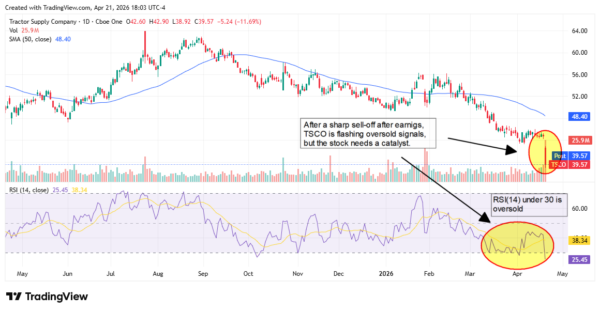
Oversold conditions can persist in entrenched downtrends, so the indicator alone isn’t actionable. What investors need to see is a close back above the $42–$43 range — near the pre-earnings gap — with diminishing volume on subsequent down days. Until then, the path of least resistance remains lower, and averaging in gradually is likely a more prudent approach than a single large entry.
Challenges to the Thesis
The bear case isn’t trivial. Tariff costs are already embedded in inventory. Average inventory per store rose to $1,278,300, up from $1,202,100 a year ago. And management explicitly noted that no incremental benefit from tariff refunds is assumed in the outlook, leaving margin guidance exposed to any escalation.
Operating cash flow dropped sharply to $91.1 million from $216.8 million a year ago, driven largely by a $499.5 million inventory build as the company stockpiled spring seasonal purchases. New customer acquisition remains soft and largely dependent on new store traffic rather than organic demand. The companion animal category, which has historically been a traffic-driving segment, is underperforming with no clear near-term catalyst. And with SG&A deleveraging 70 basis points to 29.7% of sales, the path to meaningful EPS recovery is narrow unless comp sales accelerate in Q2 and beyond.
Patience Required, the Foundation Holds
Tractor Supply is a stock that only value investors could love. The chart is broken, the near-term EPS trend is negative, and macro uncertainty around tariffs and consumer spending remains unresolved. But the core thesis — a needs-based rural retailer with a 17-year dividend growth streak, a record store opening pace, stable gross margins, and rising owned-brand penetration — hasn’t changed.
Management reaffirmed full-year EPS guidance of $2.13 to $2.23 with 4%–6% net sales growth, and the back half of the year is expected to carry the heavier earnings load. At $39.57, investors are buying a 17-year dividend grower at a price that reflects fear, not fundamentals. That’s historically been a reasonable place to start building a position.
Leave a Reply