At some point, you have to call a spade a spade — athletic apparel manufacturer Nike (NYSE:NKE) has been a putrid long-side investment. Since the start of the year, NKE has plunged almost 31%, an embarrassing implosion for one of the world’s top discretionary brands. Over the past five years, the security is down a staggering 67%. Yet this catastrophe may also hide a contrarian opportunity.
Table of Contents
Of course, various technical indicators are flashing red for NKE stock, as would be expected. Down sharply below key performance benchmarks like the 50 and 200-day moving averages, NKE serves as a cautionary tale against knife-catching attempts. At the same time, contrarians may argue that we’re talking about a broken stock, not necessarily a broken company.
The most aggressive players consider NKE stock a classic mean reversion play. First, it’s impossible to ignore the potential “Dogs of the Dow” yield proposition. At the current spot price of $44.20, NKE’s dividend yield has risen to 3.71%, which is a historical anomaly. Typically, Nike is known to reward shareholders at a yield of under 2%.
It should also be noted that the apparel maker has inked 23 years of consecutive dividend increases. Adding to the context that the consumer discretionary sector’s average yield is 1.89%, the massive haircut in NKE stock may act as a synthetic floor for the share price.
Fundamentally, the company’s leadership shift may help spark a revival in the brand. With Elliott Hill taking over as CEO, Nike has concentrated on aggressively repairing relationships with retailers. This initiative could help the apparel juggernaut reclaim physical shelf space lost to opportunistic competitors. As well, Nike is vigorously investing in its innovation pipeline, potentially boosting consumer engagement.
Finally, there’s the whole point about much of the bearishness being priced into NKE stock. Any bit of good news — even just brewing vibes ahead of Nike’s next earnings disclosure on June 25 — could have a disproportionate impact on market valuations.
Using Inductive Math to Plot a Path Forward for NKE Stock
If I may be honest, the above storylines aren’t exactly the linchpin for my interest in Nike stock. Sure, the mean reversion play is an intriguing concept, but practically everyone who covers NKE has thought about it. In addition, statistical facts — such as the dividend streak — are well known. We’re talking about one of the world’s top corporations, not some no-name pink sheet ticker.
No, what really caught my eye was the inductive math that undergirds the bullish proposition. At the basic level, induction is an analytical method that leverages pattern recognition to make educated guesses about future events. The discipline relies on the uniformity of nature or the assumption that the future will behave like the past.
To be clear, induction doesn’t yield perfect forecasts but instead relies on observed probabilities. For example, on your way to work (or some other destination), you may have noticed that cops hide out in certain areas to catch speeding motorists. Based on this observation, you deliberately slow down ahead of the problematic zone to reduce your chances of getting a ticket.
Just because you made similar observations of law enforcement at that place doesn’t necessarily mean a cop is waiting to bust you at this moment in time. However, you want to be smart. That’s induction in the practical realm.
I argue that induction is also very practical (even though it’s not perfect) in the equities sector. In the case of NKE stock, we can observe that in its current bearish regime — which began approximately in August 2021 — a random 10-week long position is likely to suffer a negative bias. Using the current spot as an anchor, we would expect NKE to land between about $41 and $45.50 over the next 10 weeks.
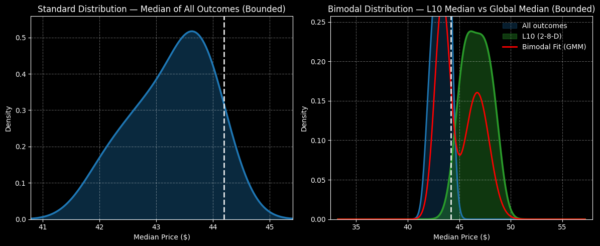
However, we’re not trading NKE as an aggregate. Instead, we’re focusing on a specific quantitative signal. In the last 10 weeks, NKE has managed to print only two up weeks, leading to an overall downward slope. We’ll label this signal as 2-8-D for succinctness.
My inductive argument is that, under 2-8-D conditions, the forward 10-week distribution would be different from the aggregate of all 10-week sequences. As it turns out, this hypothesis is warranted. Based on this signal, we would expect NKE stock to range between $42.50 and $51 over the next 10 weeks, implying a positive bias.
Identifying a Specific Options Trade
Looking at the week-to-week forecast of NKE, there’s a possibility that the optimism in the aforementioned bullish distribution could be frontloaded. In other words, NKE has historically demonstrated a tendency — under 2-8-D conditions — to rise more aggressively in the first half of the forecasted period and taper off in the second half.
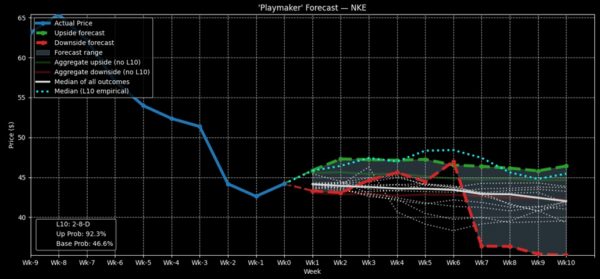
If that’s the case this time around, it may behoove options traders to consider a nearer-term expiration date. Of course, from a debit-side perspective, buying a longer-term option could be considered “safer” because you have more time for the trade to make good. But the flipside is that, if your target is triggered much earlier, you would have to eat into your implied profits to exit early.
Yes, you could choose to wait out the term. However, you also run the risk of the stock falling and the trade being untriggered. That would mean a winning hand would become a losing one.
It’s a lot to think about. Still, if you believe in the inductive process and are willing to accept the risk, the 45/47.50 bull call spread expiring May 15 appears enticing. Should Nike stock rise through the $47.50 strike at expiration, the maximum payout for this trade stands at nearly 205%. Plus, the net debit is quite reasonable at $82.
Adding to the tempting proposition, the breakeven price for the bull spread is $45.82. Both key price targets — the stalemate threshold and the max profit point — are well within the expected statistically observed tendencies under 2-8-D conditions.
I must stress for emphasis that inductive models don’t guarantee expected outcomes. As I said in prior articles, just because you see a thousand white swans does not necessarily mean all swans are white. However, induction arguably offers the best evidence for what might happen in the future.
Leave a Reply