
Soft drink juggernaut Coca-Cola (NYSE: KO) delivered the goods for its first-quarter earnings report, and KO stock has unsurprisingly popped higher. By the numbers, the data looks very impressive. Coca-Cola posted earnings per share of 86 cents, beating out analysts’ consensus estimate of 81 cents. On the top line, the beverage maker generated $12.47 billion, exceeding its $12.25 billion target.
Table of Contents
Even better, Coke raised its earnings outlook, with management projecting comparable EPS growth of 8% to 9%. Previously, the forecast stood at 7% to 8%; the improved sentiment related to lower effective tax rates. Particularly encouraging to shareholders, Coca-Cola reiterated its previous outlook of organic revenue growth of 4% to 5% despite uncertainty over the U.S.-Iran war and the potential consequences for the broader economy, per CNBC.
Along with the strong numbers are the equally compelling narratives. Fundamentally, the bull case undergirding KO stock is no longer just about the flagship crimson label. Increasingly, “better-for-you” (relatively speaking) product lines and other functional categories have driven growth. For example, Coca-Cola Zero Sugar continues to be a massive catalyst, surging 13% globally in the latest quarter. Further, the company has leaned heavily into “plus” beverages — drinks infused with vitamins and minerals.
Essentially, Coca-Cola is no longer relying on its legacy branding and reputation. Instead, it’s actively acknowledging broad generational shifts in consumer tastes and habits, which means offering more choices for health-conscious buyers.
It’s also done KO stock tremendously well. On Tuesday, shares closed up nearly 4%. On a year-to-date basis, Coke is up a hair over 12%. That has led to some publications rationally claiming that Coca-Cola is now fairly valued, which may mean a signal to hold, not necessarily to buy.
However, there’s a different quantitative narrative to consider here.
Using the Inductive Method to Analyze KO Stock
Induction, which is basically a fancy term for pattern recognition, lies at the heart of what equities analysts do. Unless you are working in a deductive system — where the conclusion is contained within the premises (like a mathematical proof) — any forecast is an inductive leap.
This principle relies on the uniformity of nature or the assumption that the future will resemble the past. If you observe ‘Signal A’ results in an upswing 70 out of 100 times, you’re betting that the next move will also result in a positive return.
However, inductive methodologies always flirt with succumbing to the black swan risk: just because you see a thousand white swans does not mean all swans are white. Once a black swan appears, the inductive assumption fails immediately.
That’s the ugly reality. The other ugly reality? There’s nothing you can do about it.
Take, for instance, technical analysis. In certain branches of this discipline, a head and shoulders materializing represents a harbinger of the target security facing an imminent correction. However, there is no official arbiter to define exactly what these patterns truly are. As such, it’s difficult to build even a naïve statistical model using technical analysis because the input itself is often disputed.
To get around this raging debate, I prefer discretization or imposing endpoints in the inputs. For example, discretization is difficult in fundamental analysis because no arbiter can universally define what ‘good’ or ‘bad’ revenue and earnings mean. However, a positive or negative weekly candlestick is a quantified fact.

From here, I apply a Markovian logic to the target security, which asserts that the probabilistic future state of a non-deterministic system depends only on the current state. I define a state as a 10-week, discretized snapshot of KO stock. Subsequently, to find out the probability of what the next state (10-week period) is, I need to observe what tends to happen following the current state.
At the most basic level, I’m forecasting the near future based on an ‘if this/then that’ structure. As mentioned earlier, it’s not a perfect methodology. However, the philosophy is that we can have some idea of what tends to happen based on certain statistical conditions.
Identifying a Compelling Trade for Coca-Cola Stock
Using a dataset going back to January 2019, short-term traders of KO stock typically enjoy a bullish bias. If you were to buy Coca-Cola at random and hold it for a 10-week period, the expected exceedance ratio stands at a healthy 60.9%. Out of 363 rolling 10-week sequences, 221 of them popped above the starting point.
So, if you bought Coca-Cola stock simultaneously across 100 parallel universes, you would expect to be profitable about 61 times. Further, the forward distribution would likely range between $77.50 and $81 (assuming a starting price of $78.35), with probability density peaking between roughly $78.90 and $79.60. You’d be a winner but with modest gains.
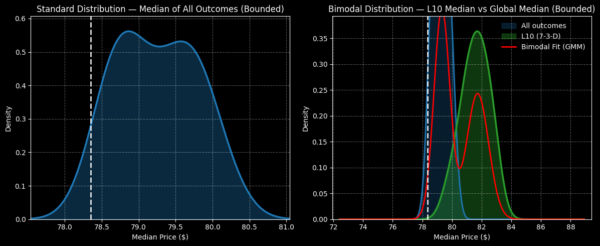
However, we’re not necessarily interested in buying Coke stock randomly. Instead, we’re really focused on the current state. In the last 10 weeks, KO has printed seven up weeks but with a downward slope. This unusual 7-3-D signal shoots the exceedance ratio to 75%. Using a mixture of inductive observations and Bayesian-lite inference, we may anticipate the forward 10-week distribution to land between $78 and $84.20. Further, probability density may peak at around $81.90.
Given this information, the one debit-based options trade that stands out to me is the 80/82.50 bull call spread expiring June 18. Here, the speculation is that KO stock has enough in the can to rise through the $82.50 strike at expiration. If it does, the maximum payout comes in at almost 198%.
What does that mean nominally? Each spread costs a net debit of $84. With the full payout, you’re looking at a capped profit of $166.
That’s the beauty of the debit spread. Coca-Cola stock is arguably very close to fair value at this point. Yeah, there’s a lot of excitement, but it’s also a slow-moving blue chip. But that doesn’t mean there isn’t any potential for milking additional gains, especially the leverage provided by multi-leg options strategies.
Leave a Reply