
Volatility, geopolitical fractures and rising competition from players that didn’t even exist a decade ago. Yet, JPMorgan Chase & Co (NYSE: JPM) just delivered one of its cleanest quarters in recent memory when it reported its first quarter 2026 results. The bank posted an EPS of $5.95, surpassing estimates of $5.45, while revenue came up at a whopping $50.5 billion against $49.2 billion estimates.
Table of Contents
The unclear part, however, is why those numbers are showing up now, in this environment, under these conditions. This is because when you read the report alongside Jamie Dimon’s shareholder letter, you are forced into a contradiction that most investors will walk right past if they stay at the surface.
Bank Earnings Could Be Misleading
Treating strong bank earnings as confirmation of healthy economic conditions is a reflexive instinct, and here, it is the wrong one. Net income reached $16.5 billion, up 13%. ROTCE came in at 23%. These are dominance-level numbers. But a meaningful portion of that outperformance came from areas that don’t thrive in calm markets.
Markets’ revenue reached $11.6 billion, up 20%. The Commercial & Investment Bank generated $23.4 billion, up 19%, driven by trading activity and elevated market flows. These are revenues extracted from dislocation and uncertainty — from a global system generating more friction than it was twelve months ago. In short, JPMorgan didn’t outperform in a stable environment. It monetized an unstable one, and that distinction matters more than any single line in the income statement.
Staying on Top Has a Price
Strength at this scale is not self-sustaining. The $26.9 billion in noninterest expenses – up 14% year-over-year – reflects deliberate investment in compensation, technology, and expansion. The urgency behind that spend is hiding in plain sight in Dimon’s letter: the firm is now tracking over 100 competitors globally, spanning fintech, digital payments, blockchain infrastructure, and capital markets platforms.
These aren’t fringe challengers. They are fast-moving, well-funded, and structurally different from anything JPMorgan has historically competed against. Meaning, the old playbook of out-scaling the competition doesn’t fully apply when your competition is built lighter, moves faster, and isn’t carrying a $4 trillion balance sheet’s worth of regulatory and operational weight.
Dimon Said It But Most People Skimmed It
There is a line in the shareholder letter that deserves more attention than it will get. Dimon explicitly acknowledges that size can become a liability – introducing complexity, slowing decision velocity, and creating conditions for the one thing a dominant institution cannot afford: complacency. Think about it: the man who built the most profitable bank in the world is warning that the very thing that made it dominant could be what undoes it.
Scale generates friction. In an environment where challengers are iterating faster and deploying quicker, that friction carries a real cost – and the same institution generating $50 billion in quarterly revenue must operate with the urgency of one that cannot afford to feel comfortable with that number.
Peak Profits And Pessimistic CEO
JPMorgan is delivering what may be peak-cycle performance by almost any measure, while its CEO simultaneously outlines a world of rising geopolitical fragmentation, structural economic pressure, and narrowing financial mobility for the average American. Dimon’s reference to the American Dream becoming harder to attain is a directional signal about the durability of consumption, household resilience, and the long-term demand environment underpinning everything from card spending to mortgage origination.
These are not cyclical concerns; they are structural, and they matter because JPMorgan’s current strength is a direct product of navigating the very instability Dimon is warning about. The volatility generating $11.6 billion in market revenue is the same volatility he is telling investors to take seriously.
I’d argue that is the most important signal in the entire report, and sadly, most people will never connect those two things.
What The Chart Confirms
Heading into earnings, JPMorgan Chase traded around $295–$300, holding above its 50 and 200 EMAs, with price steadily building higher lows. Post-earnings, the stock broke out to $312, confirming strength, but quickly failed to hold those highs, pulling back to $305, where it is now stabilizing.
That pullback matters. Price remains above the 50 EMA and well above the 200 EMA, keeping the broader uptrend intact. RSI has dropped to about 41, showing momentum has cooled significantly without triggering a breakdown, while volume during the pullback has remained controlled, not indicative of distribution.
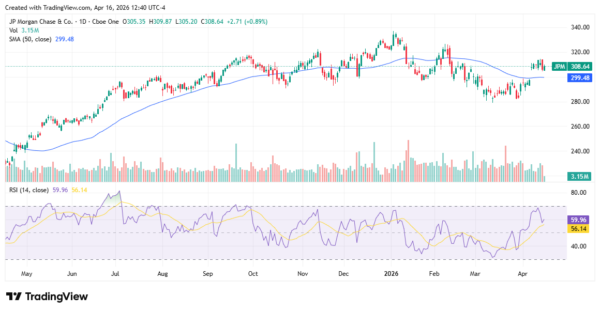
It’s simple: the breakout validated strength, but the rejection at highs shows that buyers are no longer aggressively chasing. The trend holds, but conviction is becoming more selective.
Options-like Business Model
JPMorgan isn’t thriving despite the instability. It is thriving because of it. Volatility is revenue in this business model. Dislocation generates flows. Uncertainty drives clients toward the balance sheet they trust most. The risk isn’t whether JPMorgan can perform in this environment – it’s what happens to the performance profile if conditions stabilize, or worse, deteriorate past the point where they can be monetized.
The thesis hasn’t changed, and JPMorgan & Chase still tops my buy list.
However, you have to pay attention to the fact that it is no longer a story about a bank navigating cycles with superior execution, but a story about a bank generating extraordinary returns from a system becoming progressively harder to stabilize, and a CEO clear-eyed enough to say so while the numbers are still green.
Leave a Reply