
At a quick glance, it’s difficult not to at least be tempted by Microsoft (NASDAQ:MSFT). Sure, the company is suffering through a rough patch, with MSFT stock succumbing to both corporate missteps and the broader uncertainties associated with the Iran conflict. As well, there’s the ever-present concern that the bubble in artificial intelligence has popped.
Table of Contents
Still, advocates of MSFT will point to the obvious. From the perspective of price action, the security is down more than 23% on a year-to-date basis. Over the past 52 weeks, it dipped a bit over 4%. In other words, all the hoopla in 2025 that drove the tech brand to record heights has evaporated. When looking at the situation from a contrarian angle, the bullish thesis does seem enticing.
Let’s also consider the quantitative valuation. Right now, MSFT trades at 23.21 times trailing-year earnings. Back in September of last year, this metric stood at nearly 38 times. According to standard financial logic, Microsoft stock — given that the underlying business is critical to global digital ecosystems — has significant room to grow back into its prior multiple.
Translation? Fundamentally and technically, the tech juggernaut appears to be discounted, if not cheap. However, this line of thinking incorporates a major presupposition that may not be warranted.
MSFT Does Not Have a Fixed Utility
One of the critical problems of declaring MSFT as a discount simply because the multiple is low is that it ignores a key question: low relative to what? If the answer is low relative to last year’s elevated multiple, this statement presupposes that the current sentiment regime is identical or similar to the comparison period. However, the analyst would need to justify that premise, not just hand-wave it into the conclusion.
Stated differently, price is a surprisingly poor mechanism to assess value. Indeed, the confusion centers on the concept of utility — whether it is fixed or variable.
Let’s consider the example of an off-price department store. While retail manufacturers aim to produce the right amount of supply for their markets, it’s inevitable that some products simply don’t resonate with the consumer. Either that or manufacturers overshoot demand expectations, leading to inventory buildup. Rather than toss the excess product, it’s more economical to distribute these items to discount specialists.
It’s a win-win scenario. Producers get at least something for their less-wanted inventory, while the discount specialists have created a new economic category. Additionally, consumers are ecstatic because they can purchase name-brand goods at a lower rate than frontline retail.
In this paradigm, price is an excellent mechanism for discovering undervaluation — and that’s because these goods enjoy fixed utility. Assuming no defects, a frying pan can be used to cook food. Similarly, a suitcase carries various travel items. The utility of these products doesn’t change based on their price. Thus, a lower-cost frying pan is likely to be a good deal.
Unfortunately, the same cannot be said automatically about MSFT — or any other publicly traded security. Here, the utility (which is an expectation of forward returns) is variable. Just because a stock has been severely cheapened doesn’t necessarily mean that it’s a positive opportunity.
I don’t want to use a macabre analogy, but a stable blood pressure reading doesn’t necessarily translate to being cancer-free. You still need to run some specific tests to better determine a proper diagnosis.
Using an Inductive Model to Get a Better Read for Microsoft Stock
It’s important to flesh out the utility concept because Microsoft stock does not have a single distribution of expected outcomes. That might be the case if MSFT had fixed utility. As I explained above, there’s nothing fixed when it comes to the valuation of securities.
Instead, where MSFT is likely to head next depends largely on the current behavioral state. Further, we can establish forward distributional properties through a process known as induction. In fact, every model of the future is necessarily an inductive model. That’s because there’s nothing that logically compels a security to be at a certain price based on a signal or indicator; rather, these forward estimations are inferences.
For full disclosure, inferences are not failproof — but that’s also where the opportunity lies. If market valuations were indeed deducible logically, then the reward structure would be extremely limited since we would essentially be dealing with a risk-free environment. The trick is to narrow our assumptions as much as possible.
One way to tackle this problem is to discretize price action so that we’re dealing with objective quantitative signals rather than unreliable price action. For example, MSFT in the past 10 weeks has printed only two up weeks, leading to an overall downward slope. This 2-8-D quant signal represents a distinctly bearish starting point. Subsequently, we would expect a different outcome over the next 10 weeks relative to any other signal.
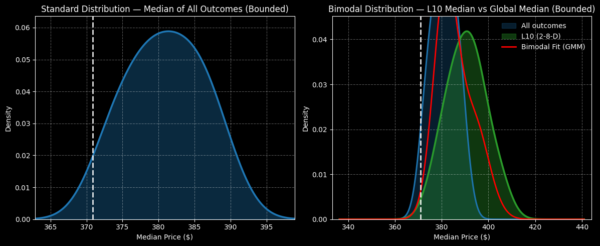
So far, the data appear to justify this thesis. When aggregating all 10-week quant signals, the average forward 10-week distribution would be expected to see MSFT land between $360 and $400. However, under 2-8-D conditions, the forward distribution has been observed to land between $360 and $420. Moreover, probability density tends to cluster at $390.
This gives us a mathematically derived forecast to aim at. No, it’s not perfect, but given similar conditions in the past, MSFT stock appears to have bounce-back potential.
A Bull Spread in Focus
For those who want to take a shot, I’m looking at the 385/390 bull call spread expiring June 18. This transaction involves simultaneously buying the $385 call and selling the $390 (under one execution) for a net debit paid of $205. Should MSFT rise through the $390 strike at expiration, the maximum profit is capped at $295, a payout of nearly 144%.
If you want to get more aggressive, you could opt for the 395/400 bull spread, also expiring June 18. Primarily, the difference here is that the spread is much tighter. Thus, Microsoft stock really has to trigger the $400 strike in an extremely tight window. However, with the max payout clocking in at over 194%, it’s a tempting proposition.
Leave a Reply