
Netflix, Inc (NASDAQ: NFLX) had the opportunity to deploy roughly $87.5 billion into premium sports and large-scale live content ecosystems tied to players like Warner Bros. Discovery Inc (NASDAQ: WBD), in a market where competitors like Amazon (NASDAQ: AMZN) and Disney (NYSE: DIS) have aggressively secured rights to leagues like the NFL and NBA in pursuit of engagement and advertising dominance. It walked away.
Table of Contents
That decision matters more than anything in its latest first quarter 2026 earnings report.
A Quarter That Looks Like Growth, But Reads Like Control
The streaming company reported $12.25 billion in revenue, up 16% year-over-year, alongside earnings per share of $1.23 versus $0.79 expected, a spread wide enough to signal not just a beat, but a business operating ahead of expectations. Operating income came in at $3.86 billion, and an operating margin of 31.5%, a level that would have been unthinkable for Netflix just a few years ago, when profitability was still being sacrificed for scale, as shown in their letter to shareholders.
At the same time, the company now serves over 325 million global memberships, and I want you to actually process what that means, because once you reach that level, the game changes from expansion to extraction. Free cash flow continues to trend strongly positive, with Netflix generating roughly $2.1 billion in free cash flow for the quarter, reinforcing a business that is no longer dependent on external financing to sustain its model.
The Growth Engine Is Far From Rusty
The engine driving this performance has shifted in a way that most investors still underestimate. Revenue is no longer primarily a function of subscriber additions; it is increasingly driven by how much each user is worth. That is where pricing and advertising come in.
Netflix expects its ad-supported tier to generate approximately $3 billion in revenue in 2026, effectively doubling year-over-year, which introduces a second monetization layer that scales alongside subscriptions without requiring equivalent growth in users .
At the same time, content spending remains elevated, but it is being deployed with far more discipline. Instead of chasing volume, Netflix is focusing on efficiency – on titles that travel globally and deliver sustained engagement. That shift is subtle, but it shows up in the margins, and you can already see it in that 31.5% operating margin holding firm even as the platform continues to invest.
The $87.5 Billion Pass Explains Everything
This is where I think most people misread the situation.
Live sports is the most aggressive growth lever in streaming today, and if Netflix had leaned into that $87.5 billion opportunity regardless of the lawsuit, the long-term upside could have been substantial. You would likely see stronger engagement, deeper ad monetization, and a broader ecosystem forming around live content.
At the same time, you would also see margins come under pressure. Cash flow would tighten. Earnings would become less predictable.
Right now, Netflix is delivering great figures in free cash flow, and that stability exists because the company is not tying itself to assets that demand constant reinvestment and escalating bidding wars. By walking away, Netflix preserved its structure.
So yes, they passed on growth. But they protected quality, and in this phase of the business, that matters more.
A Market That Understands the Trade-Off
Strangely, a quarter with this level of revenue growth, earnings beat, and margin strength would normally trigger aggressive upside. But price action flipped the script.
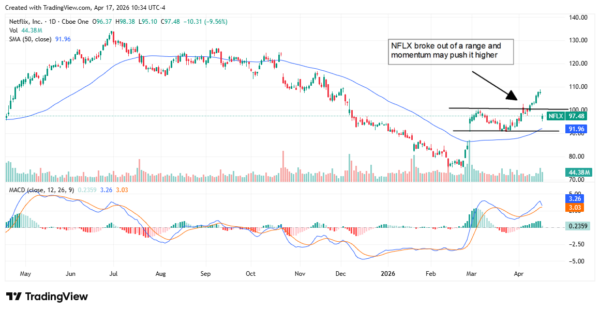
Heading into earnings, Netflix traded around $97–$100, holding just above its 50-day moving average with no aggressive positioning. The initial reaction was strong, the NFLX price broke above $100 and pushed toward $106 on expanding volume, signaling institutional participation.
But it didn’t hold as it gapped down nearly 9% back to $97, rejecting higher prices immediately after the breakout. RSI sits around 47.9, confirming a reset in momentum rather than a breakdown.
The move higher reflects confidence in the earnings, while the sharp gap down reflects hesitation about what comes next.
Meaning, we are no longer dealing with a company that the market prices purely on growth acceleration. But one that is being evaluated on how well it can sustain what it has already built.
Hastings Leaving Is Not a Footnote
Reed Hastings built Netflix from DVD mailers into the dominant global streaming platform, effectively rewriting how content is distributed and consumed at scale. That kind of leadership is built for one phase of a business – the phase where you are creating something from nothing, pushing through resistance, and growing faster than the market expects. But this phase demands discipline, capital control, and consistency to maintain the company’s legacy.
A Business That Knows What It Is Now
A company generating $12.25 billion in quarterly revenue at a 31.5% operating margin with $2 billion in free cash flow is not experimenting. It has a model, it understands the model, and it is executing against it with growing precision. Debt remains manageable relative to cash generation, and the continued free cash flow build strengthens its ability to fund strategy internally without returning to external capital markets. Consequently, it is no longer about whether Netflix can grow, but how deliberately it chooses to.
Perfect Entry Point For Buyers
Netflix has not abandoned growth. It has redefined it, and the numbers make that case cleanly. Revenue up 16%, margins at 31.5%, free cash flow above $2 billion, monetization runway still expanding. The $87.5 billion pass was discipline, not retreat. Of course, the leadership transition is a real variable worth watching. But a business with this margin profile and cash generation doesn’t stay mispriced for long. This presents good entry points, and I’d be a buyer here.
Leave a Reply