
Healthcare juggernaut Abbott Laboratories (NYSE: ABT), which specializes in medical devices, has not enjoyed an auspicious start to the new year. Since the beginning of January, ABT stock has fallen nearly 20%, an ignominious decline given its blue-chip status. It’s also problematic from a timing perspective, given how the company is about to release its fiscal first-quarter earnings this Thursday.
Table of Contents
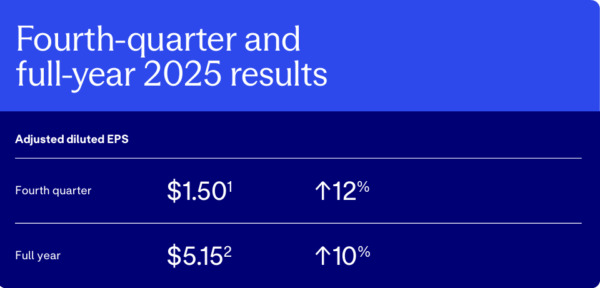
Analysts will be looking for earnings per share to hit $1.14 on revenue of $11.01 billion. While these metrics should be within realistic reach, Abbott hasn’t enjoyed a strong string of performances recently. In the prior Q3 and Q4 reports, the healthcare specialist merely met EPS targets, while missing on the top line.
To be fair, it did beat on both profit and growth in Q2. Unfortunately, the impact has been limited, with ABT stock losing over 21% in the past 52 weeks. As such, options traders aren’t taking any chances. When you consider the positioning of trades in the derivatives market, the volatility skew for the upcoming April 17 expiration date shows clear downside risk protection.
Again, no one should be surprised. Perusing the technical chart, the five-year look reveals a security that has plundered 19% of value. Obviously, that money could have been put to better use, imposing an air of regret on ABT stock.
Still, for the aggressive contrarian, a deeper investigation may be warranted.
Volatility Skew is Relatively Promising for ABT Stock
Let me get something straight from the get-go: the smart money is not necessarily prescient. Yes, the “smart” label implies a level of sophistication — and that assumption is generally warranted. However, there’s no indicator that absolutely reveals what top options traders are thinking. And even if such an indicator existed, following it wouldn’t automatically lead to profits.
Nevertheless, options screeners like volatility skew provide important clues regarding sentiment. Further, I believe the skew is a more reliable mechanism for assessing sentiment — rather than, say, social media posts — because we’re dealing with professionals and institutional players.
Simply put, these are the folks who have serious money. They can move the market if they want to. However, many of these elite traders choose to position themselves first in the options market to avoid triggering huge waves in the open arena. And that’s ultimately the signal provided by the volatility skew — we can see how much risk protection the smart money is willing to pay to have confidence in the trade.
In the case of ABT stock, the skew for the April 17 expiration date shows relative calm near the current spot price. While it is true that there is urgency in the left side of the axis (thus indicating that the market is aggressively adjusting implied volatility per unit of distance from spot), the fact that such protection exists shouldn’t catch anyone by surprise. After all, we’re talking about a severely underperforming blue-chip stock.
What is surprising, though, is the right side of the skew. Despite the prior carnage in Abbott stock and the lingering doubts, the smart money is clearly pricing for upside convexity. Stated differently, while they may fear further downside, these sophisticated traders recognize the potential for a near-term bounce back. Subsequently, they don’t want to be caught with at least some exposure to the bullish side of the trade.
What’s more, the convexity is significantly elevated, even though the magnitude of urgency isn’t as strong as for downside mitigation. Suffering extensive red ink, the return of bullish sentiment will be a welcome sight for intrepid contrarians.
Leveraging Inductive Analysis to Trade Abbott Stock
When making any forecast about the future, induction is unavoidable. This term refers to a method of analysis that begins with specific observations to formulate a general rule or theory. Induction relies on the uniformity of nature or the assumption that the future will behave like the past.
A simpler way to define the process is pattern recognition. By recording various events and tracking their evolution, we can postulate forward probabilities when those same events materialize in the present space. Although this is arguably the best mechanism for forecasting stock price movements, the methodology comes with a serious caveat.
Basically, if you see a thousand white swans, it does not necessarily mean that all swans are white. Should the next swan be black, the presumed absoluteness of the inductive model would collapse immediately.
As a result, market analysts never talk in absolutes. Because no one indicator or signal logically compels a security to act in a certain way, analysts use the language of probabilities, not certainties.
While these caveats may sound problematic, induction is powerful because it conditions market behaviors on specific (discretized) events. In other words, we’re not looking at a smorgasbord of price action and forecasting next trades on vibes. Rather, we’re making specific observations and assigning probabilities of what may happen in the future based on these established markers.
Diving into the Details
Using data extending back to January 2019, we can observe that an average 10-week-long position generally features a tight distribution. Using the current ABT stock price as an anchor, a 10-week hold would be expected to range between $100 and $103.50.
However, we’re conditioning Abbott stock under the current framework. In the past 10 weeks, ABT printed only three up weeks, leading to an overall downward slope. This 3-7-D sequence features a unique forward distribution relative to the aggregate condition of all sequences. Again, using the current spot as an anchor, we would expect ABT to land between $95 and $115 over the next 10 weeks.
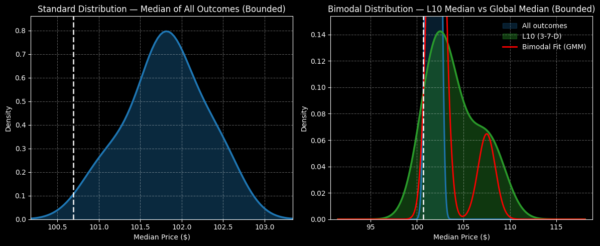
Since this range stems from an inductive inference, I cannot say that ABT is logically compelled to land in this distribution. However, if you want to get extremely aggressive, you may consider the 105/110 bull call spread expiring June 18.
Should ABT stock rise through the $110 strike at expiration, the maximum (capped) payout would clock in at nearly 186%. That would turn a $175 net debit into a $325 profit. Further, the second-leg strike is within the observed forward distribution of ABT under 3-7-D conditions.
If you want to dip your toes into true contrarianism, Abbott should be on your radar.
Leave a Reply