
The war in the Middle East shows no signs of cooling as Iran drops missiles on Israel. Energy ETFs are surging as oil prices climb, making now a critical moment for investors to consider their exposure to the sector.
Table of Contents
And while President Trump is determined to reach a deal, officials in Israel say that it’s unlikely that Iran would agree to U.S. demands.
Sure, the idea of positive talks between Iran and the U.S. sent markets screaming higher yesterday. However, “No negotiations have been held with the US,” Mohammad Bagher Qalibaf, the speaker of Iran’s parliament, said, as quoted by the Associated Press. “And fakenews is used to manipulate the financial and oil markets and escape the quagmire in which the US and Israel are trapped.”
That’s creating even more uncertainty, with investors unsure of what’s really happening. As we all know, markets hate uncertainty, which is why markets are red again. Adding to that uncertainty, analysts at Citigroup (NYSE: C) believe oil could eventually test $200.
“We posit that the ongoing loss of energy supply to [the] global economy is so large (larger than the shocks of the 1970s as a share of oil supply) that it simply must be solved, either militarily or diplomatically, and that through various potential channels this occurs by mid-late April,” said the firm, as quoted by MarketWatch.com.
The firm expects things to only get worse, with Brent possibly running to at least $120 over the next month. If we see prolonged energy production through June, $200 oil could become a reality. “They come up with that number based on the typical relationship between inventory and price, given the world is now without 13.5 million barrels per day, taking out some 400 million barrels per month, due to Strait of Hormuz disruptions,” added MarketWatch.com.
That would aggressively force oil stocks and ETFs higher until demand destruction sets in.
So, what’s the best way to trade the news?
Investors can always jump into Exxon Mobil (NYSE: XOM), Chevron (NYSE: CVX), and Occidental Petroleum (NYSE: OXY). However, if you want to diversify at a lower cost, ETFs offer good value. In fact, here are three energy ETFs pushing higher with oil that we’ve been pounding the table over for months.
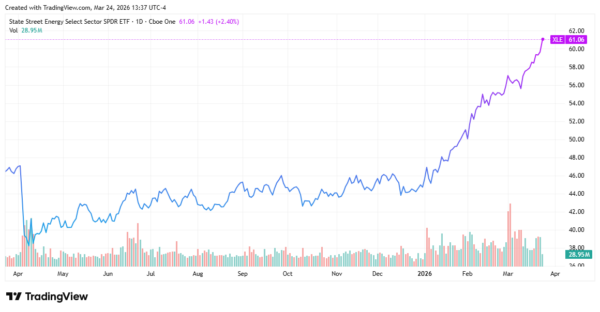
SPDR Energy Select Sector ETF (XLE)
With an expense ratio of 0.09%, the Energy Select Sector SPDR Fund (NYSEARCA: XLE) provides exposure to companies in the oil, gas and consumable fuel, energy equipment and services industries, as noted by State Street SPDR. Since February 20, the XLE ETF has run from about $54.50 to a high of $59.80.
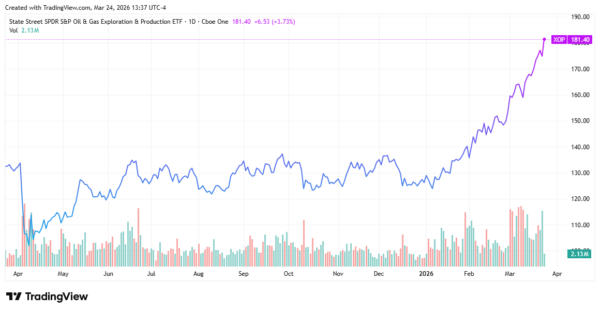
SPDR S&P Oil & Gas Exploration & Production ETF (XOP)
With an expense ratio of 0.35%, the SPDR S&P Oil & Gas Exploration & Production ETF (NYSEARCA: XOP) provides exposure to 51 stocks in the oil and gas exploration and production segment of the S&P TMI, which comprises the following sub-industries: Integrated Oil & Gas, Oil & Gas Exploration & Production, and Oil & Gas Refining & Marketing, as noted by State Street SPDR. Since February 20, the XOP ETF has run from about $150 to $175.
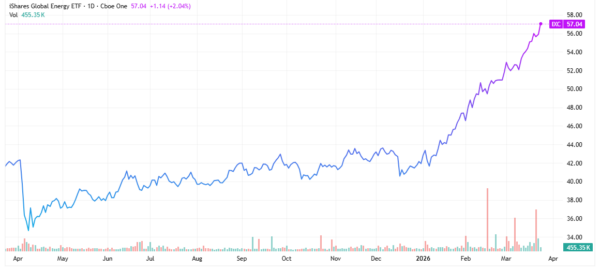
iShares Global Energy ETF (IXC)
With an expense ratio of 0.40%, the iShares Global Energy ETF (NYSEARCA: IXC) seeks to track the investment results of an index composed of global equities in the energy sector. Some of its 50 holdings include Exxon Mobil, Chevron Corporation, BP PLC (NYSE: BP), Total SA, and EOG Resources (NYSE: EOG). Since February 20, the IXC ETF has run from about $50.60 to $55.90 so far.
Best Energy ETFs to Watch as Oil Prices Rise
With geopolitical tensions showing no sign of easing and oil prices under continued pressure from Strait of Hormuz disruptions, energy ETFs remain one of the most compelling opportunities in the market. XLE, XOP, and IXC have all demonstrated strong momentum since late February, and analysts warn that further price spikes could push these funds even higher.
For investors seeking diversified exposure to rising oil prices without picking individual stocks, energy ETFs offer a cost-effective, flexible solution worth watching closely.
Leave a Reply