
Costco (NASDAQ: COST) stock slid in pre-market trading even as the warehouse retailer delivered a solid fiscal second quarter, raising a question that more investors are quietly asking: Is the dividend enough to justify paying nearly $1,000 per share for a stock with limited upside from current levels?
Table of Contents
Costco reported second-quarter fiscal 2026 results after the market closed on March 5, delivering net sales of $68.2 billion, good for 9.1% year-over-year growth. Comparable sales rose 7.4%, while adjusted comparable sales — stripped of gasoline price swings and foreign exchange impacts — climbed 6.7%. Traffic was up 3.1% and average ticket size increased 4.2%, signaling that existing members are both showing up more frequently and spending more when they do.
Net income grew 13.8% to $2.04 billion, and diluted earnings per share of $4.58 represented nearly 14% growth year over year. Membership income surged 13.6%, with paid memberships reaching 82.1 million, up 4.8%. The worldwide renewal rate held at 89.7%, and the U.S. and Canadian renewal rate was a remarkable 92.1%.
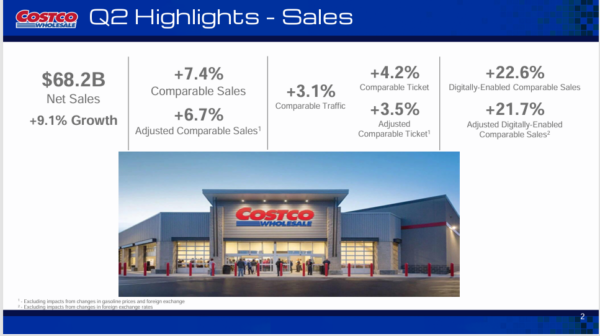
By virtually every traditional retail metric, this was a very good quarter. Yet COST stock slid roughly 2.4% in pre-market trading to around $979, but has since recovered above the psychologically significant $1,000 level as buyers stepped in on the open. That suggests the initial selloff wasn’t about the business, but about the price tag on the stock itself.
Solid Fundamentals, But Already Priced for Perfection
Costco’s business model continues to prove why it’s one of the most admired retailers on the planet. The gross margin expanded 17 basis points year over year to 11.02%, while SG&A improved 13 basis points to 9.19% of net sales. That’s a double positive that most retailers can only dream about. Digital momentum was equally impressive, with digitally-enabled comparable sales jumping 22.6% and app visits surging 63%.
E-commerce site traffic grew 32% and average order value rose 15%, suggesting Costco’s tech investments are beginning to pay tangible dividends. International performance was particularly noteworthy: Canada posted comparable sales growth of 10.1% and Other International came in at 13.0%, both outpacing the U.S. segment’s 5.9% gain. The company also continued its warehouse expansion, opening 10 new locations in the first half of fiscal 2026, with 18 more expected before year-end, bringing the total to approximately 942 warehouses globally.
The Dividend: Reliable, But Modest
Costco has increased its dividend for 21 consecutive years, growing the payout at roughly 12-13% annually over the past five years. The current quarterly dividend of $1.30 per share works out to $5.20 annually — a yield of just around 0.52% at current prices. The payout ratio is a conservative 27%, meaning the dividend is in no danger and future growth is virtually guaranteed.
Costco also has a history of issuing special dividends, having paid out large one-time cash distributions in prior years. For long-term income investors, the dividend consistency and growth rate are admirable. But a 0.52% yield is hardly what drives people to pay a premium for this stock. At current prices, Costco’s dividend alone won’t move the needle for most investors. That puts the entire return thesis squarely on capital appreciation. And that’s where the math starts to get complicated.
Headwinds: What If the Economy Softens?
Costco’s business has historically held up better than most retailers in downturns, because value-seeking consumers tend to gravitate toward the warehouse model when budgets tighten. That resilience is real. However, it is not unlimited. The company’s own safe harbor disclosure flags several risks worth watching: softening consumer and small business spending patterns, geopolitical conditions including tariffs, rising employee costs, and foreign exchange pressures.
Gas price deflation is already shaving roughly a percentage point off headline comparable sales, as evidenced by the 70-basis-point gap between reported and adjusted comps. New warehouse openings, while a long-term positive, can also create short-term cannibalization effects on existing locations. Meanwhile, with a trailing P/E ratio hovering around 54 times earnings, Costco has almost no margin for error. Any material miss on traffic trends or membership renewal rates could send the stock sharply lower from what are already stretched valuation levels.
COST Stock: Extended, But a Golden Cross Offers Hope
The daily chart tells an interesting story. COST peaked near $1,075 in early spring 2025, then spent the better part of the summer and fall retreating to lows around $850 before staging a strong recovery into early 2026. Notably, a bullish golden cross — where the 50-day moving average crosses above the 200-day — appeared in COST’s chart for the first time in nearly three years on the day of the earnings release, which is a historically positive long-term signal.
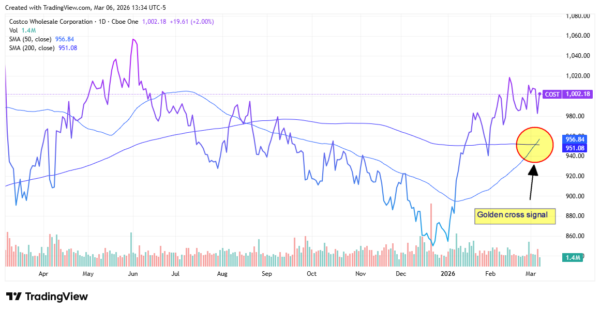
The pre-market dip to $979 briefly undercut the 50-day weighted moving average sitting near that same level, but Friday’s intraday recovery back above $1,000 suggests buyers treated the pullback as an opportunity rather than a warning. The MACD remains in a mild bearish cross from recent elevated levels, meaning short-term momentum has softened.
The $1,000 level is now the key line in the sand — holding above it keeps the bullish structure intact, while a sustained break below could reopen a test of the $940-$950 area. To the upside, clearing $1,025 would set up a push toward the $1,067 52-week high and ultimately the $1,100 analyst price target.
Bottom Line: A Great Company at a High Price
There is nothing wrong with Costco’s business. The membership model is sticky, the brand is beloved, the balance sheet is strong, and management executes consistently. The question is not whether Costco is a great company — it clearly is. The question is whether it’s a great stock at nearly $1,000 per share.
With an average analyst price target around $1,050-$1,085 and a top target of roughly $1,100-$1,200, the implied upside from current levels is relatively modest for a stock carrying a premium multiple. Investors who already own Costco and are reinvesting that growing dividend for the long haul are likely fine. But for new money seeking meaningful appreciation, the risk-reward picture at current valuations warrants careful scrutiny.
Leave a Reply