
AT&T (NYSE: T) delivered higher revenue, stronger adjusted earnings, and an improved profit outlook in its third-quarter report. But investors still sent shares lower.
Table of Contents
That might seem like a strange reaction. After all, a beat and higher guidance usually give shareholders something to celebrate. The problem is that investors are looking beyond the latest profit numbers.
Wireless customer growth, network spending, and the threat of tougher competition are also shaping expectations. For AT&T, a good quarter wasn’t enough to put those concerns to rest.
AT&T Beats Q3 Earnings and Revenue Estimates
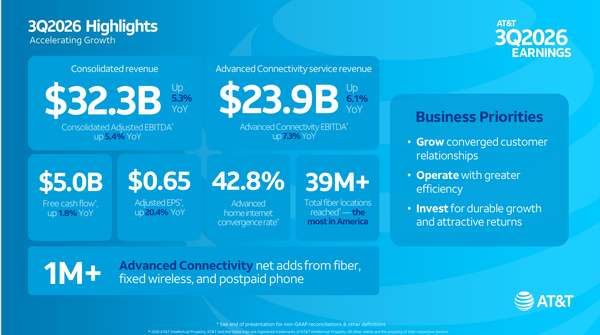
AT&T posted third-quarter revenue of $32.3 billion, up 5.3% from a year earlier and ahead of the $31.7 billion analysts expected. Adjusted earnings reached 65 cents per share, compared with 54 cents a year earlier and expectations of 60 cents. That represents growth of roughly 20%, a solid improvement for an established telecommunications company.
Adjusted EBITDA jumped 5.4% to $12.5 billion. Free cash flow came in at $5 billion. AT&T also raised its full-year adjusted earnings outlook to around $2.40 per share. Previously, management expected between $2.25 and $2.35.
Those results suggest the business is making progress. The question is whether that progress will be enough to support stronger returns for shareholders.
Wireless Subscriber Growth Falls Short of Expectations
One sticking point was AT&T’s addition of 379,000 postpaid phone subscribers, as compared to the 387,410 expected. Against that estimate, AT&T fell short by about 8,400 customers. Unfortunately, the result offered little evidence of a major upside surprise in wireless growth.
Fiber Growth and Higher Guidance Offer Reasons for Optimism
AT&T’s internet business provided a stronger growth story. The company added a quarterly record of 769,000 consumer and business internet connections. That included 442,000 fiber additions and 327,000 fixed-wireless additions.
Fiber delivers broadband through fiber-optic cables. Fixed wireless provides internet service using a wireless network rather than a wired connection running into the property. Together, those services give AT&T multiple ways to reach customers.
In addition, as noted in a company press release, “AT&T is increasing its outlook for 2026 adjusted EPS* and lowering its long-term outlook for capital investment. AT&T maintains its long-term outlook for improved growth in adjusted EBITDA* and adjusted EPS* and higher free cash flow* through 2028, its plans to return $45 billion+ to shareholders during 2026-2028 through dividends and share repurchases, and an expectation that its net debt-to-adjusted EBITDA ratio* will return to a level consistent with its target in the 2.5x range during 2029.”
And, according to the company, it expects:
- Adjusted EPS in the $2.40 range in 2026 with a double-digit 3-year CAGR through 2028
- Capital investment in the $23 billion to $24 billion range in 2026 and in the $22 billion to $23 billion range annually in 2027 and 2028
- Free cash flow of $18 billion+ in 2026, $19 billion+ in 2027, and $21 billion+ in 2028
- Strong capital returns, including plans to maintain its current annualized common stock dividend of $1.11 per share and $24 billion+ of share repurchases, including approximately $10 billion during 2026.
AT&T Stock Breaks Below Key Support
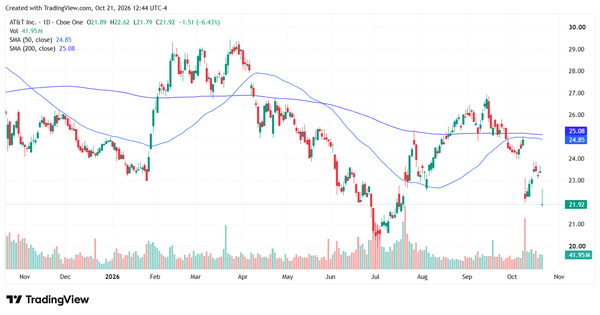
AT&T stock suffered a sharp technical setback on October 21, falling 6.43% to $21.92 on volume of approximately 41.95 million shares. That decline pushed the stock well below its 50-day simple moving average at $24.85 and its 200-day moving average at $25.08.
Both averages are now overhead resistance, and their proximity creates a significant hurdle for any recovery. The sell-off also erased much of the stock’s rebound from its July lows, suggesting investors are reassessing the outlook despite the earnings beat.
Key T Stock Levels to Watch
- Immediate support: Around $21.80–$22.00, near the latest session’s low and closing price. A sustained break below this area could expose the stock to further downside toward $21.
- Near-term resistance: Around $23.00–$23.50, where recent trading offers a potential first hurdle for a rebound.
- Major resistance: $24.85–$25.08, the 50-day and 200-day moving averages. AT&T would need to reclaim this zone to improve its technical outlook meaningfully.
The heavy trading volume makes this decline particularly noteworthy. Although a rebound is possible after such a sharp drop, the stock has yet to establish a new support base. Until shares stabilize and reclaim important technical levels, the chart favors caution over a confirmed recovery.
What AT&T Investors Should Watch Next
AT&T’s quarter gave investors reasons to be encouraged, even if the stock’s reaction suggested otherwise. Higher earnings and strong internet customer growth support management’s outlook. But investors still want to see stronger wireless growth and evidence that network spending will deliver lasting results.
The next few quarters will help show whether AT&T can turn its plans into steady cash flow growth while funding dividends, buying back shares, and managing debt. If it delivers, that could help rebuild confidence in the stock. For now, the message from investors seems clear: a good earnings report is welcome, but consistent progress matters more.
Leave a Reply