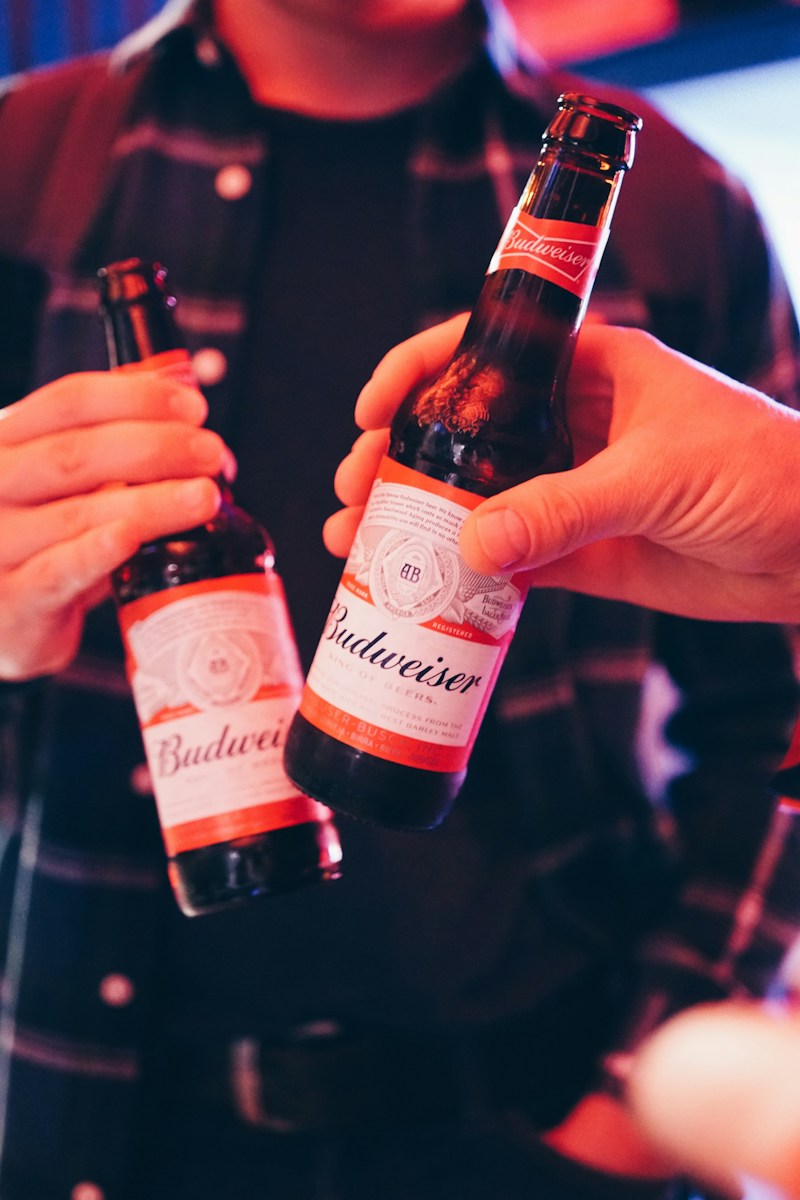
Consumer discretionary stocks are getting bludgeoned by inflation fears and a fresh interest rate hike. Under that backdrop, it’s worth noting that Deutsche Bank recently upgraded Anheuser-Busch (NYSE: BUD) from a Hold to a Buy and assigned a $91 price target.
Table of Contents
For perspective, the $91 price target is in line with the consensus price target nearly to the penny ($91.08), That would give investors an upside of around 15% to go along with a dividend that yields 1.79% as of the market close on Sept. 17.
However, BUD stock is up more than 22% in 2026. So, having a leading analyst forecast further growth for Anheuser-Busch may get investors off the sidelines.
Before you decide whether to invest in the company with the iconic brand known as The King of Beers, it’s important to understand both sides of the alcoholic beverage market. The threats are real, but so are the opportunities.
America is Becoming a Drier Country
A data point that was hard to ignore in the last several rounds of corporate earnings was bearish for alcohol stocks. American consumers are drinking less. Not just a little less…a lot.
The numbers back that up. In Anheuser-Busch’s own Q2 2026 earnings report, released July 30, U.S. volumes fell 0.7% even as the industry’s top brands, Michelob Ultra and Busch Light among them, continued to gain share. The company only grew U.S. revenue at all (up 2.6%) because it pushed pricing and mix harder, not because more people were buying beer.
That’s particularly true of the coveted Gen-Z demographic. They’re on the wellness train and opting for social activities that don’t revolve around alcohol.
Two or three quarters may still be an anomaly, but it doesn’t feel like it. There’s something going on, and it’s not likely to change soon.
America Isn’t Where Anheuser-Busch Makes Its Money
Here’s the piece of the puzzle Deutsche Bank analyst Mitch Collett is leaning on. Anheuser-Busch barely looks like an American beer stock once you check where the growth is actually coming from.
According to the company’s own 2Q26 segment breakdown, Middle Americas (Mexico, Colombia, and the rest of the region) accounted for 41% of EBITDA and grew organic EBITDA 10.3%. South America added another 18% of EBITDA, up 14.3%. Combined, those two emerging-market zones represent nearly 60% of the company’s profit base, and both are compounding at double-digit rates.
Contrast that with North America, which contributed 20% of EBITDA but grew organic EBITDA by just 0.5%, and Asia Pacific, where EBITDA fell 10.9% on a 4.7% volume decline in China. The pattern is consistent: developed markets are flat to shrinking, and developing markets are carrying the company.
That split matters because the “Americans are drinking less” narrative, however real, is a developed-market story. A 2025 Gallup poll found that just 54% of U.S. adults drink alcohol at all, the lowest reading in 90 years. Collett’s argument is that Anheuser-Busch’s dominant share across its core emerging markets acts as a kind of structural insulation. Mexico alone posted 9.8% revenue growth and 50.3% EBITDA margins in the quarter, the kind of numbers no developed beer market comes close to matching right now.
Collett called Anheuser-Busch one of the most emerging-markets-focused names in European staples. That’s a notable distinction in a sector where most large beverage names still draw the bulk of their profit from slowing developed economies.
On the domestic side, Collett points to Beyond Beer, Anheuser-Busch’s lineup of cocktails and sparkling beverages, as a second growth lever. It’s not a small bet anymore: Beyond Beer revenue grew 44% company-wide in the quarter, led in the U.S. by Cutwater, which the company says was the #1 share-gaining brand in the entire spirits industry.
No-alcohol beer, led by Michelob Ultra Zero, grew revenue more than 100% and continues to outpace the broader no-alcohol category. Those are the two categories built for a consumer who wants something in hand at a social occasion, just not necessarily a Bud Light.
Wall Street, broadly, agrees with the upgrade. Of the 12 analysts covering the stock, 11 rate it Buy or Strong Buy, with just one Hold remaining. That’s about as close to consensus as a sell-side call gets.
BUD Stands Out Among Its Peers
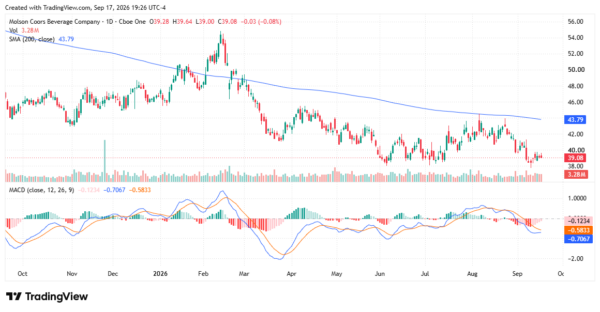
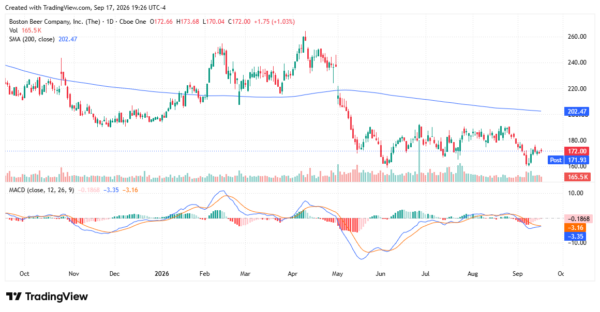
Another way to understand the Deutsche Bank rating is to look at the performance of BUD relative to peers such as Molson Coors (NYSE: TAP) and The Boston Beer Co. (NYSE: SAM).
BUD stock is up 22.9% year-to-date as of the market close on Sept. 17. By contrast, TAP stock is down 16.4%, and SAM stock is down 11.3%. Both stocks are down over the last 12 months, in contrast to BUD, which is up 33.9% over the same period.
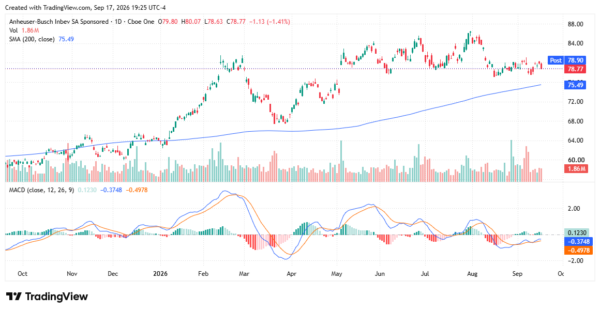
In this case, there may be a story behind that move. Investors may remember that Anheuser-Busch was identified as part of a boycott after it aired a social media promotion featuring transgender influencer Dylan Mulvaney. BUD stock fell sharply, which at the time was seen as overdone.
The point is, some of this gain may be a catch-up trade. But it’s unlikely to believe that it explains all of it.
The Balance Sheet Backs Up the Growth Story
One more thing worth noting: this isn’t growth funded by leverage. Anheuser-Busch’s net leverage ratio fell to 2.86x as of June 2026, down from 3.27x a year earlier and more than a full turn better than four years ago.
Free cash flow jumped $2.5 billion year-over-year to $3.9 billion for the first half of 2026, and underlying earnings per share grew 23.4% in the quarter. A brewer with improving cash generation and a shrinking debt load has more room to keep investing in Beyond Beer and emerging-market share gains, even if U.S. volumes stay soft.
Why This Upgrade Should Matter to Your Portfolio
None of this erases the real headwinds facing the alcohol sector. Gen Z’s retreat from drinking is a genuine structural shift, not a temporary blip, and it will keep showing up in developed-market volume numbers for years, as Anheuser-Busch’s own U.S. results just confirmed.
But Deutsche Bank’s upgrade is a reminder that a stock’s exposure to a bearish narrative isn’t the same as its exposure to the underlying numbers. With nearly 60% of profit coming from emerging markets growing double digits, and a balance sheet in its best shape in years, the gap between perception and fundamentals may be the whole investment case for BUD.
Leave a Reply