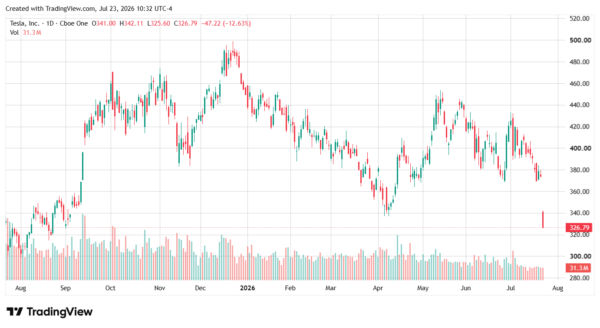
Tesla (NASDAQ: TSLA) is falling apart after posting second-quarter earnings that showed strong sales growth but weaker profits. Granted, the company is selling more vehicles and bringing in more revenue than ever before, but heavy spending on artificial intelligence, new factories, and future products is weighing on earnings today.
Table of Contents
Tesla reported second-quarter revenue of $28.2 billion, up 26% from a year ago and above Wall Street expectations. The company also reached a major milestone, generating more than $100 billion in trailing 12-month revenue for the first time in its history.
Vehicle deliveries remained strong.
Tesla delivered 480,126 vehicles during the quarter while producing 451,758. Nearly all of those deliveries came from the Model 3 and Model Y, which accounted for more than 467,000 vehicles. Strong demand helped drive higher sales, but it wasn’t enough to offset growing costs.
TSLA earned $0.33 per share on an adjusted basis, well below analysts’ expectations of $0.51. The company earned $0.40 per share during the same quarter last year. GAAP net income came in at $1.1 billion, while adjusted net income totaled $1.2 billion.
The biggest disappointment was profitability. TSLA’s operating margin fell to 1.4%, down from 4.1% a year ago. Gross margin also slipped to 16.8%, missing analysts’ expectations. The lower margins reflect Tesla’s strategy of cutting vehicle prices to boost sales while continuing to spend heavily on future technologies.
Heavy Spending Hits Cash Flow
TSLA also reported its first negative free cash flow in more than a year.
Free cash flow came in at roughly negative $1.1 billion, largely because capital spending jumped to $5.8 billion during the quarter. The company is investing heavily in artificial intelligence, battery production, semiconductor manufacturing, robotics, and energy infrastructure. The company did end June with $43.5 billion in cash, giving it plenty of funds for future growth.
Big Plans for 2026
Management made it clear that the spending isn’t slowing down.
TSLA said it remains focused on lowering costs while expanding its product lineup and building new AI-powered services. Several major projects are still on schedule.
The company expects production of the Tesla Semi and Megapack 3 to begin in 2026. Tesla also said it is installing its first production lines for Optimus, its humanoid robot, with manufacturing expected to start next year.
At the same time, Tesla continues investing in AI computing, batteries, semiconductors, and solar products. Those projects are expensive today, but management believes they will create new revenue opportunities over the long term.
Robotaxis Remain the Big Story
While the earnings numbers drew most of the headlines, many investors were looking ahead to TSLA’s conference call for updates on autonomous driving. That’s because robotaxis and artificial intelligence have become a major part of the investment story.
RBC Capital Markets analyst Tom Narayan said TSLA continues to make steady progress. According to Narayan, robotaxis are expanding as planned. Tesla is operating with safety drivers in the San Francisco Bay Area and has either launched or is preparing unsupervised service in Austin, Dallas, Houston, Miami, Orlando, Tampa, Phoenix, and Las Vegas.
Software Business Continues Growing
Another bright spot was Full Self-Driving subscriptions. TSLA reported 1.48 million FSD subscriptions, up 56% from a year ago and 16% from the previous quarter. The company is also expanding the software outside the United States after receiving approvals in several European countries, including Belgium, Denmark, Estonia, Lithuania, and the Netherlands.
Growing software revenue is important because investors believe it could eventually become much more profitable than selling vehicles.
What’s Next For Tesla
TSLA’s latest earnings report offered something for both bulls and bears.
On one hand, revenue continues to grow at an impressive pace, deliveries remain strong, and the company has billions of dollars to invest in future technologies. Progress in robotaxis, Full Self-Driving, and Optimus also supports Tesla’s long-term growth story.
On the other hand, profits are shrinking, margins continue to fall, and heavy investment spending is putting pressure on cash flow.
For investors, the biggest question hasn’t changed. TSLA is betting that today’s spending on AI, robotics, autonomous driving, and manufacturing will create much larger businesses in the future. Whether those investments deliver enough growth to justify the stock’s premium valuation remains the key issue in the future.
Leave a Reply