
When people think about the California Gold Rush, they usually picture miners racing into rivers with nothing more than a pan and a dream. History tells a different story. Many of the largest fortunes ultimately belonged to the businesses supplying the picks, shovels, railroads, banks, and equipment that made the rush possible. Every technological revolution reaches a point where success begins spreading far beyond its original winner. I think the AI semiconductor boom is arriving at that moment now.
Table of Contents
For the past two years, NVIDIA Corp. (NASDAQ: NVDA) has become almost synonymous with artificial intelligence after reporting fiscal first-quarter 2027 revenue of $81.6 billion, data center revenue of $75.2 billion, and a GAAP gross margin of 74.9%. Those numbers comfortably surpassed Wall Street’s expectations, but they also point to a much bigger question.
If AI continues expanding at today’s pace, can one company realistically capture all of the value being created, or has the semiconductor industry quietly entered an entirely new phase?
The AI Semiconductor Boom Is Expanding Beyond Nvidia
History rarely allows one company to dominate an entire technological revolution forever.
Henry Ford transformed automobile manufacturing, but the industry’s long-term wealth eventually spread across tire manufacturers, oil producers, insurance companies, steelmakers, highway construction firms, and dealerships. The internet initially rewarded networking companies before cloud computing, cybersecurity, and enterprise software emerged as equally important investment themes.
Artificial intelligence is now following that same script. Nvidia still occupies the center of AI computing. Its GPUs remain the preferred choice for training many of the world’s largest language models, and demand continues exceeding supply in several product categories. But the infrastructure required to support AI has become far larger than graphics processors alone.
Broadcom Inc. (NASDAQ: AVGO) illustrates that shift perfectly in the fiscal second quarter report. “Q2 semiconductor revenue from AI of $10.8 billion grew 143% year-over-year, above forecast, driven by increasing demand for custom AI accelerators and AI networking,” said Hock Tan, President and CEO of Broadcom Inc. “The momentum continues and in Q3 we expect semiconductor revenue from AI to grow over 200 percent year-over-year to $16.0 billion.” Those numbers tell me hyperscalers are increasingly investing in custom AI accelerators designed specifically for their own workloads.
Advanced Micro Devices Inc. (NASDAQ: AMD) is benefiting from the same diversification. The company’s data center segment produced $5.8 billion in first-quarter revenue, rising 57% from a year earlier as cloud providers expanded deployments of its Instinct accelerators alongside Nvidia’s hardware.
Notice what’s happening underneath these earnings? Wall Street is no longer debating whether AI spending exists. It’s debating where that spending flows after leaving Nvidia’s doorstep.
The Next AI Bottleneck Isn’t Computing
Once you look beyond processors, the investment story becomes even more interesting.
Every AI system depends on enormous quantities of high-bandwidth memory, advanced packaging, custom networking, interconnect technologies, and cutting-edge manufacturing capacity. Each of those layers is becoming a competitive bottleneck in its own right.
Micron Technology Inc. (NASDAQ: MU) may offer one of the clearest examples. The company recently disclosed more than $22 billion in multi-year customer agreements tied largely to AI memory demand, while CEO Sanjay Mehrotra said High Bandwidth Memory supply is expected to remain constrained through at least 2027. That’s a remarkable statement because it tells investors the shortage surrounding AI has already expanded beyond processors into memory infrastructure itself.
Taiwan Semiconductor Manufacturing Co. (NYSE: TSM) reinforces the same conclusion from a different angle. High Performance Computing accounted for 59% of the company’s wafer revenue during the latest quarter, making it TSMC’s largest end market by a considerable margin. Even more revealing, 3-nanometer and 5-nanometer technologies together represented 58% of wafer revenue, demonstrating that customers continue migrating aggressively toward the world’s most advanced manufacturing processes.
Put differently, AI isn’t creating one winner anymore. It’s creating an ecosystem where every constraint becomes an investment opportunity. That’s exactly how industrial revolutions mature.
Wall Street Is Broadening Its AI Bets
The price action across the semiconductor sector reinforces that broader thesis.
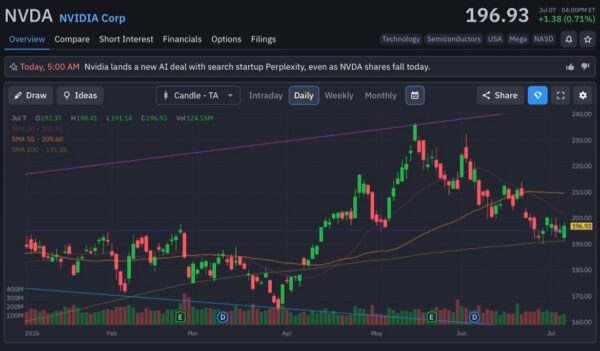
The charts reinforce the same conclusion emerging from the earnings. NVIDIA Corp. continues holding above its 200-day moving average near $191.26 despite remaining below its 20-day and 50-day averages, with 124.15 million shares traded as investors digest one of the strongest rallies in AI history rather than abandoning it.
Broadcom Inc. paints a different picture. Shares have consolidated sharply from the June highs, yet continue trading above the 200-day moving average near $361.64 as 24.11 million shares changed hands. That looks less like distribution and more like institutions cooling excessive optimism after an extraordinary run.
Leave a Reply