Turnaround investing always looks straightforward in hindsight. Buy the company everyone has given up on, wait for management to fix the obvious problems, then enjoy the rerating once confidence returns. Reality rarely follows that script because by the time the turnaround becomes visible, the market has usually moved on to a different question. Investors stop asking whether the company can survive and start asking whether the recovery is strong enough to justify paying a higher multiple.
Table of Contents
That’s where Boeing Co. (NYSE: BA) sits today. For the better part of two years, Boeing’s story revolved around production failures, regulatory scrutiny and whether the company could simply build airplanes consistently again. Those concerns haven’t disappeared, but they no longer dominate the investment debate. Production is improving, certification programs are advancing and deliveries are climbing. Ironically, that’s made the investment case more demanding because operational progress alone is no longer enough.
The Factory Floor Is Finally Moving Again
The first quarter gave investors something they hadn’t seen from Boeing in quite some time, that is, measurable operational momentum. Revenue increased 14% to $22.2 billion, driven by 143 commercial aircraft deliveries, while operating cash outflow narrowed from $1.6 billion a year ago to just $179 million. Even more encouraging, Boeing ended the quarter with a record $695 billion backlog, including more than 6,100 commercial aircraft, giving the company years of visible demand already sitting on its books.
That backlog represents far more than future revenue. It gives Boeing (NYSE: BA) something the company has desperately needed throughout this turnaround, which is visibility. Now, management no longer has to convince investors customers still want Boeing aircraft. A backlog of exactly 6,100 airplanes already waiting to be built answers that question. The challenge has shifted from generating demand to executing well enough that those orders eventually translate into stronger margins, healthier cash generation and a business that once again resembles the Boeing investors remember.
The production system also looks healthier than it did a year ago. The 737 program is producing 42 aircraft per month, the 787 has stabilized at eight per month, and certification work continues progressing on the 737-7, 737-10 and 777X. You can argue that those aren’t headline-grabbing announcements, but they’re exactly the kind of operational milestones investors wanted management to deliver before talking about a full recovery.
Wall Street Has Already Raised The Standard
That’s exactly why the investment debate has changed. Early on, investors rewarded signs that management has stopped making things worse. Later, those same investors become far less forgiving because improvement gradually stops being the story. Once confidence returns, markets begin measuring the company against healthier competitors rather than against its own troubled past.
Commercial Airplanes still posted a $563 million operating loss, operating margin remained negative 6.1%, and free cash flow stayed negative $1.45 billion despite stronger deliveries. Boeing (NYSE: BA) also carries $47.2 billion of debt, reminding investors that rebuilding the balance sheet will take considerably longer than restarting production.
None of that diminishes the progress management has made. It simply explains why the next stage of Boeing’s recovery will be harder than the last. Producing more aircraft solved the operational crisis everyone could see. Converting those deliveries into expanding margins, sustainable free cash flow and a consistently profitable commercial business is what ultimately determines whether this turnaround deserves another leg higher.
What Do Investors Want?
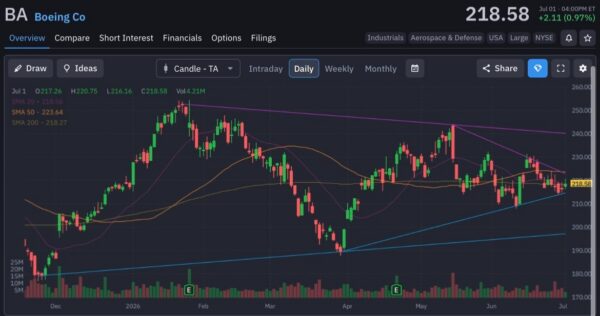
After rallying from roughly $180 late last year to nearly $250 in January, the stock has spent the past five months trapped beneath a descending trendline, with every attempt to break above the $230–240 area running into sellers. At the same time, buyers have consistently defended the rising long-term support around $210, while the 20-day, 50-day and 200-day moving averages have begun converging into a tight range. That’s rarely the price action of a market questioning whether a company can recover. It’s the behavior of investors waiting for the next catalyst before deciding whether the turnaround deserves another rerating.
Notice that the stock isn’t giving back the recovery either. Every retreat has found buyers before sentiment deteriorated, suggesting investors remain willing to accumulate shares while they wait for stronger evidence that operational improvements are beginning to flow through the income statement.
2 Ways To Approach This Stock
There’s one mistake I think many turnaround investors make. They continue celebrating the milestones that got the company back on its feet long after the market has started looking somewhere else. You have to understand that stocks don’t keep rerating because yesterday’s problems disappeared. In many cases, they rerate because tomorrow’s earnings become increasingly believable.
So if I were trading Boeing over the next few months, I’d pay closer attention to whether the stock can finally clear that overhead resistance and attract fresh momentum because that’s likely to determine the next move long before another annual report does.
As a longer-term investor, though, focus would be on commercial margins, free cash flow, debt reduction and whether every additional aircraft delivered starts producing proportionally stronger profits instead of simply higher revenue.
Again, repairing the factory floor brought the company this far. My attention stays here over the next several quarters. Not on another headline celebrating higher production, but on whether each additional aircraft delivered produces stronger margins, healthier cash generation and a balance sheet that gradually begins resembling the Boeing investors remember. That’s the stage of the turnaround the market is trying to price now.
Leave a Reply