As one of the flagship names of artificial intelligence, NVIDIA (NASDAQ: NVDA) really needs no introduction. And because it’s incredibly relevant to the broader innovation space, any downturn in NVDA stock is likely to be viewed as a contrarian opportunity. Given that the security has declined by more than 11% in the trailing month, the red ink poses an enticing question: is now a good time to buy?
Table of Contents
Invariably, the financial publication space will attempt to answer this question through fundamental analysis. However, I believe this methodology has significant constraints. Rather than attempting to extract the long-term investment value of NVDA stock, I prefer to focus on short-term exposure via the options market. To provide a quantitative roadmap, I’ll be using a process known as non-parametric conditional sequence simulation or path-dependent conditioning.
Why Not Discuss the Fundamentals for NVDA Stock?
Before getting into the good stuff, I’ll quickly explain why I’m not particularly keen on fundamental analysis — at least the way that it’s commonly practiced in the finpub space.
Primarily, the bullish case for NVIDIA stock centers on the multi-token inference economy and platform lock-in. While it’s true that skeptics have focused on the leveling off in initial large-language-model (LLM) training clusters, those with a glass-half-full perspective are pointing to NVIDIA’s transition toward the emerging agentic AI segment.
Notably, NVIDIA is leveraging its software moat to help enterprises deploy real-time autonomous agents. Moreover, the semiconductor giant is rigorously expanding its architecture to address memory bandwidth bottlenecks. Here, its deployment of ultra-high-speed inference platforms targets real-time, low-latency token throughput. Subsequently, this move ensures that even if training demand moderates, the sheer volume of computing required to run millions of active agentic systems globally sustains hardware demand.
There are many other positive catalysts for NVDA stock, such as hardware efficiency improvements and a massive revenue pipeline for its key products. Further, nation-states are building out domestic data centers to ensure data-localized independence, bolstering the company’s long-standing relevance.
I could go on and on but none of this information above provides any edge. That’s because — unless there’s evidence to suggest otherwise — all these catalysts have been fully reflected in the NVDA stock price.
And that’s honestly the core reason why I don’t want to waste too much time on NVIDIA’s fundamentals. NVDA stock is one of the most heavily traded securities in the world. I highly doubt that major banks, institutional investors and algorithmically enhanced hedge funds forgot to incorporate the good news into NVDA — but somehow Bob from Arkansas saw something that nobody else did.
What About Unusual Options Activity for NVIDIA Stock?
Some of the more advanced finpubs will often discuss unusual options activity as a basis for exposure to NVDA stock. The premise goes that because the smart money is buying up large blocks of NVIDIA call options, the open market will eventually follow suit with a positive rerating of shares.
That’s not how options work. For one thing, every transaction in the derivatives market has a counterparty; in other words, if someone is buying calls, there’s another person selling them. Options can’t be transacted in the ether. It’s misleading to label derivatives trading as a net bullish or net bearish because the options market is a zero-sum game.
What’s more, trading unusual options activity for NVDA stock could be a detrimental way to go about your business. By the time that big block of orders has hit the options screener, the underlying market maker has hedged the order to remain delta-neutral. This hedging creates a spike in implied volatility for the affected strike price.
Basically, if you buy the exact same option that is flashing as unusual, you are buying it at a heightened volatility premium. What finpubs don’t tell you — because it would obviously hurt their retention — is that you need to trade options before they become unusual.
Other than pure speculation, there’s no telling when an order will become unusual. So, we need to rethink the whole game.
Asking the Right Question
Everything begins by asking the right question. For those seeking a quick profit from Nvidia stock, the question is as follows: what is the expected performance of NVDA if I were to buy shares randomly (i.e. without timing the market)?
Using a dataset going back to January 2019, we can calculate that if you bought NVDA stock today (at $197.58) and held it for 10 weeks, your median forward distribution would land roughly between $190 and $230. Probability density will peak at around $215, implying an upward bias. As this is our random baseline, any trading signal that we’re interested in must consistently beat this performance; otherwise, there’s no incentive to trade.
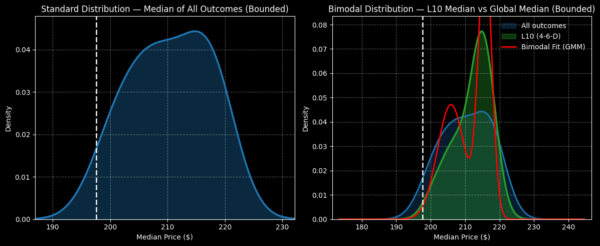
As mentioned earlier, NVDA stock is suffering from a bearish cycle. From a weekly candlestick perspective, in the last 10 weeks, NVDA printed only four up weeks, leading to an overall downward slope. Conditioned for this 4-6-D sequence, the expected forward distribution over the next 10 weeks comes out to between $190 and $230. Probability density also peaks at around $215, which doesn’t give much variance from the baseline.
From these stats, it’s easy to dismiss NVDA stock. However, on a week-by-week basis, the median pathway of NVDA following the 4-6-D signal tends to lift higher than the baseline pathway over the next five to six weeks. Therefore, if this inference rings true, a near-expiry options trade could be lucrative.
Identifying a Tempting Trade
For aggressive speculators, I’d take a look at the 205/210 bull call spread expiring Aug. 7. If the aforementioned signal’s observed median pathway holds true, the $210 strike would represent a realistic target at expiration. Should the trade pan out, the maximum payout would be over 156%.
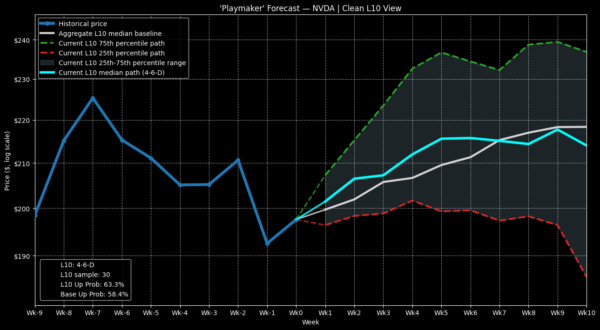
Of course, the caveat with pattern recognition is that there’s no necessary reason for the trend to materialize as expected. Stated differently, just because you see something happen a hundred times does not mean the 101st time will yield a similar result. That’s the black swan risk of inductive methodologies.
At the same time, without induction, we’re left with just guessing where NVDA stock will head next. I find that to be an intellectually unsatisfying process, which is why I’ll continue to focus on path-dependent conditioning.
Leave a Reply