
Adobe (NASDAQ: ADBE) just delivered another quarter of impressive growth, beating Wall Street expectations on both earnings and revenue due to surging demand for AI. The company also raised its full-year guidance, a move that would normally send shares higher.
Table of Contents
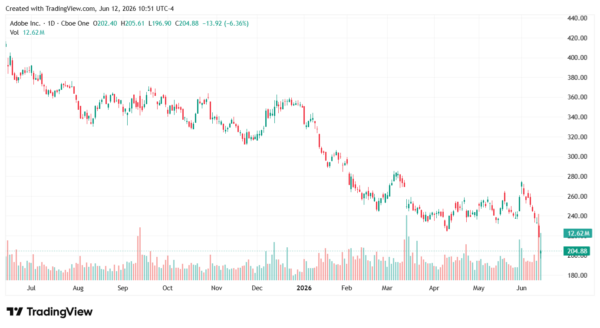
Unfortunately, investor enthusiasm quickly faded after the company announced that CFO Dan Durn would be leaving the company, triggering a wave of analyst downgrades.
- Stifel downgraded Adobe shares to Hold from Buy and significantly reduced its price target to $200. Analysts acknowledged the company’s strong financial performance but suggested that the stock could face challenges as investors digest the CFO transition.
- Wolfe Research also lowered its rating on Adobe to Peer Perform from Outperform, reflecting a more cautious stance despite the company’s solid operating results.
- Bernstein also lowered its price target on ADBE to $379 from $447, citing uncertainty over the departure of the CFO.
- Meanwhile, Evercore ISI downgraded the stock to Hold from Buy and lowered its price target to $225. The firm pointed to uncertainty surrounding the leadership change.
For the second quarter, Adobe reported adjusted earnings of $5.96 per share on revenue of $6.62 billion. Both figures exceeded analyst expectations. Wall Street had been looking for earnings of approximately $5.82 per share on revenue of $6.45 billion.
The market’s reaction highlights a growing trend among investors. In today’s environment, strong earnings are often not enough to satisfy Wall Street. Investors increasingly want clear visibility into future leadership, execution, and competitive positioning, particularly for companies operating in fast-moving AI markets. Adobe’s results demonstrated that demand remains healthy, but the CFO announcement created a new variable that analysts felt compelled to address.
AI Continues to Fuel Abode Growth
In fact, according to CEO Shantanu Narayen in the company’s earnings release, “Adobe delivered record revenue of $6.62 billion in Q2 reflecting strong AI-driven demand across our customer groups.”
Even better, thanks to AI demand, the company also raised its full-year outlook. It now expects full-year EPS of between $24.35 and $24.45 on revenue ranging from $26.5 billion to $26.6 billion. The updated guidance came in ahead of many analyst expectations and reinforced the view that AI-related demand continues to support the company’s growth trajectory.
Adobe has been aggressively integrating generative AI capabilities across its product portfolio, including Creative Cloud, Acrobat, and Experience Cloud. The company’s Firefly AI models continue to gain adoption among both enterprise and individual customers, allowing users to generate images, edit content, and streamline workflows. These innovations are helping Adobe defend its competitive position while creating new opportunities to monetize AI-powered features.
Under normal circumstances, such a combination of strong earnings, record revenue, and increased guidance would likely have pushed the stock higher. Instead, investors focused on a major executive change that introduced uncertainty into the investment story.
The good news is that weakness may have created a buy opportunity – especially as the company continues to benefit from an unstoppable AI boom. We also have to remember that Adobe is one of the dominant players in creative software, with millions of users relying on its products for professional design, marketing, video editing, and document management.
The Real Story Here
While Wall Street is currently focused on the departure of Adobe’s CFO, the company’s underlying business remains exceptionally strong. Record revenue, an earnings beat, and higher guidance suggest that demand for Adobe’s AI-powered products continues to accelerate. Leadership transitions can create short-term uncertainty, but they do not necessarily change the long-term investment thesis. For investors willing to look beyond the immediate headlines, the recent pullback may present an opportunity to gain exposure to one of the leading beneficiaries of the AI revolution at a more attractive valuation.
The key question for investors is whether the CFO change represents a fundamental shift in strategy or simply a temporary distraction. Based on the company’s latest results, there is little evidence that Adobe’s growth engine is slowing. If AI adoption continues at its current pace, the company appears well-positioned to deliver additional revenue and earnings growth over the coming quarters.
Leave a Reply