
Earnings growth driven by the artificial intelligence (AI) boom will send the S&P 500 above 8,000 mark in 2026, according to Citi. In fact, strategist Scott Chronert says he expects to see earnings of $350 per share for the S&P in 2026, with that number rising to $400 in 2027. “AI tailwinds are fueling an episodic fundamental surge across related sectors,” he said, as quoted by CNBC. “We have high confidence in continued earnings beats through year-end.”
Table of Contents
“We presume that fundamentals and related price action tell us we’re in middle innings. In turn, both trailing and forward PEs should be expected to moderate going forward, thus increasing the burden on earnings growth and related expectation to drive index price action.”
The AI Boom Shows No Signs of Slowing Down
With the global AI market already surpassing $230 billion in 2024, analysts now see a clear path to multi-trillion-dollar expansion—and the next five years may deliver the strongest gains yet.
Forecasts now place AI’s value between $1.7 and $3.5 trillion by the early 2030s, with the most aggressive estimates topping $7 trillion by 2035. And judging by the surge in corporate investment, the market is moving toward the high end of those projections.
Plus, we have to consider that artificial intelligence will continue to create massive demand for data centers, which will lead to further demand for NAND. After all, NAND is a vital part of the AI infrastructure for massive amounts of data storage, speed and performance. We also have to consider that demand for more data centers (which will need more NAND) are exploding.
The data tells the story
According to MIT Technology Review, there are about 3,000 data centers across the U.S. Plus, according to a report from McKinsey, $5.2 trillion in AI infrastructure investments will be needed by 2030. Again, growing demand for data centers will mean growing demand for more NAND memory in an already tight market.
In addition, “As the demand for data processing and storage continues to surge, data centers are experiencing unprecedented growth. McKinsey’s analysis ‘suggests that demand for AI-ready data center capacity will rise at an average rate of 33 percent a year between 2023 and 2030 (reflecting a trend that is already underway.),’” according to analysts at McKinsey, as reported by BOMA International.
The “AI Bubble” Argument Is Fading
Warnings of an “AI bubble” are increasingly being dismissed by top analysts.
Goldman Sachs says, “it believes the AI story is just getting started – and the investments that seem huge today will be dwarfed by the benefits AI will deliver,” as noted by Quartz.com.
Long term, the investment bank says that AI adoption could add $20 trillion to the U.S. economy. AI, according to Goldman Sachs, is already delivering those gains in productivity when deployed right.”
JPMorgan’s Mary Callahan Erdoes added, “AI is presenting opportunities not fully appreciated or understood yet,” as noted by CNBC. “AI itself is not a bubble. That’s a crazy concept… We are on the precipice of a major, major revolution in a way that companies operate.”
How Investors Can Tap Into the AI Boom
One way is to invest in heavyweights like Nvidia (NASDAQ: NVDA) and Advanced Micro Devices (NASDAQ: AMD).
Or, if you prefer to diversify, consider ETFs such as:
One of the Leading AI-Focused ETFs
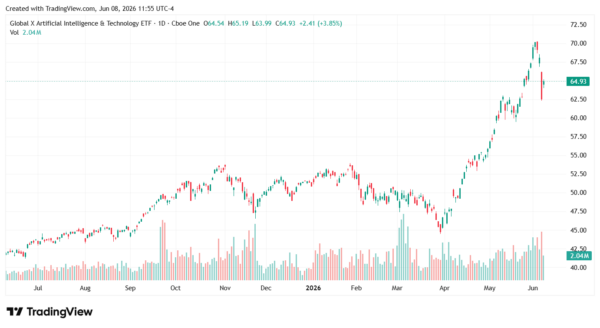
If you want to diversify at a lower cost, there are ETFs like the Global X Artificial Intelligence & Technology ETF (NASDAQ: AIQ). With an expense ratio of 0.68%, the ETF invests in companies that may benefit from the continued development and use of artificial intelligence (AI). Some of its top holdings include Palantir, Oracle, Broadcom, Netflix, Nvidia, Microsoft, and Meta Platforms, to name a few of its 86 total holdings.
A Core ETF for Automation and AI Expansion
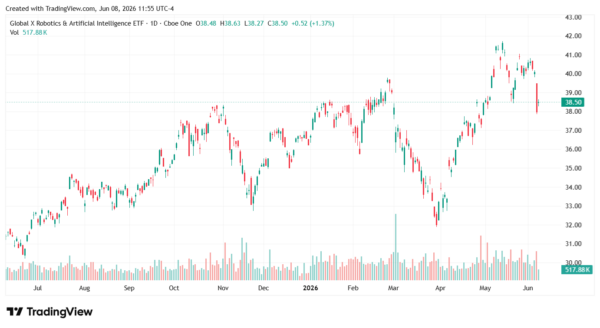
Another top AI ETF to consider is the Global X Robotics and Artificial Intelligence ETF (NASDAQ: BOTZ). With an expense ratio of 0.68%, the ETF invests in companies that should benefit from the increased adoption of robotics and AI. Some of its 49 holdings include Nvidia, Keyence, DynaTrace, SMC Corp., Intuitive Surgical, Upstart Holdings, and C3.ai.
Leave a Reply