
For years, the U.S. has been overly dependent on China, which controls about 80% of the world’s rare earth supply. However, as we’ve learned the hard way, that has to change. After all, without rare earths, the world can’t produce the millions of electric vehicles government leaders want on the roads.
Table of Contents
We can’t produce smartphones, computers, flat panel televisions, wind turbines, electric vehicle batteries, computer chips, defense equipment, semiconductors, digital cameras, or catalytic converters. Even the U.S. Department of Defense could run low on rare earths and other warfighting products.
Today, rare earth stocks are starting to explode higher again.
This time on news that analysts at Needham just initiated a buy rating on MP Materials (NYSE: MP) and USA Rare Earth (NASDAQ: USAR).
The firm noted, “We believe we are in the early innings of a multi-year investment cycle across the rare earth magnet value chain as governments around the world push to diversify critical supply chains outside of China. Through 2030, the industry is likely to be characterized by a race by Western suppliers to catch Western demand,” as quoted by CNBC.
While investors can always jump into those stocks, ETFs offer greater diversification at a lower cost. In fact, here are three you may want to consider.
Diversified Exposure to Rare Earth Producers and Strategic Metals
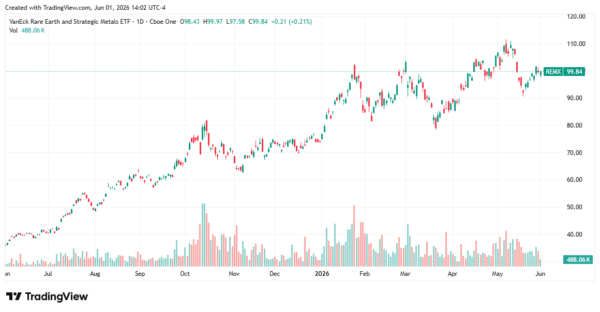
With an expense ratio of 0.58%, the VanEck Rare Earth and Strategic Metals ETF (NYSEARCA: REMX) attempts to replicate the performance of the MVIS Global Rare Earth/Strategic Metals Index, which is intended to track the overall performance of companies involved in producing, refining, and recycling of rare earth and strategic metals and minerals.
Since bottoming out at around $80 in March, the REMX ETF is now up to $99.63. From here, we’d like to see it rally back to $110 near-term.
A Broad Play on Critical Materials Powering New Technologies
There’s also the Global X Rare Earth & Critical Materials ETF (NASDAQ: EART).
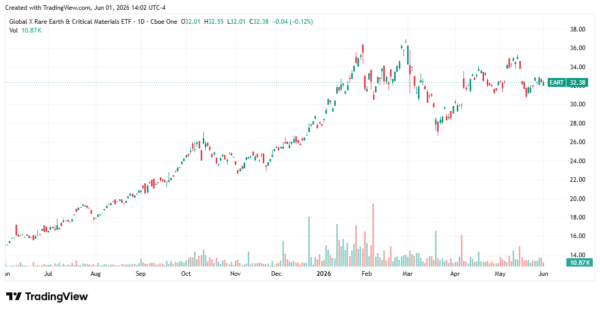
With an expense ratio of 0.59%, the EART ETF invests in companies producing rare earth components, metals and other raw or composite materials that are essential to the expansion of critical technologies, such as electric vehicles, energy storage, robotics, and radar systems. Targeted companies include those involved in the exploration, mining, production and/or enhancement of Rare Earth Elements, Zinc, Platinum & Palladium, Nickel, Manganese, Lithium, Graphene & Graphite, Copper, Cobalt, and Carbon Fiber.
Some of its top 50 holdings include Rio Tinto (NYSE: RIO), Freeport-McMoRan (NYSE: FCX), Southern Copper (NYSE: SCCO), Albemarle (NYSE: ALB), and Impala Platinum (OTCMKTS: IMPUY). Since bottoming out at around $26.66 in March, the ETF is now up to $32.41. We’d like to see it retest $37 near term.
Investing in the Materials Behind the Energy Transition
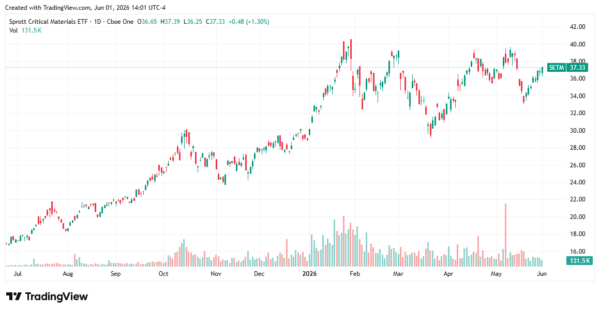
With an expense ratio of 0.65%, investors may also want to consider the Sprott Energy Transition Materials ETF (NASDAQ: SETM), which provides exposure to companies involved in producing the critical materials needed for the global energy transition.
The fund invests in miners and producers of commodities such as lithium, copper, nickel, cobalt, graphite, and rare earth elements that are essential for electric vehicles, battery storage systems, renewable energy infrastructure, and advanced electronics.
Investing in the Future of Energy and Technology
As governments secure supply chains outside of China, companies involved in rare earth mining, processing, and critical materials production could see years of increased demand. While individual stocks such as MP Materials and USA Rare Earth may offer significant upside, diversified ETFs provide investors with broader exposure to a sector that is rapidly gaining importance.
For those looking to capitalize on the global push for supply chain independence and advanced technologies, rare earth ETFs may be one of the simplest ways to participate in what could be a long-term growth trend.
Leave a Reply