
This week, Intuit (NASDAQ: INTU) announced plans to cut roughly 3,000 employees, about 17% of its workforce. Companies usually make decisions like that when growth slows, margins shrink, or customers disappear.
Table of Contents
However, Intuit reported Q3 earnings for FY26 with revenue of $8.56 billion and GAAP diluted EPS of $11.65. With these figures, companies don’t tear apart a workforce unless they see something more dangerous than a weak quarter. That’s exactly what I’m about to uncover.
An Empire Built Around Problems Most People Hate Solving
Most investors and consumers know Intuit through products they’ve already touched: TurboTax. QuickBooks. And Credit Karma.
But what they often miss is the scale at which each is operating. And understanding them is the first step to analyzing this quarter and the layoff.
TurboTax and the broader Consumer Group generated $4 billion in revenue during the quarter.
QuickBooks and the Global Business Solutions segment generated another $2.8 billion.
Credit Karma revenue jumped 31% year-over-year.
Those businesses sit at the center of how millions of Americans handle taxes, accounting, payroll, credit decisions, borrowing, and personal finance.
TurboTax became a giant because most people don’t understand the tax code. QuickBooks, because most business owners aren’t accountants. Credit Karma, because most consumers struggle to make confident financial decisions.
This means Intuit’s biggest businesses all depend on the same thing continuing to exist: a world where financial decisions remain difficult enough that millions of people still need help making them.
So what happens when the very idea that built these products is threatened?
AI Is Moving Directly Toward That Complexity
The threat facing Intuit doesn’t look like traditional competition.
The company has spent decades competing against tax software, accounting software, payroll platforms, and financial websites. The bigger threat comes from companies building intelligence itself, like OpenAI, Anthropic, and Alphabet Inc. (NASDAQ: GOOGL).
Think about what happens when AI becomes trusted enough to handle financial workflows:
A taxpayer uploads a stack of documents and receives a completed return. A business owner asks why margins fell and receives an answer instead of a dashboard. A consumer asks whether they can afford a mortgage and receives guidance built around income, debt, spending patterns, and credit history.
And once consumers stop paying for navigation, they start paying for answers. That’s where some of Intuit’s most valuable businesses begin looking exposed.
Why The Management Is Scared Of The Numbers
This quarter, revenue grew 15%. GAAP operating income climbed 19% to $3.7 billion. GAAP operating margin expanded to 43.4%.
Management raised full-year guidance again. Again, those are not the numbers of a company under financial pressure, which makes the layoffs far more revealing.
Strong companies disrupt themselves when they believe the future is arriving faster than the market understands. No wonder Intuit repeatedly discussed directing resources toward AI investments and future growth initiatives.
The thing is, when most investors hear another company talking about AI.
I heard management looking at businesses generating billions of dollars every quarter and realized they could not afford to defend them the same way they always had. A reaction you only get from a company scared of how the market could transform in the shortest time possible.
Wall Street Is Pricing In More Than Earnings
Intuit beat earnings, raised guidance, expanded margins, and still dropped almost 4%. That reaction tells you investors weren’t focused on the quarter. They were focused on the message hidden inside it.
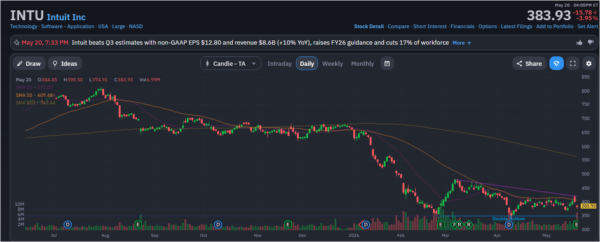
Technically, INTU remains below its declining 50-day moving average near $407, while resistance around $400-$420 continues capping rallies. Buyers have repeatedly defended the $350-$360 zone, creating a potential double-bottom structure, but the stock has yet to prove institutions are willing to chase it higher.
The 17% workforce reduction changed the conversation.
Instead of celebrating strong earnings, investors began asking why a company growing revenue 15%, expanding margins to 43.4%, and raising guidance felt compelled to eliminate 3,000 jobs.
The chart reflects that uncertainty.
Wall Street appears less concerned about Intuit’s current business and more focused on whether management sees an AI-driven disruption approaching faster than investors do. If the market starts viewing the layoffs as offensive positioning rather than defensive cost-cutting, the stock has room to reclaim the $400-$420 range. If not, resistance likely remains intact.
Intuit Is Fighting To Keep Its Products From Becoming Features
This was the most fascinating realization hiding inside the quarter.
For years, Intuit competed against software.
The next battle could revolve around something much bigger: the interface itself. Because the future winner may not be the company that builds the best tax software or accounting software. The future winner is the company that becomes the first place people go when they need financial answers. Just like people still consult Google after Yahoo, Bing, and, dare I say, ChatGPT.
That’s why the layoffs, though morally questionable, are strategic for the company.
TurboTax generated $4 billion. QuickBooks generated $2.8 billion. Credit Karma grew 31%…
All three businesses were built around the assumption that financial complexity remains difficult to solve.
AI is attacking that assumption directly. As a result, the company is now racing against the possibility that the very problem underpinning its empire becomes dramatically easier to solve. So if management is right, the biggest threat to TurboTax, QuickBooks, and Credit Karma won’t come from a better version of those products.
It will come from a future where millions of people stop needing them in the same way at all. In retrospect, that’s akin to building castles in quicksand.
Leave a Reply