
TJX Companies (NYSE: TJX) delivered a blowout first quarter on May 20, posting results that beat on every major metric. Net sales of $14.3 billion rose 9% year-over-year, comparable sales jumped 6% across all divisions, and diluted earnings per share of $1.19 came in 29% above the same period last year and well ahead of the company’s own guidance.
Table of Contents
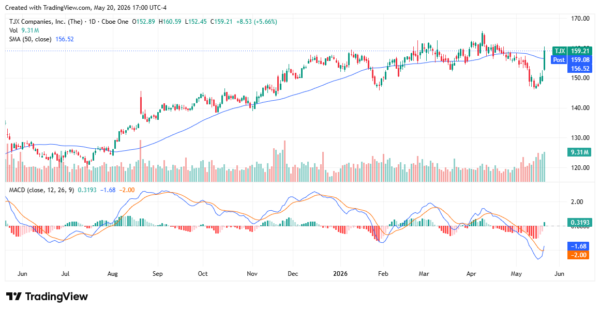
TJX also raised its full-year fiscal 2027 outlook accordingly, bumping EPS guidance to $5.08–$5.15 and upping its share buyback authorization to $2.75–$3.0 billion. The stock surged more than 5% on the news, closing at $159.21 — just above its 50-day moving average of $156.52.
However, investors should read the fine print. When they do, here’s the part that should give the broader market pause: TJX thrives when consumers are under pressure. The off-price model (i,e., offering brand-name and designer merchandise at 20% to 60% below full-price retail) is built for economic stress.
When households feel the squeeze of persistent inflation, elevated interest rates, and slowing wage growth, they trade down. They find T.J. Maxx and Marshalls. A blowout quarter for TJX isn’t necessarily a vote of confidence in the American consumer — it may be closer to the opposite. The treasure-hunt experience is compelling on its own, but the tailwind here is macroeconomic anxiety, not prosperity.
The Best House in a Bad Retail Neighborhood
The comparison to full-price retail tells a stark story. While department stores and specialty retailers have struggled with excess inventory, shifting consumer habits, and margin compression, TJX has consistently grown its store count, traffic, and profitability. This quarter, HomeGoods led the way with a remarkable 9% comp sales gain in the U.S., while TJX Canada posted a 7% comp sales gain. TJX International, covering Europe and Australia, grew 4% on a comparable basis despite currency headwinds — a meaningful feat given the economic softness in the UK and continental Europe.
The company added 48 net new stores during the quarter, bringing its total to 5,262 locations across 10 countries. Segment profit rose in every division: Marmaxx grew to $1.269 billion, HomeGoods nearly matched prior-year levels, and international operations continued to gain traction. TJX is not just surviving in a tough retail environment — it is systematically expanding while others retreat. That positioning — well-capitalized, operationally disciplined, and structurally advantaged relative to full-price peers — makes it arguably the strongest franchise in brick-and-mortar retail today.
Growth Is Priced In — And That’s the Risk
The stock’s reaction tells a nuanced story. A 5.66% single-day gain on earnings this strong might seem modest given the magnitude of the beat, but TJX was already pricing in excellence. The stock had traded near all-time highs before a broader market pullback pushed it below its 50-day average — from which it snapped back sharply on Wednesday. With full-year EPS guidance of roughly $5.08–$5.15 and the stock trading near $159, investors are paying approximately 31 times forward earnings for a retailer, however exceptional it may be.
TJX’s full-year guidance also came with a notable caveat: the company is explicitly not flowing through the full Q1 beat to the annual outlook. Management cited the expectation of higher fuel costs for the remainder of the year as a headwind to margins — a reminder that even TJX cannot fully insulate itself from commodity and supply chain volatility. For growth to continue surprising to the upside, the macro environment will need to cooperate, or at a minimum, not deteriorate further.
Technical Analysis: Momentum Returning After a Rough April
The chart tells a compelling near-term recovery story. After peaking around the $165–$168 range in late winter, TJX sold off through April and into early May, pulling well below its 50-day simple moving average of $156.52. The MACD indicator had diverged deeply negative — the signal line falling to -2.00 — signaling weakening momentum. Wednesday’s earnings-driven surge pushed the stock back above the 50-day, with a MACD that is beginning to curl back toward neutral. Volume of 9.31 million shares was well above recent averages, confirming conviction behind the move. The recovery breakout is early-stage but technically constructive.
Why the Stock Could Have More Upside
Walmart (NASDAQ: WMT) reports on May 21, and its results could provide a meaningful tailwind or headwind for TJX. If Walmart reinforces the narrative of the value-seeking consumer, TJX benefits from the same thematic trade. If Walmart disappoints, it may signal a consumer more stressed than the TJX results imply, putting both names under pressure.
Looking further out, there are structural reasons to stay constructive on TJX. The company generated $1.1 billion in operating cash flow in Q1 alone, ending the period with $5.6 billion in cash. It is actively buying back stock at scale, pays a growing dividend (declared at $0.48 per share this quarter, versus $0.425 a year ago), and has a long runway for international expansion — particularly in Europe, where TK Maxx remains underpenetrated relative to the U.S. market. JPMorgan recently raised its price target to $174, suggesting roughly 9% additional upside from current levels. Analysts at Truist also cited TJX alongside Ross Stores as off-price leaders positioned for continued outperformance.
Conclusion: A High-Quality Franchise at a Premium Price
TJX Companies has earned its reputation as one of the most resilient and well-run retailers in the world. Over any meaningful time horizon — three years, five years, a decade — it has delivered strong total returns, driven by consistent comparable sales growth, expanding margins, and disciplined capital allocation. This quarter was no exception: 6% comp growth, a 1.7 percentage point expansion in pretax profit margins, and earnings per share up nearly 30% year-over-year are exceptional results by any standard.
But the near-term outlook for TJX — like every consumer-facing business — hinges on variables entirely outside its control: the Federal Reserve’s rate trajectory, the stickiness of core inflation, and oil prices. These factors shape the consumer’s mood, spending capacity, and propensity to trade down into off-price retail.
TJX benefits from the first two remaining elevated and suffers if the third spikes. Whether this is the best house in a bad retail neighborhood is almost beside the point — it is certainly the house most likely to hold its value when the neighborhood gets rough. For long-term investors comfortable paying a premium for quality and consistency, that may be reason enough to own it.
Leave a Reply