
For decades, the modern economy rewarded companies for becoming less dependent on physical reality. Software scaled infinitely. Cloud businesses expanded without needing factories, railroads, or industrial infrastructure.
Table of Contents
But Constellation Energy (NASDAQ: CEG) may have just exposed a problem hiding underneath the AI boom that few investors fully appreciate yet.
Constellation Energy reported Q1 2026 earnings with adjusted operating earnings of $2.74 per share, versus expectations closer to $2.45, while revenue surged 64% year-over-year to $11.12 billion. Net income reached approximately $1.42 billion, equivalent to $4.49 per share, while operating cash flow climbed to roughly $2.06 billion during the quarter. The company also reaffirmed its 2026 operating EPS guidance range of $11 to $12 per share.
The message is clear: AI needs enormous amounts of electricity. But the deeper implication is far bigger than that.
Silicon Valley spent years convincing investors that the future would become increasingly detached from physical infrastructure. AI may now be proving the exact opposite, through Constellation Energy.
Civilization Always Hits The Same Wall
Ancient Egypt did not become powerful because intelligence suddenly appeared along the Nile. It became powerful because irrigation systems allowed agriculture, trade, labor specialization, and population growth to scale together.
From Rome to the Industrial Revolution, every major economic leap eventually becomes an infrastructure story.
That same pattern may now be reappearing through AI.
Despite all the obsession surrounding models, chips, and software, AI itself does not scale infinitely. It consumes staggering amounts of electricity, cooling capacity, land, and transmission infrastructure. And unlike software, those systems cannot be instantly replicated.
That is where Constellation Energy suddenly becomes important.
Not merely because it generates power. But because it already owns infrastructure, the market spent decades treating it like invisible plumbing while chasing higher-growth digital narratives elsewhere. Nuclear fleets. Baseload generation. Reliable large-scale power infrastructure.
And the company’s financials suggest the market is already beginning to reprice those assets differently. Adjusted operating earnings climbed 28% year-over-year from $2.14 per share to $2.74, while operating cash flow crossed $2 billion in a single quarter. That is not speculative AI hype anymore. That is infrastructure scarcity beginning to translate into real earnings power.
Hyperscalers Are Rediscovering The Old Economy
The symbolism surrounding Microsoft’s agreement tied to restarting the Three Mile Island nuclear facility captures this shift perfectly. One of the world’s most advanced AI companies suddenly relying on one of America’s most infamous nuclear sites would have sounded absurd ten years ago. Today, it feels economically inevitable.
Microsoft reportedly signed a 20-year agreement to restart the former Three Mile Island Unit 1 reactor, now renamed the Crane Clean Energy Center.
The reactor itself generates roughly 835 megawatts of electricity, while Constellation estimates the restart project could cost approximately $1.6 billion.
The U.S. Department of Energy later approved a $1 billion federal loan supporting the restart effort, while analysts at Jefferies estimate Microsoft may ultimately pay roughly $110 to $115 per megawatt-hour under the agreement.
This may be one of the most important signals in this entire AI cycle, because the point is not that Microsoft signed an electricity deal. It is that hyperscalers may now be willing to lock themselves into decades-long infrastructure agreements at premium pricing simply to secure a reliable AI-era power supply.
For years, the market rewarded businesses for becoming asset-light, digitally scalable, and less dependent on physical systems. Utilities, grids, and power infrastructure became background noise while software companies absorbed the market’s imagination.
Now, suddenly, the AI economy is rediscovering the importance of foundational infrastructure underneath it.
And the bottleneck may become physical rather than digital. Not who builds the smartest models, but who controls enough infrastructure to keep those models running at scale.
Constellation’s acquisition of Calpine reinforces that positioning as well. The company is not simply operating nuclear assets anymore. It is expanding generation scale across infrastructure categories; the market may increasingly be treated as strategically scarce if hyperscaler electricity demand continues accelerating alongside AI expansion.
Wall Street Is Now Repricing CEG
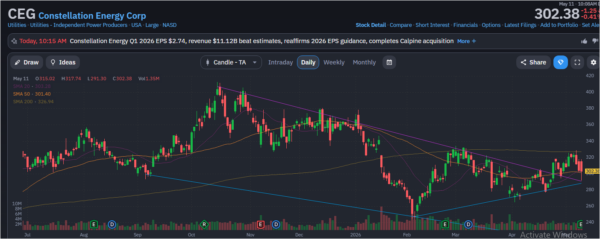
The chart tells a much more specific story after earnings than a standard utility analysis would suggest.
Despite broader market volatility, CEG held firmly around the $300 region immediately following earnings after briefly trading above $317 intraday. That matters because strong earnings reactions normally fade quickly in traditional utility names when investors view the quarter as temporary or cyclical. Constellation’s price behavior looked different.
Volume reached roughly 1.35 million shares during the earnings session while the stock defended both its 20-day moving average near $303 and 50-day moving average around $301 almost perfectly. More importantly, buyers stepped in aggressively before the stock could meaningfully retrace toward its longer-term rising trendline from the April lows.
That behavior suggests institutions are increasingly treating Constellation less like a defensive utility and more like a strategic infrastructure asset tied directly to long-duration AI demand.
That shift explains why the stock continues attracting buyers even after the massive rally from the February lows near $250.
The market is no longer simply pricing electricity demand.
It is beginning to price infrastructure scarcity.
Brace For Impact: The Old Civilization Is Back
It’s not difficult to be bullish on Constellation because this story feels much larger than one earnings beat or one AI narrative cycle.
Civilizations have always depended on foundational systems capable of sustaining expansion. Irrigation enabled agricultural empires. Railroads and electrification enabled industrialization. And now nuclear fleets, grids, and baseload generation may increasingly determine how far the AI economy itself can realistically scale.
That is why I think Constellation matters so much here.
Not because utilities suddenly became fashionable again.
But because the AI boom may be forcing the modern economy to rediscover something it spent decades trying to abstract away through software, even digital revolutions eventually run into physical reality.
Leave a Reply