
In December 1903, the Wright brothers proved human flight was possible. But proving something can fly and proving it can become a durable business are two entirely different things separated by years of infrastructure buildout, regulation, manufacturing scale, capital demands, and investor patience.
Table of Contents
Aviation history is filled with revolutionary breakthroughs that arrived long before the economics supporting them matured, which is exactly why the earnings reports from flying car stocks like Joby Aviation (NYSE: JOBY) and Vertical Aerospace (NYSE: EVTL) feel so important.
For the first time, the market is starting to behave as though the technology behind flying cars (i.e. electric vertical take-off and landing vehicles – or eVTOLs) itself is no longer the biggest question. The bigger question now is whether investors are dramatically underestimating how long and financially brutal the waiting period between technological success and commercial viability could become.
Joby’s Q1 2026 Earnings: Timing Skepticism
Joby’s Q1 2026 earnings revealed a company making undeniable technological progress while still generating economics that look painfully early relative to the scale of investor expectations surrounding the business. The company reported approximately $24.2 million in revenue and an EPS loss of -$0.12, while ending the quarter with around $813 million in cash and short-term investments as it continued to push toward commercialization through FAA-conforming aircraft flights, Dubai launch preparation, certification milestones, and manufacturing expansion.
Those are not fake milestones. In fact, they are increasingly difficult for skeptics to dismiss outright. But the deeper contradiction becomes obvious once you compare the scale of the technological story with the scale of the underlying economics behind flying cars. Joby still posted a net loss of roughly $82 million alongside an adjusted EBITDA loss of nearly $110 million, reinforcing that investors are continuing to finance future belief long before a mature commercial business actually exists.
The chart reflects that tension almost perfectly. Despite steady milestone announcements, Joby remains trapped below its 20-day moving average near $8.85, 50-day near $9.15, and 200-day near $13.43, while continuing to print lower highs and fading momentum even as the broader S&P 500 rallies aggressively. Volume still spikes around announcements, including more than 30 million shares traded around earnings, but sustained institutional accumulation never truly follows, suggesting the market is reacting to progress while simultaneously questioning the timeline required for that progress to become economically meaningful.
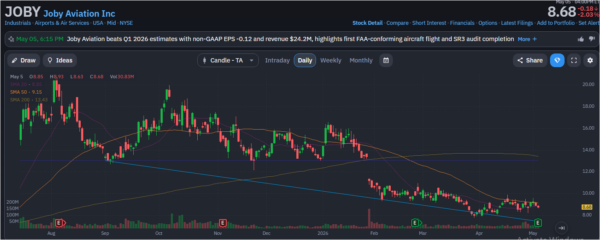
That completely changes the interpretation of the stock. Investors are no longer asking whether Joby can fly. They are starting to ask how long they can realistically afford to wait.
Vertical Aerospace (NYSE: EVTL) Q1 2026 Earnings: Survival Skepticism
If Joby represents timeline skepticism, Vertical Aerospace increasingly represents something harsher: survivability skepticism. Because while EVTL continues hitting meaningful technical milestones, its financial structure reveals how punishing the waiting period between engineering progress and commercial scale may become for shareholders.
Vertical Aerospace announced that it successfully completed a piloted two-way transition flight under UK CAA oversight, a major certification-stage milestone that moves the company closer toward operational reality rather than speculative prototype status. The company also confirmed progress toward its third full-scale prototype and continued certification advancement.
But once again, the financial side tells a much heavier story. In its Q1 earnings report for 2026 fiscal year, Vertical reported approximately $103 million in short-term liquidity, while simultaneously guiding toward expected 12-month net cash outflows between $180 million and $200 million, forcing the company to lean heavily on financing arrangements that could provide access to up to $850 million in future capital.
That imbalance matters because it reveals the hidden reality behind much of the eVTOL sector: these companies are no longer simply engineering projects. They are endurance contests for capital.
Just like JOBY, the chart reinforces the same market psychology. EVTL continues trading in a persistent downtrend despite positive milestone announcements, sitting below its 20-day moving average near $2.54, 50-day near $3.03, and 200-day near $4.68, while remaining dramatically below prior speculative highs from earlier flying-car enthusiasm cycles. Even after the latest update triggered a short-term bounce toward the $2.50 range, the stock still behaves like a market questioning whether future commercialization can arrive fast enough to justify the dilution risk, financing dependency, and years of execution still sitting ahead.
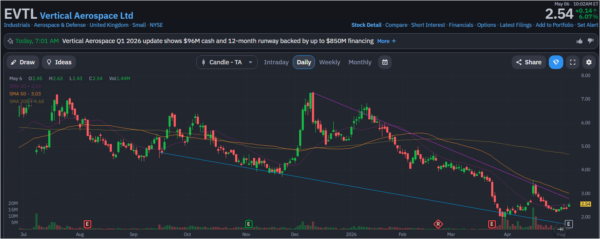
That distinction is important because markets eventually stop rewarding possibility alone. At some point, they begin demanding visibility into survivability.
History Suggests Flying Car Investors May Still Be Financially Early
That is the part many investors in the broader eVTOL sector still seem unwilling to fully process. The technology is no longer the impossible part of this story. Aircraft are flying. Certification milestones are advancing. Regulators are increasingly involved. Companies like Joby Aviation and Vertical Aerospace are proving that flying cars are steadily moving away from science-fiction speculation and toward engineering reality.
But markets don’t reward technological breakthroughs equally across time. They reward timing, survivability, scalability, and economics. Right now, those four things still look painfully uncertain across much of the sector.
Going back to my example of how the Wright brothers changed transportation forever in 1903. That did not suddenly create a mature aviation industry overnight. Commercial aviation still required decades of infrastructure spending, regulatory evolution, manufacturing scale, and brutal capital cycles before it became a durable business model. Some companies survived that transition. Many didn’t.
That’s why I still lean cautiously on flying car stocks here, even though I think the technology itself is becoming increasingly legitimate. As the biggest risk surrounding this sector may no longer be whether these aircraft can fly. But whether investors are dramatically underestimating how financially exhausting the waiting period between breakthrough and profitability could become.
That’s the distinction everyone is slowly waking up to now. And judging by how Joby and Vertical Aerospace continue trading despite increasingly significant milestones, investors may already be realizing that building the future and surviving long enough to profit from it are not always the same thing.
Leave a Reply