
It’s no secret why Spotify Technology (NYSE: SPOT) has been one of the more disappointing names in the equities market this year. Since the January opener, SPOT stock has given up nearly 28%, a victim of less-than-stellar guidance and Wall Street’s concerns regarding a structural ceiling. Nevertheless, the smart money does seem at least intrigued by the possibility of shares swinging higher.
Table of Contents
To recap, Spotify’s second-quarter guidance left many investors wanting more. Specifically, the operating income of 630 million euros missed the analyst consensus of 673 million euros. Fundamentally, this miss on profit forecast raised immediate concerns that the benefits of recent service price hikes and cost-cutting measures have peaked. Further, such actions may lead to diminishing returns, which put more pressure on SPOT stock.
Additionally, investors appeared to be hesitant regarding the streaming company’s slowing subscriber momentum. Management guided for 6 million net subscriber additions in Q2, falling short of the 302 million total premium subscribers the Street had anticipated. Many have interpreted this dynamic as the fault of aggressive pricing strategies hitting elasticity limits in mature markets.
Finally, it’s difficult not to consider the advertising revenue slump that Spotify has endured, with ad-supported revenue declining for the second straight quarter. If users aren’t converting to premium while ad revenue is falling, the platform’s ability to monetize its free user base becomes a serious question. To avoid the potential implications, many have decided to jettison SPOT stock.
Still, it might not all be bad news — especially because the smart money may be sniffing out the possibility of a contrarian comeback.
Volatility Skew Reveals a Nuanced Picture for SPOT Stock
To be upfront, there’s no one single indicator that answers all questions in the equities and options markets. Obviously, if there were, the profitable insight would have already been arbitraged to death, rendering the indicator useless. However, in my opinion, the one screener that’s the most useful in the public-facing financial space is volatility skew.
By definition, the volatility skew identifies implied volatility (IV) across the strike price spectrum of a given options chain. Essentially, the skew acts as a sort of insurance market, with traders hedging their bets or buying leveraged upside exposure. These activities at scale tend to show a certain bias toward either downside protection or bullish optimism.
The volatility skew is a way for retail traders to understand the smart money’s biggest concern: are these sophisticated market participants worried about an implosion or not being positioned appropriately for a major rip?
In the case of SPOT stock, the skew for the June 18 expiration date shows a bimodal volatility regime — the market is simultaneously paying for downside protection while also tacking on leverage for a possible moonshot. Predominantly, the left-tail put IV swings sharply higher, suggesting that the main priority is mitigating further downside damage. However, it’s important to acknowledge the right tail, where call IV rises robustly (though at a slower clip than the risk tail).
In my opinion, the skew is significant because if the smart money was that fearful of SPOT stock, we likely wouldn’t see the upside convexity. Sure, the pros are being rational with their hedging — but they’re also being hopeful.
Why Spotify Stock Gives Traders Reason to Believe
Looking at SPOT stock from the lens of technical analysis, a common argument may center on the mean-reversion concept. With the security down about 35% in the trailing 52 weeks, there’s a perception that Spotify is due for a bounce back. I can totally buy that argument, but we need a bit more specificity.
After all, who is the arbiter that determines that Spotify stock has fallen too much and is therefore due for that aforementioned bounce back? That’s a rhetorical question — and given that the equities market is a non-deterministic system, we need to use an inductive methodology to figure out the next likely near-term move.
Using a dataset going back to January 2019, the chance that a 10-week-long position in SPOT stock will yield a positive return is 59.6%. Further, the expected forward distribution would likely see shares land between $408 and $460, with probability density peaking between roughly $430 and $440.
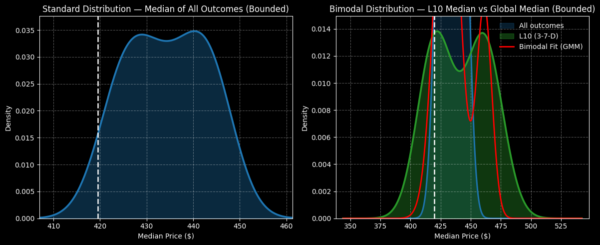
However, we’re not interested in trading Spotify stock as an aggregate performance. Instead, we’re focused on the conditional probability of the current signal. In the last 10 weeks, SPOT printed only three up weeks, leading to an overall downward slope across the period. Under this specific sequence, SPOT’s exceedance ratio jumps to 65.2%, which is a noticeable improvement over 59.6%.
What’s more, the forward 10-week distribution would be expected to land between $375 and $525. Yes, the risk profile does stretch, which is something to consider. But the reward profile stretches even further, which makes the bullish portion of the volatility skew an enticing metric.
Putting Theory into Practice
For those who wish to place a speculative bet on Spotify stock, the 440/450 bull call spread expiring June 18 appears to be an intriguing idea. For this trade to be fully profitable, SPOT would need to rise through the $450 strike at expiration. Doing so would lead to a maximum profit of nearly 120% (as of pricing data from Tuesday’s close).
Breakeven lands at $444.55, which modestly improves the trade’s probabilistic credibility.
From an inductive basis, what makes this spread appealing is that the $450 target sits within the expected distributions of both the aggregate performance of SPOT stock, along with the conditional probability of the 3-7-D sequence. Also, because the latter signal provides a bullish bias, aggressive speculators are incentivized to consider a debit-based position (as opposed to a neutral, credit-based trade).
Leave a Reply