
If you’re even thinking about retirement, one of the last things you need to worry about is consistent cash flow. Instead, you’ll want your money working for you through dividend income ETFs that can generate reliable passive income. One of the most effective ways to build that income stream is through high-yield ETFs designed to deliver regular payouts while offering long-term growth potential.
Table of Contents
With high-yield funds, you aren’t constantly timing withdrawals or watching market swings. Instead, these funds are a passive investment idea that can deliver consistent income while still offering long-term growth potential.
Some of the best options for finding stocks with high yields are exchange-traded funds (ETFs). ETFs offer diversification, professional management, and low costs. These are three traits that become increasingly important as you move from accumulation to preservation and income. If this sounds like the kind of investment that may fit your portfolio, here are three dividend income ETFs you may want to consider.
Global Dividend Income ETF for International Diversification
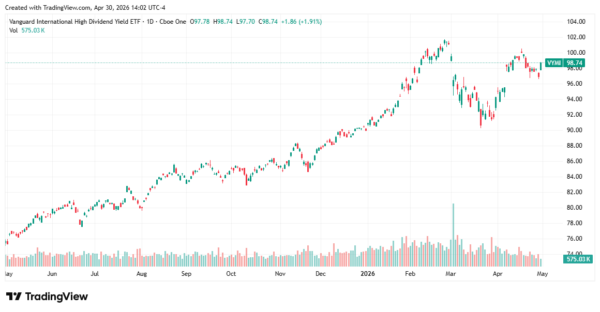
If you want to diversify beyond U.S. markets, the Vanguard International High Dividend Yield Fund ETF (NYSEARCA: VYMI) provides access to high-quality global income stocks. It also yields 3.64%.
With an expense ratio of 0.17%, the ETF targets 1,534 global companies, such as Nestle, Novartis, Toyota, and Shell. All are established companies with strong balance sheets, global revenue streams, and a history of returning capital to shareholders.
Most recently, the fund paid out a dividend of just over 79 cents a share on March 24. Before that, it paid 93 cents per share on December 23. It paid just over 70 cents per share on September 23. And before that, it paid a dividend of just over $1.07 per share on June 24. While international dividends can be volatile, with currencies, VYMI has delivered meaningful income over time.
Beyond yield, VYMI provides an important portfolio benefit: geographic diversification. Retirees who rely heavily on U.S. stocks may be overexposed to domestic issues. By incorporating international dividend stocks, you can diversify your risk.
Low-Cost Dividend Growth ETF for Long-Term Stability
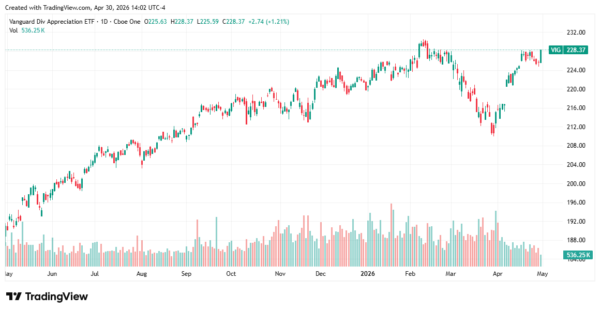
With an expense ratio of 0.04% and a quarterly dividend, the Vanguard Dividend Appreciation ETF (NYSEARCA: VIG) tracks the performance of the S&P U.S. Dividend Growers Index.
In addition, the VIG ETF has a well-diversified portfolio of 334 stocks and offers a low-cost, resilient, growth-oriented option for smart investors.
Some of its other holdings include Broadcom (NASDAQ: AVGO), Microsoft (NASDAQ: MSFT), JPMorgan Chase (NYSE: JPM), Apple (NASDAQ: AAPL), Visa (NYSE: V), Eli Lilly (NYSE: LLY), and Exxon Mobil (NYSE: XOM). Making the VIG ETF even more attractive, it yields about 1.66% and just paid out a dividend of just over 83 cents per share on March 31. Before that:
- It paid out a dividend of just over 88 cents per share on December 24.
- It paid out a dividend of just over 86 cents per share on October 1.
- It paid out a dividend of just over 87 cents per share on July 2.
High-Yield Covered Call ETF for Enhanced Monthly Income
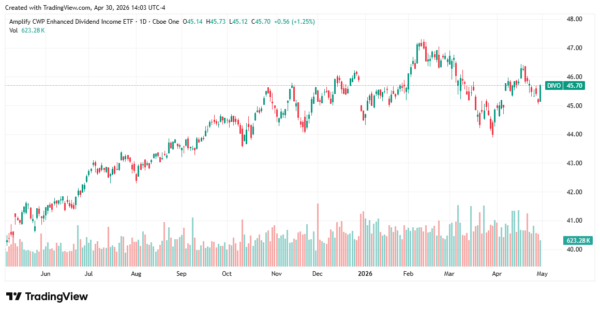
With a monthly yield of 1.61% and an expense ratio of 0.56%, the Amplify CWP Enhanced Dividend Income ETF (NYSEARCA: DIVO) holds large-cap companies that have a strong history of dividend growth. It also uses a covered call strategy on individual stocks to offer high total returns.
“DIVO seeks investment results that correspond generally to an existing strategy called the Enhanced Dividend Income Portfolio (EDIP),” as noted by AmplifyETFs.com. That strategy attempts to generate income through dividends and short-term covered calls in an effort to increase cash flow and consistent annual income. In addition, with that strategy, the EDIP holds blue-chip stocks from the S&P 500, the Dow 30 and the S&P 100.
It paid a dividend of just over 18 cents per share on April 30.
Why Dividend Income ETFs Belong in a Long-Term Portfolio
At the end of the day, building reliable passive income doesn’t have to involve chasing individual dividend stocks or constantly monitoring market volatility. Dividend income ETFs like VYMI, VIG, and DIVO offer a practical, diversified approach to generating cash flow while reducing single-stock risk. Each fund serves a different purpose—VYMI provides international diversification, VIG focuses on long-term dividend growth, and DIVO offers enhanced income through covered call strategies.
That flexibility allows investors to tailor their exposure based on their stage of life, risk tolerance, and income needs. For retirees, these ETFs can help supplement income streams without requiring active portfolio management. For younger investors, reinvesting those distributions can create powerful compounding over time. In either case, the right mix of dividend income ETFs can help create a portfolio designed to produce income today and financial stability tomorrow.
Leave a Reply