Domino’s Pizza (NASDAQ: DPZ) walked into this quarter with the market already positioned for cracks. The consumer is slowing, everyday spending is softening, and anything sitting in the middle of that crossfire is supposed to show it. Then the numbers from Q1 2026 earnings reports landed: $1.121 billion in revenue, up 3.5% year-over-year, and diluted EPS of $4.13, down from $4.33, and most people stopped reading right there, which is precisely why most people drew the wrong conclusion.
Table of Contents
Soft Demand Was Never The Actual Story
Same-store sales came in at +0.9% in the U.S. and -0.4% internationally, excluding currency effects, friction, not momentum, and there is no point dressing it up as anything else.
The consumer is hesitating, and just like every other company, Domino’s Pizza is not immune to it, and acknowledging that is the starting point of an honest read.
But acknowledging that demand is soft is not the same as concluding that the business is weakening, and conflating the two is the analytical error you can make this quarter. Sure enough, soft demand tells you what the environment looks like. At the same time, it says nothing about how a well-structured franchise system responds when its operating model is built specifically for moments like this.
The Number Everyone Skipped
Income from operations increased $20.3 million, or 9.6% year-over-year, and even after stripping out currency effects it still rose 7.9. Truth is, a business losing control of its model in a difficult demand environment simply does not produce that result.
Even better, franchise royalties are rising (U.S franchise royalty and fees increased from $151,000 to $158,014 yoy, while its international segments surged from $75,559 to $80, 980), supply chain margins are expanding, and the system is extracting meaningfully more profit from essentially the same level of consumer demand it was working with a year ago.
That is a company that has structurally reduced its dependence on volume growth to drive earnings expansion, and that distinction carries real valuation implications that the headline reaction ignored entirely.
The EPS Decline Had One Cause – And It Wasn’t The Business
Net income fell $9.8 million, or 6.6%, pulling EPS to $4.13 from $4.33, and the release tells you exactly what drove it: a $30.0 million unfavorable swing from the remeasurement of Domino’s investment in DPC Dash Ltd.. A non-cash, mark-to-market adjustment with no connection to pizza volumes, franchise royalty income, or supply chain efficiency. That is not the business you are buying when you buy Domino’s, and treating it as a signal about operational health is a category error.
Yes, free cash flow declined to $147.0 million from $164.4 million, but that movement was also driven entirely by working capital timing rather than deterioration in the underlying cash engine. Both numbers that triggered the negative reaction were pulled lower by factors sitting completely outside the core franchise model, while that model itself grew nearly 10% in operating income.
Holding both facts simultaneously is what separates a genuine read of this business from a reflexive response to the wrong lines, and you don’t want to be caught with the latter.
Smart Money Already Read Past The EPS Line
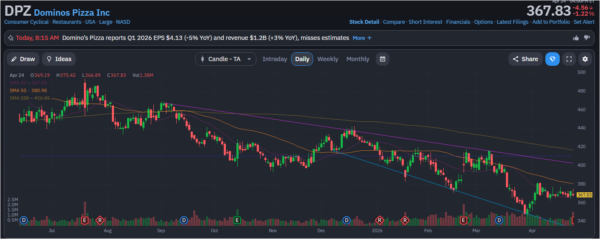
The chart tells the story that the headline numbers tried to distort. Domino’s Pizza was already in a controlled downtrend heading into earnings, drifting below its 50-day and 200-day moving averages with lower highs compressing expectations, so the “miss” was not a surprise event but something the market had largely leaned into.
What matters is what happened after: the selloff lacked conviction, price stabilized quickly around the $360–$370 range, and volume did not expand aggressively on the downside, which is not how true structural weakness behaves.
Instead of cascading lower, the stock absorbed the bad news and held its base, suggesting institutions were not rushing for the exit but quietly accepting the disconnect between weak optics and strengthening operations. That’s not fear but controlled positioning, and it aligns perfectly with a business that looks weaker on paper than it actually is underneath.
Franchise Economics Don’t Crack Under Pressure
Although Domino’s has a global net stores growth of 180, including 19 new U.S stores and 161 international openings, the fast food veteran is not a fragile, traffic-dependent restaurant concept that requires a strong consumer backdrop to protect its margins.
It is a scaled franchise system built on royalty income, supply chain leverage, and pricing discipline, designed to compound through cycles rather than despite them.
When demand softens, that architecture doesn’t deteriorate the way a traditional operator does; it filters, leaning into its franchise network, controlling its cost structure, and continuing to generate earnings growth from operational efficiency rather than volume. The market priced this quarter like the former. The business performed like the latter, and that gap between perception and reality is where you want to be.
Optics Down, Operations Up – Pick The Right One
When a company’s core operating engine is genuinely deteriorating, declining earnings are the confirmation – you step back and reassess.
But when the core engine is accelerating while reported earnings are distorted by a non-cash investment adjustment, that divergence is not a warning signal. It is a mispricing, and mispricing created by surface-level reading is the most reliable kind because it corrects the moment enough people do the work the market skipped.
When those two things move in opposite directions with this much clarity, the opportunity almost always belongs to whoever refused to stop at the headline.
Leave a Reply