
American Express (NYSE: AXP) delivered a strong first quarter in 2026. The company beat expectations on both revenue and earnings per share. Revenue grew 11% year over year to $18.9 billion. Diluted EPS jumped 18% to $4.28, up from $3.64 in Q1 2025.
Table of Contents
American Express earnings reports often move the stock in the days that follow. More often than not, that’s been in a negative direction. With that in mind, investors should look closely at what drove these results — and where the risks lie.
The company’s premium membership model continues to fire on all cylinders. Spending by U.S. consumers grew 10% year over year. International card services grew 13% on an FX-adjusted basis. Net card fees — a key indicator of brand loyalty — rose 18% to $2.75 billion. That fee line has grown at 17% per year since 2019.
One blemish in the report was a modestly elevated credit loss provision. Write-offs ticked up slightly versus a year ago. The credit reserve rate dipped to 2.8% from 2.9%. That’s a small move, but one worth watching. AXP stock has a history of selling off after earnings, even on strong results. Macro concerns can weigh on the stock when credit metrics soften.
Still, the overall picture is one of a company executing very well. Management held its full-year guidance steady, calling for revenue growth of 9%–10% and EPS of $17.30–$17.90.
Key Takeaway: Revenue and Earnings Growth Remain Robust
The headline numbers were hard to argue with. Total revenue net of interest expense reached $18.9 billion, up 11% from $17.0 billion in Q1 2025. On an FX-adjusted basis, growth came in at 10%. Net income rose 15% to nearly $3.0 billion.
Every major revenue line grew. Discount revenue — fees earned on card transactions — rose 9% to $9.5 billion. Net card fees climbed 18%, driven by growth in premium card portfolios like the Platinum Card. Service fees and other revenue grew 13%. Net interest income rose 13% to $4.7 billion, helped by growth in revolving loan balances.
The company is also buying back shares. Common shares outstanding fell to 682 million from 702 million a year ago. That 2% reduction helps boost EPS even without earnings growth. The CET1 capital ratio stands at 10.5%, right within the company’s 10%–11% target range.
American Express returned 74% of net income to shareholders over the past three years through dividends and buybacks. The quarterly dividend per share has grown 58% over those same three years.
Secondary Takeaway: Younger Cardholders Are Driving Spend
One of the most compelling stories inside the AXP earnings report is younger cardholder growth. Gen-Z spending grew 38% year over year in the U.S. consumer segment. Millennials grew 13%. Together, these two cohorts now make up 66% of all new global consumer accounts.
That matters because it signals long-term revenue durability. Premium card members tend to be loyal and high-spending. A 73% share of new accounts came from fee-paying products. Most new customers are joining at the premium tier — not the entry level.
The refreshed U.S. Consumer Platinum Card is also working. Spend growth from Platinum cardholders is up roughly 6 percentage points since the product refresh in Q3 2025. Retention rates remain very high — above 90% — for cardholders reaching their renewal anniversary month.
International card services also showed strength, with reported billings growing 20% year over year. The international business now represents a meaningful and growing share of the total network.
Technical Analysis: Stock Testing Key Support
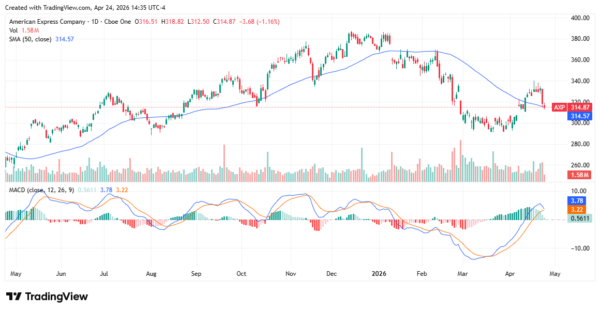
Looking at the AXP daily chart, shares closed at $314.87 on April 24, 2026, down 1.16% on the session. The 50-day simple moving average sits at $314.57 — almost exactly at the current price. This is a critical level to watch.
The stock peaked near $385 in late November 2025 before pulling back sharply into February 2026. It tested lows near $290 before recovering. Since March, AXP has been trending higher, reclaiming the 50-day SMA in April.
The MACD indicator shows a bullish crossover in recent weeks. The MACD line (3.78) is above the signal line (3.22), and the histogram is positive. This suggests short-term upward momentum is building.
However, the stock is right at the 50-day moving average right after earnings. A close below $314 would be technically weak. Bulls want to see AXP hold this level and push toward $335–$340 resistance.
Why the Bull Case Can Lose Steam
Even strong earnings don’t always push a stock higher. American Express has a history of selling off after good reports. Macro headwinds are the main risk. The company’s own credit modeling includes a downside scenario in which U.S. unemployment rises to 8%–9% and GDP contracts sharply.
Card member services expense surged 49% year over year. That’s mostly tied to higher usage of Platinum benefits — a feature, not a bug. But it puts pressure on margins if spending growth slows. Commercial services spending grew just 4%, well behind the consumer segment. Any slowdown in consumer confidence could quickly dent the bull case.
Conclusion: Fundamentals Are Strong, But Watch the Chart
American Express delivered one of its best quarters in recent memory. Revenue grew 11%. EPS rose 18%. Younger cardholders are spending more. Premium card fees keep compounding at a strong rate. The company has the capital to keep buying back shares and raising its dividend.
The credit metrics are not alarming. Net write-off rates held at 2.0%, and 30-day delinquencies stayed flat at 1.3%. But provisions rose 9% year over year, and the credit reserve rate declined slightly. In an uncertain macro environment, investors will watch these numbers closely in the coming quarters.
AMEX stock sits right on its 50-day moving average after earnings. That makes the next few trading sessions critical. A hold above $314 would be constructive. A breakdown could put the $295–$300 range back in play.
For long-term investors, American Express remains a high-quality franchise with durable earnings growth. Short-term traders should respect the technical setup and manage risk accordingly.
Leave a Reply