
There are earnings beats that confirm what everyone already believes. Then there are earnings beats that quietly break the narrative holding the valuation together. Tesla Inc. (NASDAQ: TSLA) just delivered the second kind in its Q1 2026 earnings report
Table of Contents
The company reported roughly $22.4 billion in revenue, up about 16% year over year, and beat expectations, while earnings per share came in at approximately $0.41 versus $0.36 expected.
Clean beat, strong headline, exactly what the bulls needed to see. But this wasn’t a “Tesla is strong” quarter. This was a “Tesla is structurally changing” quarter – and those two readings carry very different implications for where the valuations go from here.
Listen To The Delivery Numbers
Take a look at the one number that used to define everything.
Tesla deliveries came in at roughly 358,000 vehicles – not catastrophic, but soft enough to crack the illusion of relentless demand growth that has underwritten Tesla’s premium multiple for years.
Automotive revenue still reached approximately $16.2 billion, but that growth is no longer being driven by the pure volume dominance the market has historically rewarded.
Meanwhile, the energy segment declined roughly 12% year-over-year while services and other revenue surged approximately 42%, quietly absorbing a larger share of the business mix than most models were pricing in.
This is a compositional shift happening in real time, confirming that Tesla is still selling cars, but cars are no longer carrying the entire weight of the financial story, and the investors still analyzing this business through a pure delivery lens are working from an outdated map.
Margins: The Most Underrated Signal In This Report
Here is where most people will misread the quarter, and I want to be direct about why it matters. Gross margin reached approximately 21.1%, a significant expansion from the prior year, while free cash flow came in around $1.4 billion — confirming that the profitability improvement was not an accounting artifact but real financial output generated from a tightening cost structure.
Think carefully about what that combination actually means. Tesla expanded margins and generated substantial free cash flow in a quarter where delivery volume was soft and the energy segment contracted. That is not how a traditional automotive business behaves under those conditions. That is what happens when efficiency gains are structural rather than cyclical, when higher-margin revenue streams begin contributing meaningfully to the mix, and when a business starts generating quality earnings rather than just volume earnings.
The shift from a volume story to a quality-of-earnings story is one of the most durable re-rating catalysts in equity markets — and Tesla is showing early, concrete evidence of exactly that transition.
I Flagged This Shift Earlier – Now You’re Seeing It In The Numbers
This connects directly to what I flagged in the earlier Tesla-SpaceX merger narrative, and I think the connection is worth making explicit now that the numbers are confirming it.
Bear in mind, the argument was never about the deal itself – it was about the signal embedded in why that narrative was surfacing at all.
Transformative narratives of that kind don’t emerge from companies whose core engine is firing cleanly and delivering everything the market expects. They emerge when something structural underneath the surface is beginning to shift, and management is already thinking several moves ahead of where analysts are modeling.
This quarter is that confirmation. Tesla remains a strong business – revenue growing, margins expanding, cash generation intact – but the delivery momentum that once carried the entire investment thesis is no longer dominant enough to stand alone, and the company’s financial architecture is visibly evolving around that reality.
Old Tesla Vs New Tesla
For years, Tesla has been valued on a single, clean idea: more cars delivered equals more value created. That idea is now structurally incomplete, old even, as the company demonstrated it can generate stronger financial outcomes without depending on delivery acceleration to do it. Services are scaling, efficiency is compounding, and the earnings base is broadening in ways the consensus hasn’t fully rewired its models to reflect.
When a business changes before the market changes how it sees that business, the mispricing doesn’t announce itself in the headline numbers. It hides in the narrative – right up until it doesn’t. Tesla’s edge hasn’t disappeared. It has migrated, and the investors still waiting for a delivery supercycle to re-rate this stock are solving for the wrong variable entirely.
The opportunity is in understanding what Tesla is becoming before the market finishes pricing what it already is.
The Technical Analysis
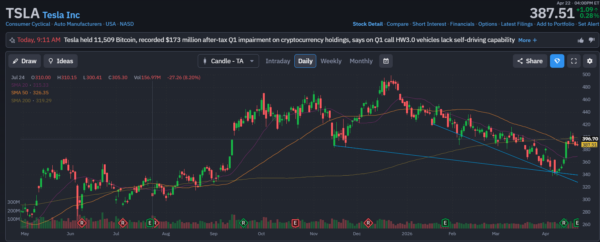
Price tells the same story the earnings did. After peaking near $480, Tesla sold off steadily, breaking below the 50 and 200-day moving averages as delivery momentum weakened.
The recent bounce from $340 to $390 shows buyers stepping in, but notice how it stalled right under the declining 50-day.
Volume on the rebound is lighter than the selloff, and the downtrend line remains intact. Indicating that this is not a market pricing explosive growth. It’s a market stabilizing around a company that’s still strong, but no longer driven purely by demand expansion.
The Bull’s Upside
Tesla is not losing strength; it is only reallocating it. With $22.4B in revenue, 21.1% margins, and $1.4B in free cash flow, the company is proving it can generate real financial power beyond pure delivery growth. That shift is not a weakness; it is evolution. And when a business strengthens while the market is still anchored to an old narrative, that is where the real upside begins for the bulls.
Leave a Reply