
3M Co (NYSE: MMM) delivered a surprise Q1 2026 earnings report, with earnings of $2.14 per share, more than the analyst expectations of $1.98, and a revenue of $6 billion, slightly above expectations. Despite the beat, there is a problem in how the market is judging this business right now. Investors are waiting for evidence of demand returning before assigning a higher multiple. A move that could lock them out of any potential growth in the coming years.
Table of Contents
230 Basis Points Nobody Is Talking About
Revenue increased just 1.3% year-over-year to roughly $6.0 billion, with organic growth of 1.2%.
Operating margin came in at 23.2%, up from 20.9% – 230 basis points of expansion in a period where revenue barely moved. You don’t extract that kind of margin improvement from a modest volume uptick. What you are seeing is the output of a structural reset: standardized operations, simplified portfolio, cost layers removed through divestitures and internal restructuring that the market has largely discounted as noise.
In other words, a business growing revenue at 1% does not expand margins by 230 basis points unless something fundamental has shifted in how it converts revenue into profit. What shifted here is not demand – it is the efficiency of the operating model itself, and that matters more than the top line at this stage. Margins reset the base from which all future earnings compound. Get the base right, and everything that follows is amplified.
Don’t Dismiss Margins Expansion
There is a tendency to dismiss margin expansion in low-growth environments as temporary – cost cuts that reverse the moment volume returns and fixed costs re-enter the structure. That reading is not only incomplete, in this case, it is also misleading.
3M is not trimming expenses to defend a shrinking margin. It is redesigning its operating model to achieve a structurally higher level of profitability. The distinction is durability. Temporary cost cuts are cyclical by nature; they compress in the down cycle and unwind in the up cycle.
Achieving 23%+ operating margins in a subdued demand environment is the signal. It means the earnings base has already been repositioned upward before the tailwind arrives. That changes the sensitivity of this business to any future recovery in a way the current multiple does not reflect.
Capital Allocation Is Telling You What Management Believes
The cash profile says the same thing the margins are saying, just in a different language. Operating cash flow came in at approximately $0.6 billion, free cash flow at $0.5 billion, while the company simultaneously returned $2.4 billion to shareholders through dividends and buybacks in a single quarter.
Read that again. A company still absorbing litigation obligations and restructuring costs returned $2.4 billion in capital in one quarter. Hence, it’s a great disservice to think that the management team is “merely” hedging against an uncertain earnings outlook. In fact, this is exactly the behavior of a management team that believes the earnings base is stable enough to absorb legacy costs and return excess capital at the same time, and is willing to put the balance sheet behind that conviction. Capital allocation is one of the most honest signals a business sends. This one is unambiguous.
The Market Is Waiting For The Wrong Confirmation
The market remains anchored to revenue growth as the trigger for re-rating 3M Company, but that framing is inherently backward-looking. Revenue is typically the last variable to inflect, while margins and cost structure adjust first. By the time top-line acceleration is visible, the earnings base has already shifted.
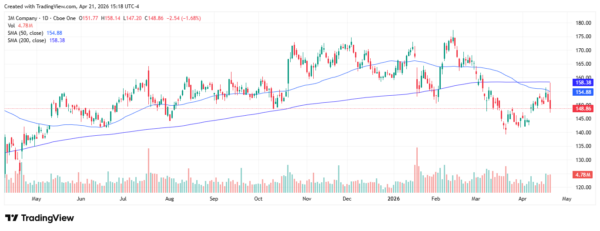
That hesitation is reflected in the tape. Heading into earnings, the stock was in a defined downtrend, bottoming in the $142–145 range while trading below key moving averages. Post-earnings, the response has been constructive rather than impulsive, with price reclaiming the 8- and 21-day averages and pressing into the 50-day, while the 200-day remains the primary supply zone.
Volume has expanded on advances and remained muted on pullbacks, indicating that selling pressure is being absorbed and buyers are re-engaging selectively. Momentum sits in transition, with RSI around 52, consistent with early stabilization rather than overextension.
Price is compressing beneath resistance while fundamentals improve beneath the surface. Though the market is waiting for revenue to confirm what margins have already signaled. By the time that confirmation arrives, the re-rating is unlikely to wait.
When Growth Returns, It Lands On A Different Company
This is the asymmetry worth owning. If revenue growth stays at roughly 1%, earnings growth is driven by incremental efficiency gains; finite, limited, and largely already reflected in current expectations. That is the bear case, and it is priced in.
If demand normalizes even modestly – moving from low single digits toward mid-single digits – the earnings impact is no longer linear. It compounds on top of an already expanded margin base, on top of a leaner cost structure, on top of a business that no longer needs volume to justify its profitability.
A company operating at 23%+ margins like this does not need aggressive revenue growth to produce meaningful earnings acceleration. It needs incremental growth applied to a more efficient structure, and that resets the maths entirely.
I’d Be A Buyer Here
3M has rebuilt its earnings base before demand recovers – and that sequencing is precisely what creates the upside. Since profitability has already been fixed, when growth arrives, it becomes an amplifier rather than a requirement.
As we speak, the market is anchored to what hasn’t changed yet – revenue. But the opportunity sits in what already has – margins, capital discipline, and an earnings base that is higher, cleaner, and more controlled than it was twelve months ago.
I’d be a buyer here. Not because the growth story is confirmed, but because by the time it is, the re-rating will already be behind you.
Leave a Reply