Delta Air Lines Inc, (DAL: NYSE) fiscal earnings report for the first quarter of 2026 delivered exactly what investors expected on the surface, with the company beating both earnings and revenue estimates as adjusted EPS came in at $0.45 versus $0.38 expected and revenue reached $13.7 billion – a near 9% increase that initially reinforced investor confidence and triggered about 10% surge from around $67 to $74 following the release. However, this move failed to hold as investors were not fully satisfied with what hides behind the earnings beat.
Table of Contents
The Airlines’ Grip On Demand Tightens
Delta Air Lines’ earnings report for the 2026 first quarter stand out not just because of the growth itself, but where that growth is coming from, as the Atlanta-based air carrier continues to expand its highest-quality revenue streams with premium revenue growing at a double-digit pace, loyalty revenue rising approximately 13% year-over-year through its American Express partnership, and corporate travel continuing its recovery. All of which are layered on top of a network that spans roughly 19.5 million seats per month and maintains about 19% share of the U.S. market.
This demand strength is not happening in isolation, though, as Delta’s operational scale, expanding network reach, and ongoing fleet optimization continue to support both volume and pricing power. In the same vein, the company also generated approximately $2.4 billion in operating cash flow and $1.3 billion in free cash flow during the quarter, reinforcing that the business is still highly cash generative even as it operates within a capital-intensive structure supported by total debt near $20 billion.
The Dissatisfaction: Costs Are Rising Just As Fast
Investors weren’t satisfied with the earnings beat as the same quarter that delivered a 9% increase in revenue also saw adjusted fuel expense rise 8.2% year-over-year to $2.59 billion, while the average fuel price increased 6.9% to $2.62 per gallon and non-fuel unit costs climbed approximately 6%. Showing that nearly every dollar of incremental revenue is being met with a corresponding increase in operating expense.
Perhaps this becomes clearer when looking at profitability, as operating income rose only to $569 million compared to roughly $546 million in the prior year while operating margin declined slightly from about 4.3% to 4.2%, confirming that growth is being absorbed rather than converted into expanding margins, no thanks to the rising input costs.
A Defensive But Critical Advantage
What separates Delta from much of the industry in this environment is its refinery, which continues to act as a structural buffer against rising fuel costs, as the company reported that the refinery reduced fuel prices by $0.06 per gallon during the quarter, translating into roughly $60 million in savings at Delta’s scale.
While fuel expense still rose 8.2% year-over-year, meaning the refinery does not eliminate cost pressure, it reduces volatility and provides a level of cost control that most competitors simply do not have, especially in an industry where fuel prices can spike violently due to geopolitical disruptions and supply constraints.
This advantage matters more in periods like this because when costs are rising across the board, the companies that can reduce the rate of increase, even slightly, gain a structural edge.
This is Fundamentally a Strong Business
The broader financial picture reinforces this tension, as Delta continues to generate strong operating cash flow of $2.4 billion and free cash flow of $1.3 billion, while maintaining a sizable but gradually improving debt position near $20 billion – reflecting a business that is fundamentally strong but operating within tight margins due to external cost pressures.
At the same time, management has made it clear that protecting profitability is now a priority, with CEO Ed Bastian stating that the company is reducing capacity growth and adjusting operations to recapture higher fuel costs, a move that reflects a shift away from maximizing volume toward protecting margins through pricing discipline and network optimization.
From Defense to Offense: Why The Refinery Could Capitalize On The Iran-U.S. Ceasefire
This is an interesting setup because of how quickly it can change, as recent geopolitical developments, including easing tensions following the Iran–U.S. ceasefire, introduce the possibility of stabilizing or even declining oil prices, which would directly reduce Delta’s largest expense category.
If that happens, the impact is not linear. Lower fuel prices reduce cost, while the refinery continues to provide additional savings, creating a compounding effect where both external relief and internal advantage begin to work in the same direction.
In that case, the same structure that is currently being used to defend margins becomes a driver of expansion.
The Technical Reaction
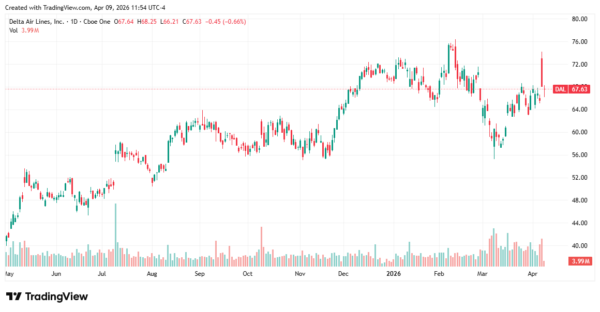
The reaction becomes more telling, as Delta’s stock surged sharply on earnings from about $67 to a peak near $74, an almost 10% spike, followed by an immediate selling pressure right at the highs. RSI jumped into overbought territory near 70 before quickly rolling over to the low 40s, confirming momentum faded just as fast as it came.
Price is now slipping below the short-term EMAs, suggesting that the move was driven more by short-term positioning than sustained institutional accumulation, reinforcing hesitation despite the earnings beat.
Conclusion: A Margin Story Ready to Turn
Delta Air Lines is not facing a demand problem, as revenue is growing to $13.7 billion, premium and loyalty segments are expanding, and the company continues to operate from a position of strength across its global network.
The challenge lies in protecting margins, as rising fuel costs and increasing operating expenses are absorbing much of that growth, leaving operating margins slightly compressed at 4.2% despite higher revenue.
Hence, a forward-looking bullish thesis holds if Delta’s refinery continues scaling its fuel and cost-efficiency advantage, strengthening its role from a defensive buffer into a structural margin driver, and if the Iran–U.S. ceasefire holds and oil prices stabilize or decline, allowing fuel costs to ease while Delta’s cost advantage remains intact.
Leave a Reply