
After beating both earnings and revenue expectations throughout last year, Levi Strauss and Co (NYSE: LEVI) reported its earnings report for the first quarter of the 2026 fiscal year, beating analysts’ estimated EPS, $0.42 VS $0.38 expected, and revenue $1.74 Billion as against $1.65 Billion expected. But beneath the numbers, there is a shift taking place, one that is driving growth today, while quietly introducing a new layer of risk into the business model.
Table of Contents
Brand Strength Continues to Drive Growth
Levi Strauss delivered a strong start to the year across its core metrics. Net revenue grew 14% year-over-year to approximately $1.7 billion, while net income increased from $140 million to $177 million, a 26% rise.
This level of growth reflects continued strength in the brand’s global appeal and its ability to attract consumers across multiple markets and demographics.
International revenue increased 12% overall, with Europe up 10%, Asia up 12%, and the Americas growing 7% . At the product level, Levi’s continues to expand beyond its traditional denim identity. Taken together, these numbers reinforce a consistent narrative that Levi’s is not just maintaining relevance but also actively expanding its reach. However, that expansion is being driven by a deliberate shift in how the company operates.
The Hidden Shift: Levi’s Is Now Driving Its Own Demand
The most important change in this report is not headline growth, but how that growth is being generated. In the first quarter, direct-to-consumer (DTC) channels accounted for 52% of total net revenue, with comparable DTC sales increasing 7%.
This marks a structural shift as Levi’s is no longer primarily dependent on wholesale partners to distribute its products. Instead, it is controlling how its products are marketed, sold, and experienced by customers. That control comes with clear advantages; for example, DTC allows for higher margins at the product level, stronger brand positioning, and direct access to customer data.
But it also introduces a new dynamic, because once a company takes control of its distribution, it also takes responsibility for generating demand.
Growth Is Now Being Funded, Not Just Earned
This shift is already showing up in the company’s cost structure.
Selling, general and administrative (SG&A) expenses rose to $872 million from $749 million, representing a 16% increase year-over-year.
The increase was driven largely by higher marketing spend, including campaigns such as “Behind Every Original,” as well as continued investment in DTC infrastructure.
At the same time, gross margin remained relatively stable at 61.9% compared to 62.1% a year ago, suggesting product-level profitability is holding. However, operating margin declined from 12.5% to 11.4%, while adjusted EBIT margin fell from 13.4% to 12.5%.
In other words, Levi Strauss & Co is spending more to sustain its growth than it previously needed to. That shift improves long-term control and margin potential, but in the short term, it makes growth more expensive.
A More Focused And More Aggressive Strategy
This change in cost structure is part of a broader “strategic improvement” model launched by CEO Michelle Gass.
As a result, Levi Strauss has been reshaping its portfolio to focus on higher-return growth areas. One of the clearest examples is the decision to sell the Dockers brand, along with earlier moves involving lower-tier brands such as Denizen. The Dockers sale, valued at $311 million with potential upside to $391 million, reflects an effort to exit slower-growing segments and concentrate capital on the core Levi’s brand.
Management has also been explicit about aligning the business around a DTC-first model, international expansion, and higher-growth categories such as women’s wear and lifestyle apparel. The faster growth in the women’s segment, combined with expanding international revenue, suggests that the strategy is beginning to take hold.
A Strong Business, With a New Layer of Risk
Taken together, the story points to one unarguable fact: Levi Strauss is growing thanks to the management’s clear strategic vision. However, the nature of that growth is changing as the company is no longer simply benefiting “solely” from brand strength but is actively investing to sustain and expand it.
Granted, that introduces a new dynamic. But not one that could challenge investors’ conviction in the brand because higher spending translates into higher revenue, and the long-term benefits of control and margin expansion begin to materialize.
But if demand slows, the cost structure remains, stifling margins and growth, and as such, giving rise to a “new” risk.
The Technical Reaction
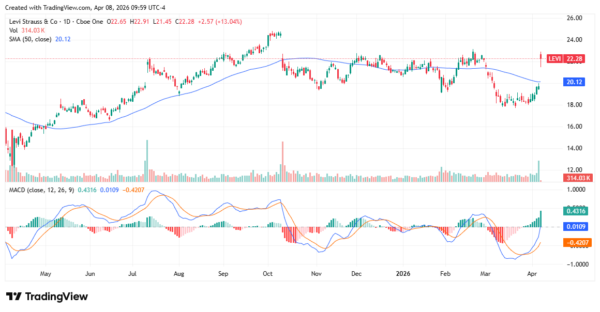
Heading into earnings, Levi’s was trading around $19.70–$20.00 before gapping sharply higher to roughly $22.50 – $22.90 on the release, a move of about 13% – 15%. Although the stock pulled back briefly, stabilizing around $22.20–$22.40, this move held rather than fading.
RSI pushed above 80, signaling the stock is now overbought in the short term, while price is trading well above its key moving averages, confirming a strong underlying trend.
Taken together, the gap shows conviction, the hold confirms sustained buying, and the stretched momentum suggests expectations are now elevated. Indicating that the market is already pricing in continued execution by the brand.
Change Is Encouraged, If It Leads To Growth
Levi Strauss & Co’s shift toward direct-to-consumer, combined with a more focused portfolio and increased investment in brand and marketing, positions the company for greater control and long-term upside.
Consequently, growth is no longer just a function of demand but of execution, or better put, spending. As long as that spending continues to translate into demand, the model holds.
Leave a Reply