
Dave & Buster’s Entertainment, Inc., (NASDAQ: PLAY). stock initially spiked following its fiscal fourth-quarter 2025 earnings release, despite reporting a loss of -$1.15 per share compared to -$0.24 a year ago and delivering another quarter of declining comparative sales. However, rather than building on that momentum, the stock failed to hold its gains, pulled back, and settled into a period of consolidation. The question is: what’s driving the optimism?
Table of Contents
The Numbers Don’t Lie, And They’re Not Pretty
The arcade and gaming company, Dave & Buster’s, reported Q4 revenue of $529.60 million, down from $534.60 million a year ago, a $5 million decline, less than 1%. On the surface, that looks manageable. But peel back the layer and the real story emerges.
Comparable store sales, the clearest measure of organic demand, fell 3.3% year-over-year. Management noted that, excluding the impact of Winter Storm Fern in January, the decline would have been approximately 1.5%.
Either way, existing locations are generating less revenue than they were a year ago. Revenue per store dropped from $180 to $169 per week, a 6.1% decline, more than six times the rate of total revenue decline. That gap shows that the weakness isn’t spread thin across the business; instead, it’s concentrated inside the stores.
Empty Arcade Machines Tell the Real Story
As stated above, this isn’t a one-quarter blip. After missing earnings three times in one year, it’s a pattern that’s forced investors to question the relevance of Dave & Buster’s in today’s entertainment landscape.
From its beginnings, the brand built its identity on a simple but powerful idea: eat, drink, play, and watch, all under one roof. Across 175 locations in 43 states, Puerto Rico, and Canada, that concept once drove real traffic and real loyalty. However, customer sentiment is shifting. Feedback points to a declining overall experience: higher perceived costs, a less engaging in-store environment, and an atmosphere that feels flat compared to what the brand once delivered.
It follows that when customers stop seeing value in the experience, visits and time spent in stores decline, and spending patterns change.
That’s exactly what the numbers show. Entertainment revenue, the primary traffic driver and the whole point of the brand, fell from $335 million to $313 million, a $22 million or 6.6% drop. Meanwhile, food and beverage revenue, which accounts for 40.9% of total revenues, grew 8.5% to $216.6 million.
The “few” customers who still visit Dave & Buster’s are eating and drinking. They’re just not playing. And for a brand whose entire identity is built around the arcade experience, their primary revenue driver, that’s a dreadful distinction and a serious problem.
A CEO With a Plan, And a Lot to Prove
The silver lining in this report isn’t in the numbers. It’s in the strategy.
After almost a year in office, CEO Tarun Lal and the team have been direct about the path forward: a back-to-basics approach focused on improved marketing, menu upgrades, and rolling out at least 10 new games and attractions in fiscal year 2026. The company has also remodeled 51 stores since the initiative launched, with 11 new locations opened this year alone.
The early results are selective but real. Food and beverage revenue is up 7% under the new focus. And management’s guidance points to positive comparable store sales, EBITDA growth, and $100 million in free cash flow for fiscal 2026.
Granted, the back-to-basics strategy has enough pull to give investors something to hold onto, which explains the stock’s post-earnings behavior. But while the optimism is real, it’s narrative-driven, not yet result-driven.
The Technical Analysis At “Play”
The stock’s price action reinforces this disconnect between narrative and reality. Heading into earnings, Dave & Buster’s was trading around $10.80. On the release, PLAY surged sharply to about $13.20-$13.40, a move of about 20%, reflecting an immediate reaction to the company’s expectations rather than the underlying fundamentals.
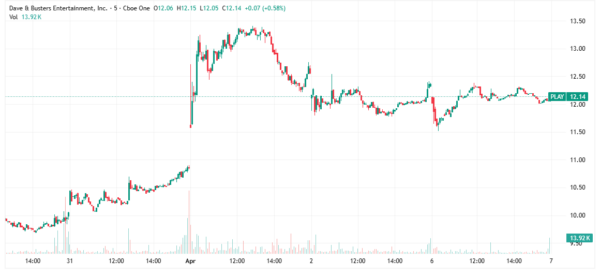
But the move didn’t hold as the stock pulled back to about $12.20, giving up almost 9% from its peak. Since then, it has settled into a tight consolidation with no strong market conviction. Taken together, the spike shows optimism, but the recent, consistent decline could send the stock falling soon.
Everyone Loves a Good Turnaround Story Until…
Dave & Buster’s is being priced as a recovery play. The CEO has a plan, the remodels are underway, and guidance is optimistic. But the core product is still losing customers, the stores are generating less per week, and the entertainment segment that defines the brand continues to shrink.
Until traffic stabilizes, the in-store experience improves, and entertainment demand recovers, the turnaround remains a narrative, not a result. And that gap between what’s being priced in and what’s actually showing up in the numbers is exactly where the risk lives, or better put, where the bears come in.
Leave a Reply