
Lamb Weston Holdings, Inc. (NYSE: LW) stock had a mixed reaction after the company reported its fiscal third-quarter 2026 earnings. The company beat both earnings and revenue expectations, pushing the stock slightly higher in early trading, but that optimism didn’t last.
Table of Contents
However, within hours, LW reversed sharply, dropping nearly 9% from around $42 to the $38 level. The reaction wasn’t about the earnings beat but the quality of those earnings.
Growth Driven by Volume, Not Pricing
Lamb Weston reported net sales of $1.565 billion, up from $1.521 billion in the prior year, a 3% year-over-year gain. On the surface, that looks like steady growth. Dig a little deeper, and a more complicated picture emerges.
Volume increased 7%, signaling strong underlying demand. But that was entirely offset by a 7% decline in price/mix, leaving constant-currency sales flat. A pattern that has been consistent all year.
Volume grew 6%, 8%, and 7% across Q1, Q2, and Q3, respectively, while price/mix declined 7%, 8%, and 7% over those same periods. This was an indication that Lamb Weston has held onto its customers for three straight quarters, but only by lowering prices to do it.
A Tale of Two Markets
In North America – the U.S., Canada, and Mexico – LW delivered 5% net sales growth on 12% volume growth, a genuinely strong result. Internationally, the story flips: net sales declined 1%, and volume fell 2%, reflecting softer demand in key markets outside the continent.
But both regions face the same trade-off: a 7% decline in price/mix, driven by pricing concessions and a shift toward lower-margin channels such as value-focused restaurants and products.
They’re Selling More and Making Less
On the surface, Lamb Weston is still a growing company. But the quality of that growth is becoming harder to defend.
The company is expanding revenue through volume increases, while pricing power is weakening. This suggests a level of customer retention and brand presence, particularly in North America, but the direct consequences for profitability are becoming harder to ignore.
This is clearly reflected in the company’s adjusted EBITDA, which fell from $373 million to $272 million, a decline of $101 million year-over-year (YOY). This pressure is also visible at the gross profit level, which declined by $93 million YOY, reflecting weaker pricing and higher production costs. Each quarter, profitability has declined even as demand has held steady, and the margin pressure isn’t showing signs of letting up.
A Pricing Strategy That’s Backfiring
When the 2025 tariff war drove up production costs, Lamb Weston faced a choice: raise prices and risk losing customers, or absorb the hit and hold the line. They chose the latter, offering trade support and lower prices, which management framed as a “focus on the customer.”
That decision sustained demand but directly compressed margins. And even with the temporary tariff pauses that followed, Lamb Weston hasn’t moved to adjust pricing back up. Investors are left wondering whether that reflects a genuine strategic choice – or an underlying fear that any price increase would cost them volume. If it’s the latter, the company may be competing more on price than value, which could keep margin pressure around for a long time.
Earlier in the year, cost savings and efficiency improvements helped offset some of this pressure. By Q3, those offsets weren’t enough. What was manageable is now showing up visibly in the numbers.
Market Reaction: Why the Stock Fell, Hard
The price action shows how quickly sentiment changed.
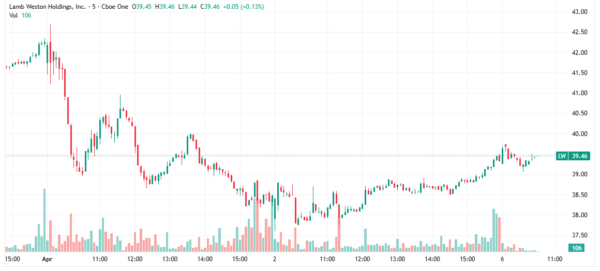
LW was trading around $42 heading into earnings, ticked higher on the initial beat, then reversed hard, selling off to an intraday low near $38 before closing at $38.48, down nearly 9% on heavy volume. Volume picked up during the sell-off, pointing to institutional participation rather than short-term noise.
By the end of the session, the market had already moved past the earnings beat and repriced the stock based on weaker margins.
Earlier quarters showed that investors were willing to look past the margin pressure. Q3 is the quarter where that patience ran out.
The Fundamentals: Solid Foundation, Visible Cracks
Lamb Weston’s fundamentals aren’t broken. The company generated $596 million in operating cash flow and $339 million in free cash flow, real financial strength that shouldn’t be overlooked despite the margin challenges.
That’s an indication that the company’s foundation is still intact. But the cracks are getting harder to ignore.
Where Lamb Weston Can Still Win
The margin problem has real solutions, none of which require continued price cuts. The persistent -7% price/mix decline signals a company competing on price rather than value.
Shifting that dynamic means pushing differentiated products, deepening partnerships with major restaurant chains, and tightening supply chain discipline.
Continued actions like closing inefficient plants – such as the Argentina facility – and better aligning production output with actual demand would both improve margins and reduce costly write-offs.
Final Take: Demand Strength vs. Margin Weakness
Lamb Weston is at a crossroads. Demand remains strong, particularly in North America, and management even raised the lower end of its full-year net sales guidance. But narrowing its EBITDA outlook reveals that while growth is holding up, profitability is not.
Pricing pressure, rising costs, and operational inefficiencies are continuing to weigh on margins, and the market is no longer willing to overlook that trade-off.
Until pricing stabilizes and operational efficiency improves, LW will likely remain under this pressure. Whether management executes on it is the only question that matters now.
Leave a Reply